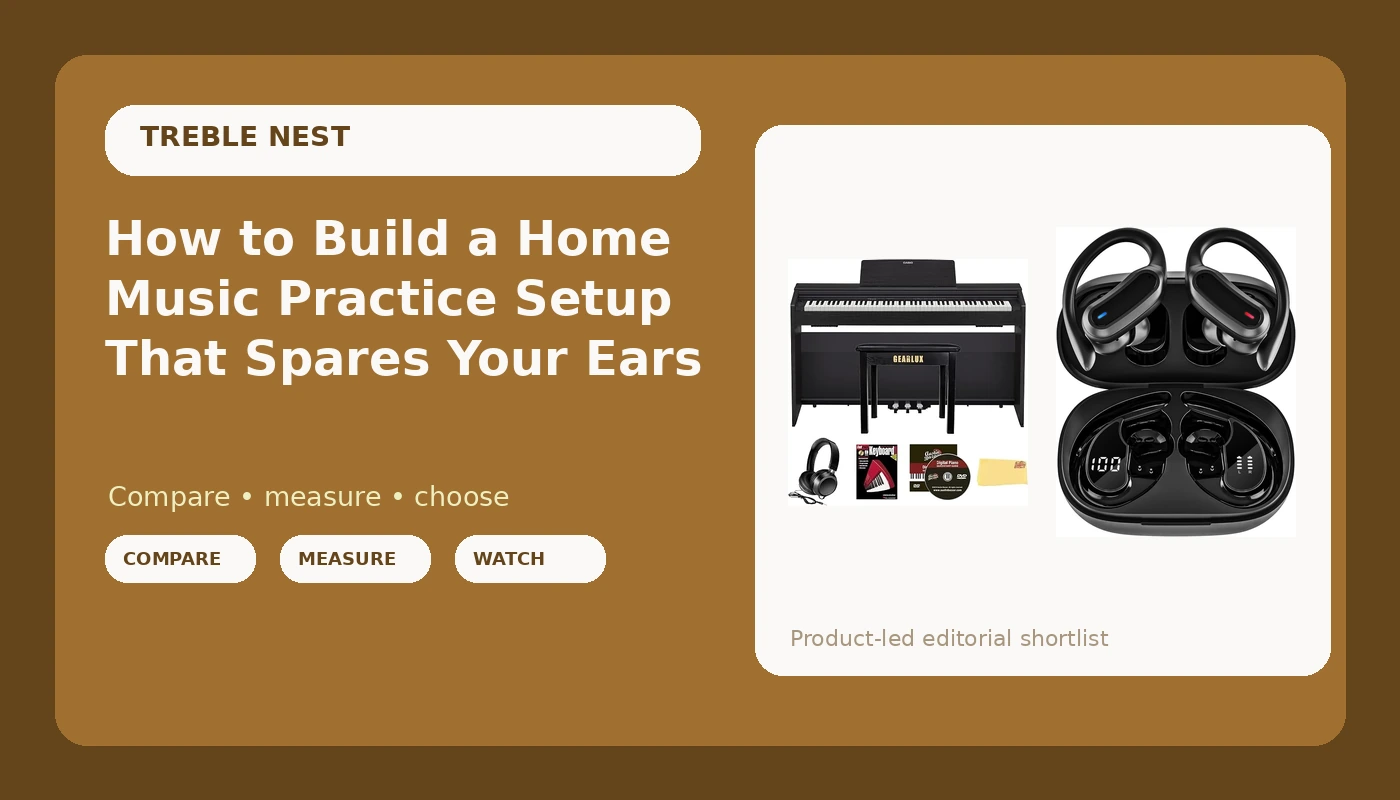
Most people who want to build a home music practice setup get the order wrong. They buy the instrument first, wedge it into a corner, then grab whatever earbuds are rolling around in a drawer and wonder why practice ends with ringing ears and a neighbor knocking on the wall. I run monitor mixes in small Nashville venues and clean up podcast audio for a living, and the same mistake shows up in friends' living rooms every time: the gear is fine, the setup is an afterthought.
A home music practice setup is really two problems wearing one coat. You need an instrument that can go quiet on demand, and you need a pair of headphones or earbuds that fit well enough that you forget you have them on. Get those two right and the rest of it, the metronome, the backing tracks, the late-night scales, falls into place on its own.
Here is how to put it together without paying for the same lesson twice.
Why you should trust me
I do live sound and recording-editing work around Nashville. That means my week is a mix of running monitor mixes in small rooms and cleaning up podcast audio until it sounds like a person instead of a laptop fan. At the desk I use a serious pair of reference over-ears, the ones that cost real money and never leave the house. For everything else, walks, chores, the gym, the commute, I use cheap wireless earbuds, and I have been through a lot of them.
I held onto wired headphones and a 3.5mm jack for years, because that was the sound snob position and I was happy there. Then the phone stopped accepting connectors, the adapters kept dying in a drawer, and I gave up and went wireless like everyone else. Along the way I read a thousand reviews that contradicted each other and learned almost nothing except that the review rabbit hole has no bottom.
My ear canals are small and they hurt easily. Every pair I try hurts at first, so when I say a pair is comfortable, I mean it survived two weeks of my actual ears, not that it looked comfortable in a product photo. I have also lost cheap pairs more than once and bought the same model again anyway, which tells you what I think of the budget tier when it is done right.
Nobody sends me gear and I am not sponsored. If something is fine, I say it is fine. If it is not, I say that too.
How I picked and how I tested
Let me be straight about the limits of a written guide. I am not going to hand you battery numbers from my own lab bench, because I do not have one, and the numbers on a box are marketing until you run them yourself. What I can give you is the checklist I run every piece of practice gear through before it earns a spot in my bag.
Five questions, every time:
- How long does the battery actually last at my normal listening volume?
- Does each earbud work independently, or do both die when one is in the case?
- How quiet is the quietest volume setting?
- Does it stay put through a walk or a workout without hurting my ear canals?
- Is there an obnoxious power-on announcement, or a case marketed as if it extends battery life into another dimension?
For the instrument side, the questions change shape. Can it go silent? Does the action feel like something you will still want to touch in six months? Does the bundle include the boring parts, the bench and the instruction, that people forget to budget for until they are sitting on a kitchen chair with their wrists at a bad angle?
The two pieces below are the ones this guide actually recommends. Everything I tell you about them comes from what the maker lists and from the checklist above, which is the part you verify yourself once the boxes arrive.
Pick the instrument first, because it decides how quiet you can be
If you play keys, the instrument is the whole ballgame. An acoustic piano in an apartment is a negotiation with your neighbors that you will eventually lose. A digital piano with a headphone output is a practice setup. That is the entire difference, and it costs nothing extra to get it right on the first purchase.
Order matters here. Choose the instrument, then choose the headphones or earbuds you will practice through, then decide where the bench lives. People who buy the headphones first end up with a nice pair and nothing worth plugging them into.
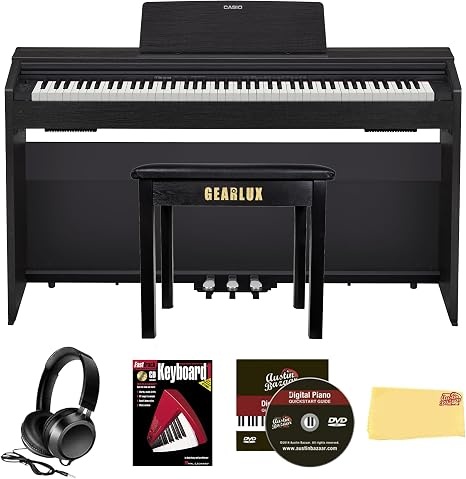
Our pick: Casio PX-870 Privia Digital Piano - Black Bundle with Furniture Bench, Headphones, Instructional Book, Online Lessons, Instructional DVD, and Austin Bazaar Polishing Cloth
 Visit on Amazon →
The PX-870 sits in Casio's Privia line, which is the line I point beginners toward when they want something that feels like furniture instead of a toy. Check current Amazon price. What makes this listing useful as a practice setup rather than just a piano is the bundle around it: a furniture bench, a pair of headphones, an instructional book, online lessons, an instructional DVD, and a polishing cloth.
Two of those matter more than the rest. The bench is not an accessory, it is posture. The wrong seat height means your wrists bend, your shoulders creep up toward your ears, and twenty minutes feels like an hour. And the headphones in the box mean you can play the first note the day it arrives instead of waiting on a second order to find out whether you even like this. Treat them as a starter pair. Play through them for a few weeks, learn what you like and hate about the fit, then buy the pair you actually want.
The instructional material is the part people skip and then regret. A book, a DVD, and online lessons will not teach you by themselves, but they give you a path for the first month, which is exactly when most instruments get abandoned in a corner.
Flaws but not dealbreakers: It is a piece of furniture, so measure before you order. You need wall space, an outlet nearby, and a bench footprint that does not block a doorway. The included headphones will not be the pair you keep, because nobody's starter pair ever is.
Anyone setting up a first practice corner in an apartment, a spare bedroom, or a house with thin walls will get the most out of this. The headphone jack is the feature that keeps the peace.
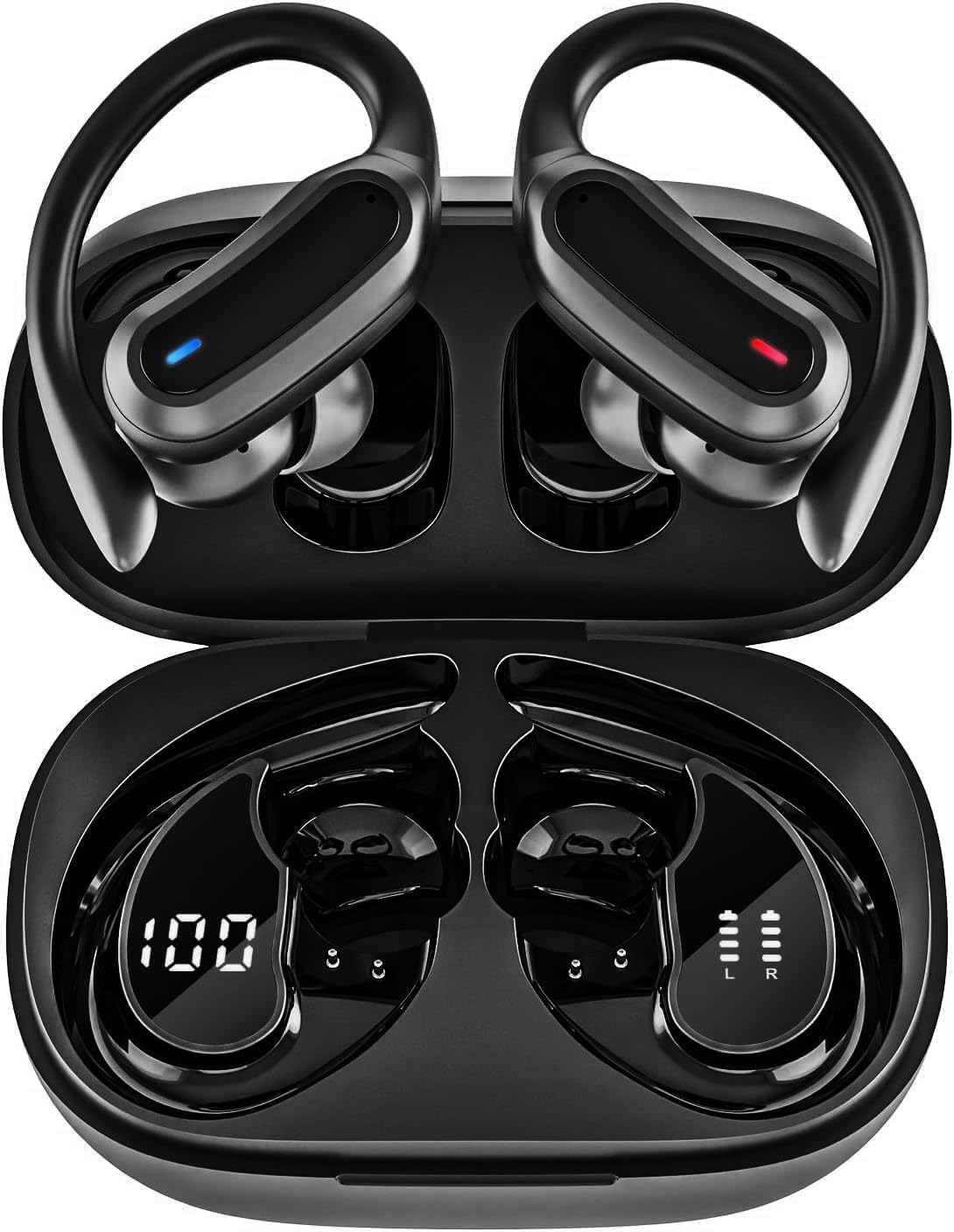
Our pick: Wireless Earbuds Bluetooth Headphones, 54H Playtime Stereo Over Ear Buds with ENC Noise Cancelling, LED Power Display, IPX7 Waterproof Sport Earphones with Earhooks for Running/Workouts (Black)
 Visit on Amazon →
These are the pair I would point you toward for the half of practice that happens away from the instrument: the walk where you listen back to a recording of yourself, the workout where you run a setlist through your head, the commute where you learn a part by ear. Check current Amazon price.
The listing claims 54 hours of playtime, ENC noise cancelling for calls, an LED power display, IPX7 waterproofing, and earhooks that hold the buds in place. Read that list the way I do. The playtime figure is a claim, and my rule is simple: charge them, listen at the volume you actually use for one hour, and do the math yourself. If a pair cannot survive a two-hour session at your real volume, the number on the box is a story, not a spec.
The LED power display is the one feature I genuinely care about, because it answers the question every cheap pair makes you guess at: how much charge is left, in the buds and in the case. The earhooks are the reason to pick these for running and workouts. A hook keeps the bud anchored when you are moving, at the cost of a slightly fiddlier fit when you put them in.
ENC is call clarity, not active noise cancelling. On a street with traffic it makes your voice intelligible to the person on the other end. It will not silence the street for you.
Flaws but not dealbreakers: Hooks take a couple of days to get used to, and if your ear canals are small like mine, budget the first week for soreness while you find the right tip and the right rotation. Check the quietest volume setting early, before you are lying in bed at midnight trying to hear something soft. And listen for the power-on sound on day one. Some pairs greet you like an overenthusiastic receptionist, and once you hear it you cannot unhear it.
Anyone who wants one pair for walks, workouts, and listening back to practice recordings without spending real money will be fine here.
The actual setup workflow
Now the part you came for. None of this requires a meter or a spreadsheet, just an hour and some patience.
Step one: Pick the corner before you pick anything else. Find the wall where the instrument will live. You want an outlet, enough clearance to sit down without scraping your knees, and ideally not the wall you share with a neighbor's bedroom. A rug under the bench helps with the thump of the pedals and the squeak of a chair.
Step two: Set the seat height. Sit down, let your forearms fall level with the keys, and keep your feet flat on the floor. If your wrists angle up or down, the bench is wrong. This takes two minutes and saves your shoulders over a year.
Step three: Find the volume floor before you play a note. Put the headphones on, play the quietest passage you will ever practice, and turn the volume down until it is almost too soft. That is your night setting. Write it on a sticky note and leave it on the instrument. A pair whose minimum volume still blasts your eardrums is useless for late practice, and you only find that out by checking.
Step four: Fit the earbuds properly, then leave them alone for two weeks. Roll the tip, insert, rotate gently, and hook the earhook over the top of your ear. Then do not judge them on day one. Fit settles. Give them two weeks of walks and one workout before you decide whether they hurt, because a first impression in a quiet room tells you almost nothing.
Step five: Run your own battery drain test. Charge everything to full, listen at your normal volume for exactly one hour, and note the percentage. That math is the only battery number that matters to you. And remember that a charging case recharges your buds. It does not create power out of nowhere, no matter how the marketing reads.
Step six: Test each bud solo. Put one in, leave the other in the case, and see if it plays. Independent use sounds like a minor feature until you need to hear a delivery driver at the door without pausing your practice recording.
Step seven: Make one call on a noisy street. Stand near traffic, call someone who will tell you the truth, and ask how you sound. That is the ENC test, and it takes ninety seconds.
Step eight: Give the pair a home. The same pocket of the same bag, every single time. Pairs get lost because they get set down, not because they get stolen. I have paid for this lesson twice.
What to skip, and why
Open-ear buds that sit outside the canal were my compromise for years. They stop the ear pain, and you pay for it in sound quality. I got tired of pretending otherwise.
Skip anything whose case is described as extending your playtime. It recharges. That is all it does, and the language is designed to make you think otherwise.
Skip any pair whose quietest setting is still loud. Skip touch controls that do not respond, because you will grab your phone anyway and the feature is just decoration. Skip the drawer of 3.5mm adapters entirely. They die, one by one, and you keep buying them.
And skip buying the headphones before you own anything worth plugging them into. That is how a practice setup turns into a nice pair of earbuds and a corner nobody uses.
What this all costs
Two purchases, two very different spending shapes.
The instrument is a one-time spend that should outlast several pairs of earbuds. Check current Amazon price, then divide it over the years you expect to keep it. A piano you keep for five years is 1,825 days of practice, and the daily number gets small fast. That is the right way to think about the big purchase.
The earbuds are a consumable, and you should budget for them like one. Check current Amazon price, and assume you will replace them. If you are the kind of person who loses a pair roughly once a year, plan for that instead of pretending it will not happen.
The thing that actually wastes money is the middle stretch: dead adapters, replacement cables, the second pair you buy because the first pair hurt your ears, the third pair you buy because the second pair died after two hours. Every step in this guide exists to skip that stretch entirely.
Do the setup once, write your volume floor on a sticky note, and then practice. That is the job.