Shopping for budget earbuds and headphones is where the most confusing decisions happen. Every listing promises the same handful of things: big drivers, long playback, noise canceling, waterproof ratings, and a price low enough that you talk yourself into buying without thinking it through. Then you read reviews, they contradict each other, and you end up further down the rabbit hole than when you started.
I do live sound and recording editing around Nashville, so I keep a serious wired pair at the desk for work. Everything else, the walks, the chores, the gym, the commute, runs on cheap wireless gear, and I have lost enough pairs to have opinions about which numbers on a box mean something and which are decoration. This is not a ranking. These four products do different jobs, and the useful question is which job you are actually shopping for.
Related: How to Check Earbud Battery Life Before You Trust the Spec Sheet →
Quick answer
Match the pair to the job, not to the spec sheet. The FiiO FT1 is the only wired over-ear in this group and the one aimed at desk listening. The Ozeino is the only one with a boom microphone and a 2.4GHz transmitter for consoles and PC. The two wireless earbud pairs are the commute and workout options: the 56-hour pair lists the longer total playback figure, while the 50-hour pair adds an LED display and is described for gym, running, and work. If you want a single pair for life outside the house, start with one of the earbuds, because a wired 32Ω over-ear is not something you carry in a pocket.
Four useful options
| Model | Best fit | What stands out |
|---|---|---|
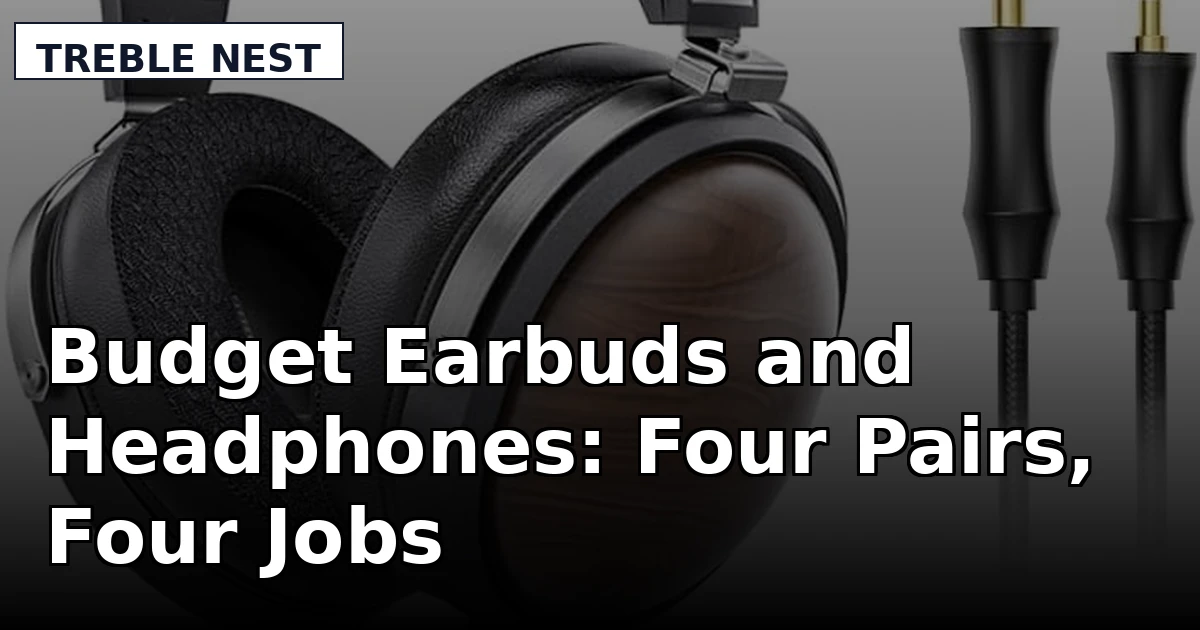
| FiiO FT1 32Ω Large Dynamic Driver Headphones with Solid Wood Cups | Desk listening and wired sessions | The only wired over-ear here, with a 32Ω impedance rating and solid wood cups |
| Ozeino Wireless Gaming Headset with Flip Microphone, RGB Lighting Gaming Headphones for PS5, PS4, PC - 2.4GHz USB & Type C Transmitter | Console and PC gaming with voice chat | Flip microphone, RGB lighting, and a 2.4GHz USB and Type-C transmitter |
| Wireless Earbuds, Bluetooth 5.3 Headphones HiFi Stereo 50H Playback LED Digital Display Ear Buds with ENC Noise Canceling Headset, IPX7 Waterproof Earphones for Gym/Running/Work(Black) | Gym, running, and sweaty work | Listed 50-hour playback, LED digital display, ENC microphone, IPX7 rating |
| Ear buds, Wireless Earbuds, 56Hrs, BT5.3 Headphones, ENC, IPX7 for iPhone | Everyday phone listening | Listed 56-hour playback, Bluetooth 5.3, ENC, IPX7 rating |
Wired reference: FiiO FT1 32Ω Large Dynamic Driver Headphones with Solid Wood Cups
This is the pair I would compare everything else against, because it is playing a different game. A wired connection avoids the compression, latency, and battery management that come with every wireless pair on this page, which is exactly why I still keep a wired set at my desk for editing. The trade-off is everything wireless solves: no cable to snag, no pocket, and nothing to listen to while you walk the dog. If you want one pair for the house and one for the street, this is the house pair.
Gaming and voice: Ozeino Wireless Gaming Headset with Flip Microphone, RGB Lighting Gaming Headphones for PS5, PS4, PC - 2.4GHz USB & Type C Transmitter
The 2.4GHz transmitter is the detail that matters here. A dedicated dongle is how gaming headsets cut latency, because it avoids the codec negotiation and buffering that Bluetooth uses to keep a stable link. That makes this a poor fit for phone listening and a sensible fit for a console or a desktop. The flip microphone is also the practical choice for a headset, since it puts the mic near your mouth and gets it out of the way when you are not talking. If your main use is voice chat, this is the one to look at first.
Gym and running: Wireless Earbuds, Bluetooth 5.3 Headphones HiFi Stereo 50H Playback LED Digital Display Ear Buds with ENC Noise Canceling Headset, IPX7 Waterproof Earphones for Gym/Running/Work(Black)
The LED display is a small feature that fixes a real annoyance. Most budget cases give you a blinking light or nothing, so you are guessing whether you have a full charge before a run. A number removes the guesswork. IPX7 is the other meaningful line here, because it covers sweat and rain without much worry. Treat the 50-hour figure as a total that includes case recharges, not as a single charge that lasts two days, and read the next section before you take any playback number at face value.
Everyday carry: Ear buds, Wireless Earbuds, 56Hrs, BT5.3 Headphones, ENC, IPX7 for iPhone
This is the pair I would hand to someone who just wants earbuds that work with a phone and does not want to think about it. The listing names iPhone, but Bluetooth 5.3 is a standard, so pairing is not limited to one brand, and the "for iPhone" line is about how the listing was written rather than a locked ecosystem. The 56-hour figure is the largest total on this page, and it is still a total, not a single charge. Nothing here is complicated, and that is the point.
Prices and availability may change. Product images, names, and retailer links must be matched by verified ASIN. Do not state a current price, rating, stock status, or measured result without current evidence.
How playback numbers and charging cases actually work
The big number on a budget earbud box is almost always a total, and it is worth understanding what is being added together. A charging case does not generate power. It holds its own battery and passes charge back into the earbuds between uses. So a listed figure like 50 hours or 56 hours typically means a few hours of playback per charge, multiplied by several recharges from the case. The case is not extending battery life into another dimension. It is recharging the earbuds, and the total is the sum of those cycles.
What matters day to day is single-charge runtime at the volume you actually use. Volume is the biggest variable in any battery figure, and manufacturer numbers are generally taken at a moderate listening level. Turn the volume up and the runtime drops. Bluetooth version matters less than people assume: Bluetooth 5.3 is a newer mainstream version with better power efficiency and link stability than older versions, but the phone or console on the other end, and the codec being used, have just as much influence on how the connection behaves in practice. A newer version number on the box is a good sign, not a guarantee.
Wired and wireless are different tools
The 32Ω figure on the FiiO FT1 tells you it is an analog headphone that expects a wired connection to a phone, computer, or audio interface. Impedance alone does not tell you how hard a headphone is to drive, since sensitivity matters too, but a 32Ω rating is in the range that ordinary devices are built to handle. Wireless earbuds spend part of their cost on a battery, a radio, a DAC, and an amplifier crammed into a shell the size of a bean, which is why the same money buys a different level of driver and materials on each side of the wired and wireless divide.
Two more terms are worth separating. ENC is not ANC. Environmental noise cancellation works on the microphone signal so the person on the call hears less of the street behind you. It does nothing to reduce what you hear. Active noise cancellation is the opposite job, and none of the products here list it. IPX7 is a water-resistance rating that means the product can survive immersion in water up to a meter deep for 30 minutes under the standard's test conditions. Sweat and rain are well inside that, but warranties rarely cover swimming.
Use a short checklist before you buy any budget pair:
- Find the single-charge runtime, not just the total with the case.
- Check whether each earbud works on its own, since independent use matters more than you expect until you need it.
- Check the minimum volume level. If the quietest setting is still loud, night listening is off the table.
- Confirm the case charges over the cable you already own.
- Look at the microphone arrangement, because a stem mic, a boom mic, and an in-ear mic behave differently on calls.
What to check before you click buy
- Confirm the return window, because fit is the one spec no listing can answer for you.
- Read the playback figure carefully and separate single-charge runtime from total runtime with the case.
- Check whether the earbuds can be used one at a time, which matters for calls and for keeping one charging.
- Look at the smallest ear tip included. Small ear canals are common and a pair that only ships with medium tips may never seal properly.
- Decide whether you need a microphone at all. A boom microphone like the Ozeino's is better for voice chat than any in-ear mic, and a wired pair has no mic at all.
Which option should you choose?
Choose the FiiO FT1 32Ω Large Dynamic Driver Headphones with Solid Wood Cups when you want a wired over-ear for desk listening and you already have a phone or computer to plug into. Choose the Ozeino Wireless Gaming Headset with Flip Microphone, RGB Lighting Gaming Headphones for PS5, PS4, PC - 2.4GHz USB & Type C Transmitter when your priority is voice chat and low-latency audio on a console or PC. Choose the Wireless Earbuds, Bluetooth 5.3 Headphones HiFi Stereo 50H Playback LED Digital Display Ear Buds with ENC Noise Canceling Headset, IPX7 Waterproof Earphones for Gym/Running/Work(Black) when you want a visible battery readout and a pair described for workouts. Choose the Ear buds, Wireless Earbuds, 56Hrs, BT5.3 Headphones, ENC, IPX7 for iPhone when you want the simplest phone-first pair and the longest listed total playback.
One caveat on everything above: the specifications quoted here come from the product listings, not from my own bench. I have not measured these specific units, and listed figures are manufacturer claims. Verify the current feature set and specifications on the product page before you buy, since budget electronics listings change quietly and often.
The bottom line
None of these four is the best at everything, and any article that says otherwise is selling you something. The FiiO FT1 is the wired option for people who want a cable and a desk. The Ozeino is the headset for gaming and voice. The two earbud pairs cover the gym, the commute, and the phone call, and the honest difference between them is the display and the listed playback figure, not some hidden leap in sound quality. Pick the one that matches where you will actually use it, check the single-charge runtime rather than the total, and confirm it fits your ears before the return window closes. That is the whole test.