Somewhere in the middle of the budget headphones and earbuds aisle, the numbers stop meaning anything. One listing promises 60 hours, another promises noise masking, a third promises reliable voice call performance, and none of them answer the question you actually have: will these survive a two mile walk without hurting my ears, and will the battery still be alive when I get home? I do live sound and recording editing work around Nashville, which means I own a proper reference pair that never leaves the desk. Everything else I listen on is cheap, and I have lost enough budget pairs to have real opinions about which ones are worth replacing. This explainer walks through four very different answers to the same problem, and the reasoning behind each one, so you can pick by the job instead of by the marketing copy.
Related: How to Check Earbud Battery Life Before You Buy →
Quick answer
There is no single winner in this group, because these four pairs are built for four different jobs. If you want a cable and no charging routine at all, the corded earhook design is the simplest answer. If a large claimed playback figure with a charging case is what you are after, that pair is the one to look at. If you are buying for sleep and want snoring and noise masking rather than music, that is a separate category with its own product. And if calls and streaming at an entry-level price point matter most, the call-focused pair covers it. Match the pair to the job first, then compare the details.
Four useful options
| Model | Best fit | What stands out |
|---|---|---|
| PHILIPS SHS3200BK Flexible Earhook Headphones, Black | Corded, no-charging listening | Flexible earhook design, no battery or pairing routine |
| TAGRY Bluetooth Headphones True Wireless Earbuds 60H Playback LED Power Display Earphones with Wireless Charging Case IPX5 Waterproof in-Ear Ear buds with Mic for TV Smart Phone Laptop Computer Sports | Long claimed playback with a case | Claimed 60H playback, LED power display, IPX5 rating, wireless charging case |
| Ozlo Sleepbuds® 2 - Sleep Earbuds, Snoring & Noise Masking Headphones | Sleep and noise masking | Purpose-built for sleep, snoring and noise masking focus |
| GOLREX Bluetooth Wireless Earbuds with Reliable Voice Call Performance, Pleasant Sound for Music, Podcasts and Audio Streaming | Calls, podcasts, streaming | Positioned around voice call performance and everyday streaming |
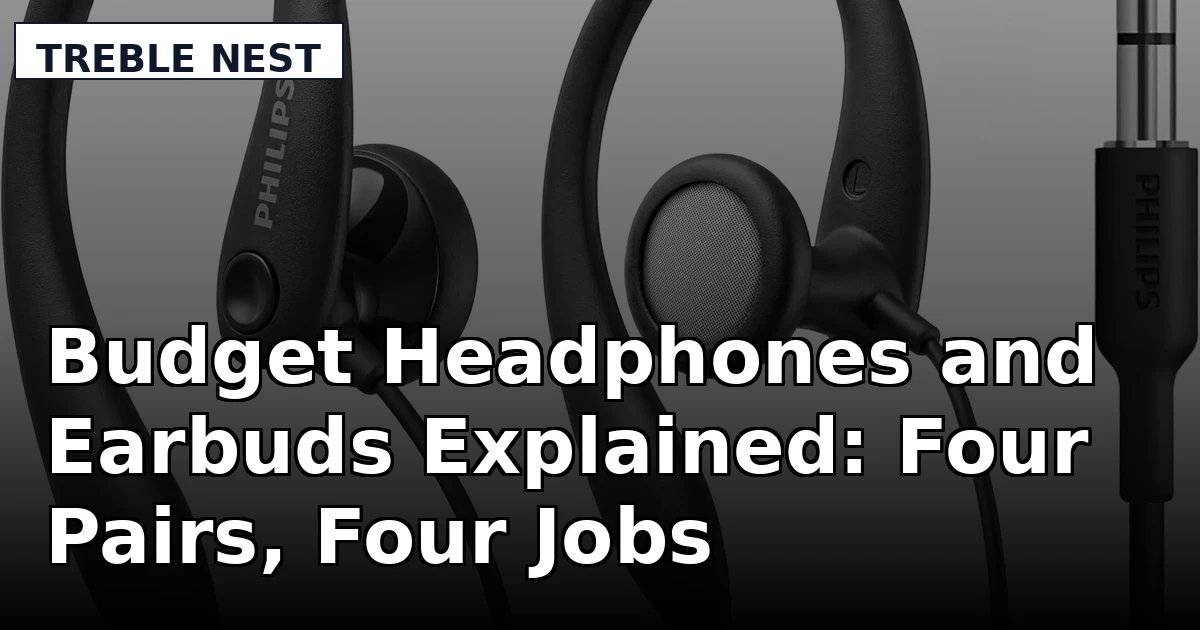
The wired holdout: PHILIPS SHS3200BK Flexible Earhook Headphones, Black
I held onto a 3.5mm jack for years, and I understand the position completely. The trade-off here is the obvious one: a cable means a cable, and if your phone dropped the headphone jack you will need an adapter, and adapters are exactly the thing that dies on you after a few months. But the earhook shape is the real argument. Nothing sits deep in your ear canal, so the sore-canal problem that plagues in-ear designs mostly goes away, and there is no battery to check before you leave the house. For a walk, a bike ride, or a laptop that still has a jack, that is a genuinely simple answer.
The long-playback pick: TAGRY Bluetooth Headphones True Wireless Earbuds 60H Playback LED Power Display Earphones with Wireless Charging Case IPX5 Waterproof in-Ear Ear buds with Mic for TV Smart Phone Laptop Computer Sports
Here is where I get blunt about "magic case" language. A 60 hour figure almost never means the buds run for 60 hours. It means the buds run for some smaller number, then the case recharges them, several times over. That is a recharging routine, not extended battery life, and the LED power display is the honest part of the design because it at least tells you where the case stands. The IPX5 rating covers splashes and sweat, which matters if these are going to the gym. Read the claimed figure as a total across recharges, then decide whether the per-charge runtime you actually get is enough for your longest day.
The sleep pick: Ozlo Sleepbuds® 2 - Sleep Earbuds, Snoring & Noise Masking Headphones
Sleep buds are not a nicer version of music earbuds, they are a different category, and mixing them up is how people end up disappointed. Noise masking is not noise cancellation. Cancellation targets the sound coming in and tries to subtract it. Masking plays a steady sound over the top of what you are hearing so the snoring or the traffic stops being the thing your brain latches onto. That distinction matters when you compare this pair to anything else on this list, because you are not buying it to hear a bass line. You are buying it so the neighbor's dog stops winning at 2 a.m. It also costs a great deal more than the other three, which is the trade-off you are accepting for a product aimed at a specific problem.
The call-first pick: GOLREX Bluetooth Wireless Earbuds with Reliable Voice Call Performance, Pleasant Sound for Music, Podcasts and Audio Streaming
If you take a lot of calls on the move, the microphone path matters more than the driver spec, and this is the pair in the group that says so out loud. The honest caveat is that call quality depends heavily on where you are standing. A quiet street and a windy intersection are two completely different tests, and no listing can promise you the second one. Treat "reliable voice call performance" as the design goal, not a guarantee, and give any pair you buy a real call in a real noisy spot before you decide it works. For podcasts, background music, and phone conversations, this is the straightforward entry point.
Prices and availability may change. Product images, names, and retailer links must be matched by verified ASIN. Do not state a current price, rating, stock status, or measured result without current evidence.
Why the spec sheet never answers the real question
Every listing gives you numbers, and almost none of them are the numbers that decide whether you keep using the thing. Battery is the clearest example. The box figure is usually a best case measured at a modest volume with features turned off. What you want to know is how long the buds last at the volume you actually listen at, and whether each bud works on its own when the other one is charging or lost. Independent earbud use sounds like a minor feature until you have it, and then it becomes the thing you cannot go back from, because one bud in while the other charges is how a lot of people get through a workday.
Fit is the second number that never appears on a box. If a pair hurts your ear canals, nothing else about it matters, and the pain does not show up in a frequency response chart. I have small, easily sore canals, so when I say a pair is comfortable I mean it survived two weeks of walks and workouts, not that it felt fine for ten minutes at a desk. The only way to learn this is to wear them the way you actually use them, for longer than a quick try-on.
Volume floor is the third, and it is the one nobody checks. Some pairs have a minimum volume that is still loud enough to be genuinely unpleasant at night, and a soft chime versus a shouted power-on announcement is the difference between gear that disappears into your day and gear that announces itself to the entire bus. Neither of those shows up in the spec table either.
How to read the claims before you buy
Manufacturers are not lying, they are just choosing the most flattering framing, and once you know the framings you can translate them quickly. A playback figure that includes the case is a total across recharges. An IP rating tells you about water resistance, not about whether the buds will survive being dropped on pavement. A "wireless charging case" means you can set the case on a charging pad, not that the case creates energy. And a product described around calls is telling you where the tuning effort went, which may mean it is not the pair to buy for critical listening.
Then there is the category question. Sleep buds, sports buds, and everyday buds are not interchangeable, even when they look similar in a product photo. Sleep buds prioritize a low profile and masking. Sports buds prioritize staying put through sweat. Everyday buds prioritize the connection and the microphone. Buying the wrong category is the single most common way people end up disappointed with a purchase that was fine on its own terms.
- Check the claimed battery figure and work out how much of it is the case recharging the buds.
- Confirm whether each earbud works independently, because that decides how you use them daily.
- Decide whether you need masking for sleep or cancellation for a commute, since they are different tools.
- Think about your ear canals before your ears. If in-ears have hurt before, consider an earhook or over-ear shape.
- Give whatever you buy a real test in the first week: a long walk, a workout, and a phone call from a noisy place.
Practical guidance for daily use
- Charge the case on a schedule, not on panic. A case with a visible power display makes this much easier than guessing.
- Test the volume floor on day one at night, before you commit to a pair for bedtime listening.
- Keep a cheap wired pair around as backup if your phone still has a jack or you own a working adapter. Cables do not need charging.
- If calls matter, take one in traffic and one indoors. That single test tells you more than any listing.
- Buy from a listing you can return. Budget audio is a fit experiment first and a sound experiment second.
Which option should you choose?
Choose the PHILIPS SHS3200BK Flexible Earhook Headphones, Black when you want a cable, no charging routine, and a shape that stays off your ear canal. Choose the TAGRY Bluetooth Headphones True Wireless Earbuds 60H Playback LED Power Display Earphones with Wireless Charging Case IPX5 Waterproof in-Ear Ear buds with Mic for TV Smart Phone Laptop Computer Sports when a large claimed playback total and a case with a visible charge level are your priorities, and you want a splash-resistant pair for workouts. Choose the Ozlo Sleepbuds® 2 - Sleep Earbuds, Snoring & Noise Masking Headphones when the problem you are solving is sleep and snoring, not music, and you accept that masking is a different tool from cancellation. Choose the GOLREX Bluetooth Wireless Earbuds with Reliable Voice Call Performance, Pleasant Sound for Music, Podcasts and Audio Streaming when phone calls, podcasts, and everyday streaming are the job and you want the simplest wireless entry point.
The caveat worth repeating: none of these claims can be verified from a listing page. Playback figures, call quality, and comfort all depend on how you listen, where you listen, and what your ears are shaped like. Buy somewhere with a return policy and treat the first week as the real review.
The bottom line
Budget audio is not about finding the one pair that beats everything. It is about matching a pair to a job you actually have, then accepting the trade-off that comes with it. A cable buys you simplicity and costs you convenience. A big claimed playback number buys you a case routine and costs you nothing but skepticism. Sleep buds buy you quiet nights and cost you a lot more money than the rest of this list. Call-focused buds buy you a working microphone and cost you critical listening. Pick the job first, check the battery math second, and check your ear canals before you check anything else. That is the whole method, and it beats another month down the review rabbit hole.