Most earbuds fail me in the same two places. They hurt my ear canals within twenty minutes, and they work their way loose somewhere around mile one. My canals are small and easily sore, so every pair eventually hurts, no matter the tip size or the material. That is how I ended up hunting earhook earbuds for workouts in the first place: not for sound, but for something that would still be in my ear when I got home.
I do live sound and recording editing around Nashville. The serious listening happens on a pair of Sony over-ears at the desk, and those never leave the house. Everything else, the walks, the gym, the dishes, the commute, runs on cheap wireless earbuds I paid for myself.
An earhook wraps over the top of your ear and holds the bud in place without driving a tip deeper into a canal that already hurts. That is the entire point of the style. Get the hook right and you forget you are wearing anything. Get it wrong and you have added a stiff piece of plastic to an ear that was already complaining.
Here is the test I run before I will say a good word about any pair, and the two earhook models I would start with in this tier.
Why you should trust me
I am a repeat buyer in the budget tier, not a sponsored reviewer. I have bought the same cheap pair of earbuds three times because I keep losing them, and I would buy a fourth. Before that I held onto wired headphones and a 3.5mm jack for years, running adapters that died every few months, until the phone stopped cooperating and I admitted wireless was the practical reality.
That history is why my standards look the way they do. Battery life comes before frequency response. Fit comes before everything, because a bud that hurts is a bud you stop wearing. I check how quiet the minimum volume goes, because I listen at night. And I have no patience for a voice announcement that greets me like an overenthusiastic receptionist every time I open the case.
What I will not do is pretend I know something I do not. I have not put these two models on a bench with a meter. What I can tell you is what the listings claim, what those claims are actually worth, and the checks that separate a pair that works from a pair that annoys you daily.
How I picked and what I check
The short version of my checklist: does each bud work on its own, how long the battery really lasts at normal volume, how quiet the quietest setting goes, whether the hook stays put without clamping down, and whether the connection holds when I walk away from the phone.
Both pairs below are earhook designs listed with an IPX7 water resistance rating, which is the rating I want for sweat and for getting caught in the rain. That is the floor, not a bonus. Everything above that floor is preference, and preference is where most buyers get talked into features they will never use.
If you want the deeper background on this category, my notes on budget earbuds that survive real use cover the baseline pair I keep coming back to.
Two earhook pairs worth a look
These are the two I would shortlist in this style. One is built around keeping the canal completely open. The other is built around a case that tells you what is left in the tank. Both approaches are legitimate, and which one you want depends on which problem bothers you more.
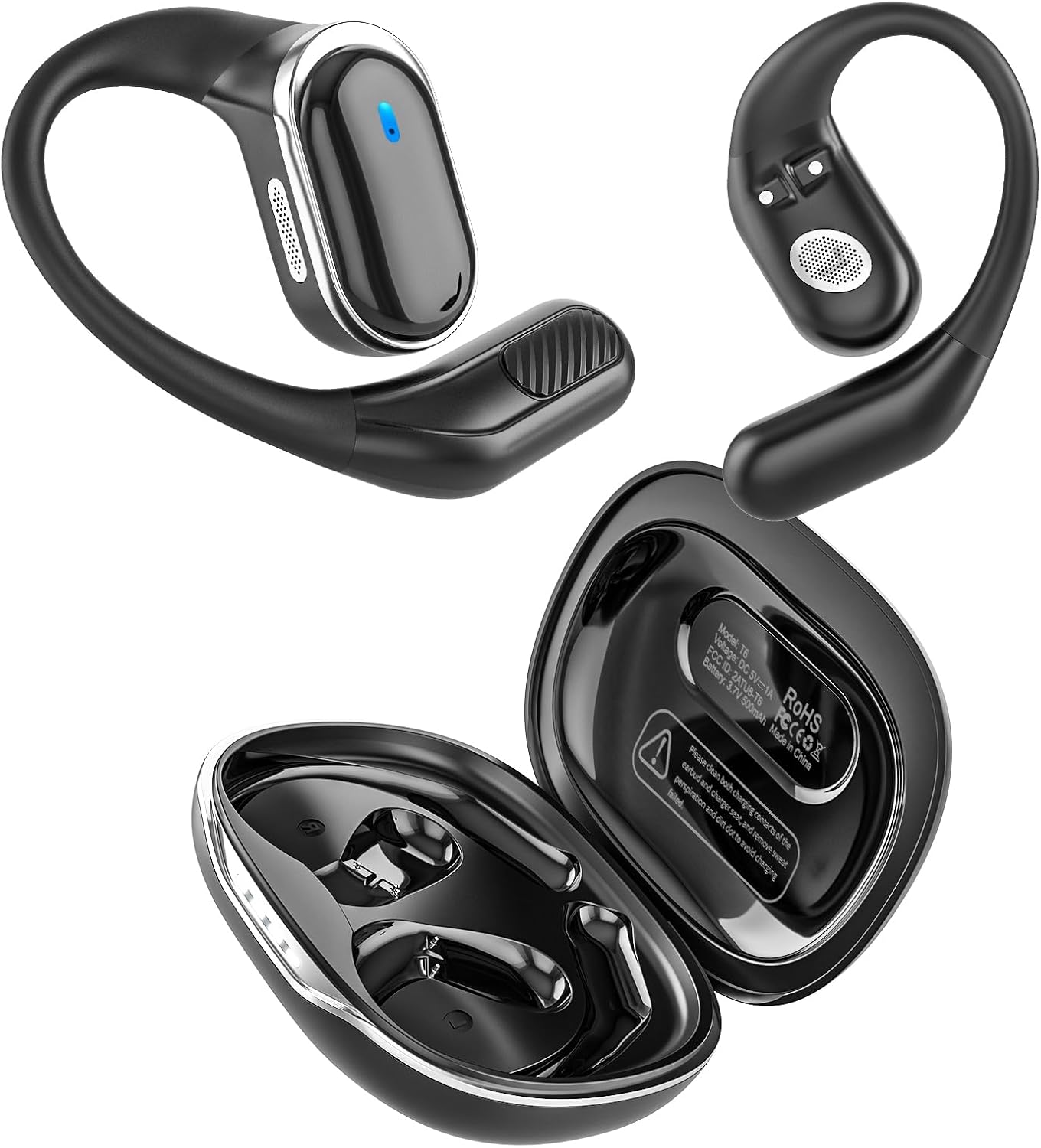
Best for open-ear comfort: Open Ear Wireless Earbuds Bluetooth Headphones, 80H Playtime Stereo Ear Buds with ENC Noise Cancelling, Fast Charging, IPX7 Waterproof Sports Earphones with Earhook for Running/Workouts (Black)
 Visit on Amazon →
This is the pair for anyone whose ears have already lost the argument. The design sits outside the canal rather than inside it, so there is no tip pressing on the sore spot that every in-ear bud finds eventually. If your ears hurt within a half hour of wearing normal earbuds, this is the shape that stops the pain instead of managing it.
The listing claims 80 hours of total playtime, fast charging, ENC noise cancelling for calls, and IPX7 water resistance. Take the 80-hour number the way you should take every playtime number: it is the case plus the buds, counted across multiple recharges, not one continuous stretch. What matters more is that fast charging means a short top-up gets you through a workout when you forgot to plug in the night before.
ENC on a call is the feature I would actually verify first, because open-ear designs let in the world around you by definition. On a noisy street, that is the trade you are making: you hear traffic and your surroundings, and you give up some isolation to get it. For running and gym work, that trade is usually the right one. For a plane, it is not.
Flaws but not dealbreakers: Open-ear sound is thinner in the low end than any sealed design, and no amount of marketing changes the physics. If you want thump, look at the next pair. Anyone with sore canals, or anyone who runs near traffic and wants to hear it, should start here. Check current Amazon price on the listing before you commit.
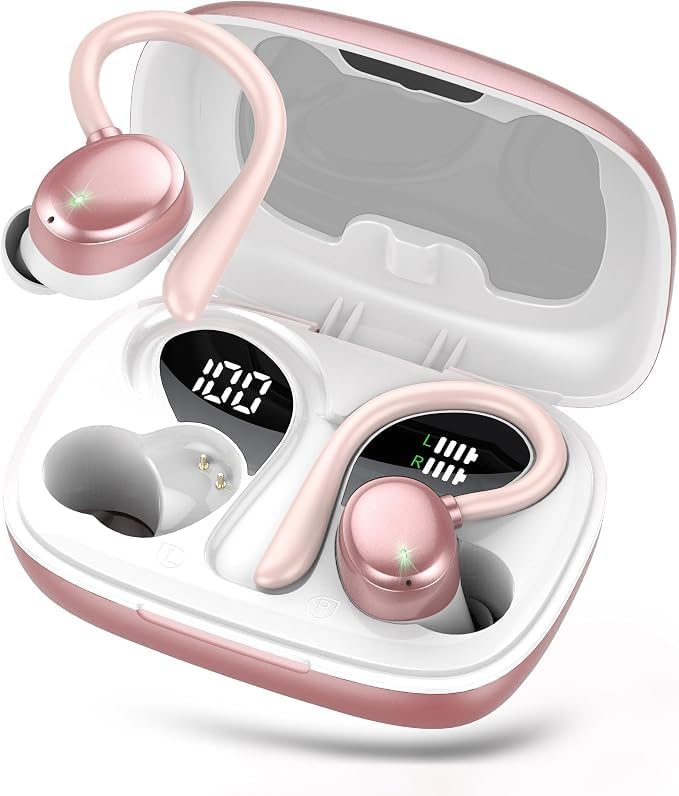
Best for bass and battery at a glance: Bluetooth Headphones Wireless Earbuds 72hrs Playtime Wireless Charging Case Digital Display, Ear Buds with Earhook, Deep Bass 2.0, IPX7 Waterproof Over-Ear Earbuds for Android iOS Workout
 Visit on Amazon →
This one takes the opposite approach: keep the bud seated, lean into the low end, and put a digital display on the case so you never guess how much charge is left. The display is the feature I did not know I wanted until I had it. A percentage readout beats a tiny blinking light that means something different on every model.
The listing claims 72 hours of playtime, a wireless charging case, Deep Bass 2.0, earhooks, and IPX7 water resistance, with Android and iOS compatibility. The 72-hour figure follows the same rules as the 80-hour figure: it is the case recharging the buds, not one heroic continuous session. The wireless charging case is the genuinely useful part, because dropping a case on a pad at night is one less cable in your life.
Deep Bass 2.0 is marketing language for a boosted low end, and boosted low end is exactly what an open-ear design cannot give you. That is the honest split between these two pairs. If your playlist is hip-hop or electronic and you want to feel the kick drum on a run, this is the shape that delivers it, at the cost of a bit more canal pressure.
Flaws but not dealbreakers: A sealed or semi-sealed fit means you hear less of the world, so keep the volume sane near roads. The digital display also drains a trickle of power to stay lit, which is normal and not worth worrying about. Anyone who wants bass, a charge readout, and a case that charges without a cable should look here first. Check current Amazon price on the listing before you commit.
The five checks that matter more than the spec sheet
None of the numbers on the box answer the questions that decide whether you keep wearing the things. These five do.
Step one: Set the hook before you set the tip. Most people push the bud in first and then fight the hook over their ear. Do it the other way. Loop the hook over the top of your ear, let it carry the weight, then let the tip rest where it lands. If you have to jam the tip in for the bud to stay, the hook is not doing its job and no tip size will save it.
Step two: Run your own battery drain at your own volume. Charge both to full, play at the volume you actually use, and note the time when the first one dies. Do it twice, because the first run is never typical. A pair that dies in two hours is useless no matter how it measures on a chart, and a case that adds four or five full recharges is the number that keeps you out of trouble on a long day.
Step three: Use one bud at a time. Take the right bud out and leave the left in the case. Does the right one keep playing? Now swap. Independent use sounds like a gimmick until you need it, and once you have it you will not buy a pair without it. It doubles your usable battery life and lets you keep one ear open for the world.
Step four: Find the volume floor. Set your phone to its lowest volume step and listen. If the quietest setting is still loud enough to blast your eardrums, that pair is a dealbreaker for night listening and for anyone sharing a room. This is the single most overlooked spec in the budget tier, and no listing mentions it.
Step five: Walk away from the phone. Leave your phone on a table and walk to the other end of the house, then outside. Count the dropouts. Bluetooth stability is not in the marketing copy, but a pair that stutters when you turn your head is a pair that is going back in the box.
Run those five and you will know more about a pair in an hour than a week of reading reviews that contradict each other.
The mistakes that cost me money
I have paid for the same lesson more than once, so here it is for free.
I have bought earbuds because the box said 40 hours and never once asked whether the case was included in that number. It always is. The case is not extending your playtime into another dimension, it is recharging the buds, and the math is simple division. Anyone selling you a magic case is selling you a battery and a plastic shell.
I have also bought pairs that could not be used one bud at a time, which sounds like a small thing until you are on a call with one ear and the other bud is dead weight in a case you have to carry anyway.
And I have kept pairs past the point where the volume floor was tolerable, telling myself I would get used to it. You do not get used to it. You just stop listening at night.
What you are actually paying for here
In this tier you are buying the shape, the battery, and the water resistance. You are not buying premium codecs, you are not buying a metal hinge, and you are not buying studio accuracy. The hooks are plastic. The mics are fine for a phone call and wrong for a podcast.
What you do get is a pair you can sweat on, rinse off, drop, and replace without grieving. That is worth more than it sounds, especially if you are the person who loses earbuds the way my guitarist loses picks. The Sony over-ears stay home for real listening. These are for the ninety percent of your day that happens away from the desk.
The bottom line
Pick the open-ear pair if your ear canals hurt, if you run near traffic, or if you want to stay aware of the world while you work out. Pick the bass-forward pair with the display case if you want low end, a charge readout, and a case that tops up on a pad without a cable.
Either way, set the hook first, run your own drain test, check the volume floor, and confirm each bud works alone. Do that and you will end up with the highest praise I hand out in this tier: they are fine, they do the job, and you will not think about them again. That is the goal. Gear that just works beats gear that impresses on paper and annoys you every single day.