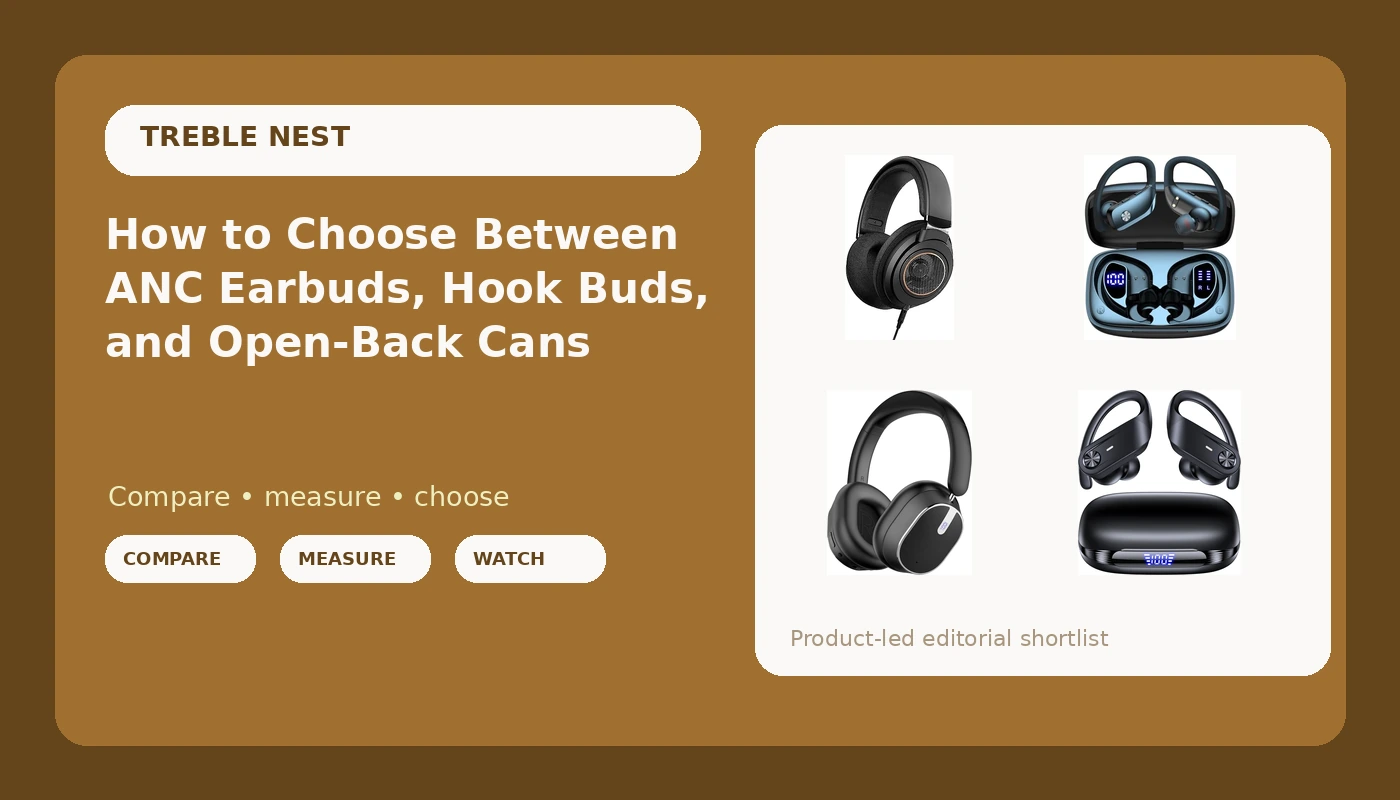
Budget noise cancelling headphones and earbuds are not one category, even when they sit on the same shelf and share half of their marketing language. The four options below are shaped differently on purpose: one is an ANC earbud with ear hooks, one is a hook-style sports bud with physical buttons, one is a wired open-back over-ear, and one is a wireless over-ear with hybrid noise cancelling. Pick by price alone or by whatever star rating happens to be highest today, and you will probably buy the wrong shape for your week.
That is the real problem with shopping this tier. Reviews rank these products against each other as if they were competing for a single crown, when they are really competing for different moments: the commute, the gym, the desk, the noisy kitchen. Read enough of them and you end up further down the rabbit hole than when you started, with five tabs open and no decision.
So forget the ranking. Ask what the shape is for, and the choice gets much easier.
Related: Budget Earbud Battery Claims, Explained →
Quick answer
There is no single winner here, because these four do not do the same job. Pick the TAGRY hybrid ANC earbuds when you want one pair for work, calls, and blocking out a room. Pick the bmani hook buds when you sweat and want buttons instead of touch controls. Pick the Philips open-back wired headphones when you listen at a desk, edit audio, or plug into a TV and do not want a battery in the chain at all. Pick the wireless hybrid ANC over-ear headphones when you want one simple over-ear for the house and are willing to verify the battery details on the product page yourself.
Four useful options
| Model | Best fit | What stands out |
|---|---|---|
| TAGRY Hybrid Active Noise Cancelling Wireless Ear Buds 80 Hrs Playtime Hi-Res Stereo Quality Bluetooth Earbuds with Transparency Mode Headphones Bluetooth Earhooks ANC Earphones for Work | Work, calls, and noisy rooms | Hybrid active noise cancelling, a transparency mode, ear hooks, and a stated 80 hours of playtime |
| bmani Ear Buds Wireless Earbuds Bluetooth Headphones with 80H Playtime LED Display Case, Over-Ear Hook with Mic, Stereo Sound, Easy Button Controls, Sports Earphones for Running Workout Gym Black | Running, gym, and workouts | Over-ear hooks, physical button controls, an LED display case, and a stated 80H playtime |
| Philips Open Back Wired Headphones - Cushioned Over Ear Headphones with Adjustable Headband for Ultimate Comfort and Superior Sound Quality, Plugs into TV, Stereo or PC, Ideal for Podcasts or Music | Desk listening, TV, PC, podcasts | Wired open-back design with cushioned over-ear pads and an adjustable headband |
| Hybrid Active Noise Cancelling Bluetooth Headphones Wireless Headphones | One over-ear pair for the house | Wireless over-ear with hybrid active noise cancelling |
The ANC earbud pick: TAGRY Hybrid Active Noise Cancelling Wireless Ear Buds
The trade-off with any ear hook is bulk. You get stability, and you give up the flat, pocketable case that disappears into a jeans pocket. You also get two features that pull in opposite directions on battery: noise cancelling drains faster than plain listening, and transparency mode is a microphone feed running in real time, which is its own draw. If the 80-hour number is the reason you are buying, treat it as a total across recharges and check what a single charge looks like before you commit.
That said, for someone who moves between a noisy room, a call, and a walk, this shape covers the most ground of the four.
The workout hook bud: bmani Ear Buds
Buttons are the underrated part of this one. Touch controls and sweaty hands do not get along, and there is nothing more annoying mid-run than tapping a bud four times and having it ignore you, so you end up grabbing your phone anyway. A real button that clicks is a small thing that shows up every single session.
The LED display on the case is the other practical detail. It answers the question you actually ask before leaving the house, which is whether there is enough charge left, without making you do percentage math in your head.
The hook shape is the same compromise as above: secure, but not the smallest thing to carry.
The wired open-back option: Philips Open Back Wired Headphones
Open-back means exactly what it sounds like: the outside of each cup is not sealed, so sound escapes and room noise comes in. That is a downside on a bus and a benefit at a desk, because your ears never feel pressurized and you can still hear a doorbell or someone talking to you.
What you buy with the cable is certainty. No charging, no pairing, no codec negotiation, no lag between a video and the audio you hear. If you are editing a podcast or watching something on a TV with a headphone jack, that removes an entire category of daily annoyance. What you give up is portability and isolation, and there is no noise cancelling here at all.
The budget over-ear: Hybrid Active Noise Cancelling Bluetooth Headphones
This is the least complicated option of the four, and for some people that is the whole point. Over-ear headphones do not fall out, do not need ear tips, and do not care whether your ear canals are small. If earbuds have always hurt you, this is the shape that sidesteps the problem entirely.
The catch is that the listing does not publish a playtime figure, so battery life is the open question here. Do not assume a number, and do not assume noise cancelling behaves the same as it does on a more expensive pair. Check the current product page, and check whether the specs mention a wired listening option for when the battery runs out.
Prices and availability may change. Product images, names, and retailer links must be matched by verified ASIN. Do not state a current price, rating, stock status, or measured result without current evidence.
What 80 hours of playtime actually means
Two of these products advertise 80 hours. That number deserves a translation before it becomes a reason to buy.
A charging case does not extend playtime. It recharges the buds. When a listing says 80 hours, that figure almost always combines the charge held in each bud with several full recharges from the case. The number you feel in daily life is the per-charge figure: how long one bud runs before it has to go back in the case. The case then buys you extra sessions, not extra hours in a single sitting. I have ranted about this before, because the phrase "extends playtime" makes people believe the case is doing something magical when it is doing the same thing a wall charger does, just slower and in your pocket.
Three other things move the real number. Volume is the big one, since every hour at high volume costs more than an hour at moderate volume. Noise cancelling and transparency mode both draw power continuously, and transparency is the hungrier of the two because it runs microphones in real time. And temperature matters at the edges, which is why buds that behave in October can behave differently in a Nashville August.
None of that makes the stated figures dishonest. It just means the number on the box is a best case, and the useful question is what a single charge looks like at the volume you actually listen at.
Fit comes before frequency response
I have small ear canals that hurt easily. Every in-ear pair I have owned has hurt at some point, no matter the tip size or material, which is why I stopped treating comfort as a footnote. Fit beats frequency response, because a pair that hurts or falls out mid-walk gets left in a drawer no matter how good it sounds.
That is the honest argument for the two over-ear options here. Cushioned pads rest against the ear instead of inside it, so the canal never gets involved. The Philips pair goes one step further by being open-back, which removes the pressure seal entirely, at the cost of letting the room in. If you have ever taken a bud out after an hour and been relieved, this is the section that matters most to you.
Ear hooks solve a different problem. They keep a bud from falling out, which is why both hook-style pairs here are aimed at movement, but they do not make an in-canal tip softer. If the pain is from the tip pressing inside your ear, a hook will not fix it. If the problem is buds working their way loose, a hook fixes it immediately.
Here is the order I would work through before buying anything:
- Write down the three places you listen most, and be specific about noise and movement.
- Decide whether you can live with a cable at your desk, because that single question removes battery and pairing from the equation.
- Check the battery claim and separate the per-charge figure from the case-inclusive total.
- Confirm whether you need each bud to work independently, since one-ear use at a desk is a feature people only miss after they lose it.
- Check the controls and the power-on sound. Buttons or touch, and whether the thing greets you with a dramatic announcement every time you open the case.
How to shop these four without getting burned
- Buy for fit first. The shape you can wear for two hours beats the shape that sounds impressive for twenty minutes.
- Treat every playtime number as a manufacturer claim until you have lived with it for a week, and expect real-world results to land under the box figure.
- If your ear canals hurt, go over-ear. Both the Philips open-back pair and the wireless over-ear pair avoid the canal completely.
- If you sweat, prioritize physical buttons. Touch controls and moisture are a bad combination, and buttons work with gloves and wet hands.
- Match noise cancelling to the noise you actually have. Hybrid ANC helps most with steady low rumble, and it does much less with sudden, sharp sounds like a dog barking.
- Keep one wired option in the house for latency-sensitive work, even if it lives in a drawer most of the year.
Which option should you choose?
Choose the TAGRY Hybrid Active Noise Cancelling Wireless Ear Buds when you want the most flexible single pair: ANC for a noisy room, transparency for a conversation, ear hooks for movement, and a case that keeps them topped up between sessions. Choose the bmani Ear Buds when workouts are the main event and you want buttons, a hook, and a case that shows you the charge level without guesswork. Choose the Philips Open Back Wired Headphones when you sit at a desk or a TV and want zero battery, zero pairing, and zero lag. Choose the Hybrid Active Noise Cancelling Bluetooth Headphones when you want one simple wireless over-ear for the house and earbuds have never been comfortable for you.
There is a limit to what any listing can tell you. Fit, battery behavior at your normal volume, and how the controls feel after a month are things only your own ears and your own routine can answer. I have not measured these four units, and no spec sheet will tell you whether a bud will hurt your ear canal on day nine.
The bottom line
These four products are not ranked, they are sorted by shape, and the shape is what decides whether you keep using them. ANC ear hooks for work and calls, hook buds with buttons for the gym, a wired open-back pair for the desk, and a plain wireless over-ear for the house. The 80-hour figures are case-inclusive totals, so check the per-charge reality and the current Amazon listing before you buy, and pick the one that matches the way you actually listen rather than the way a comparison table says you should.