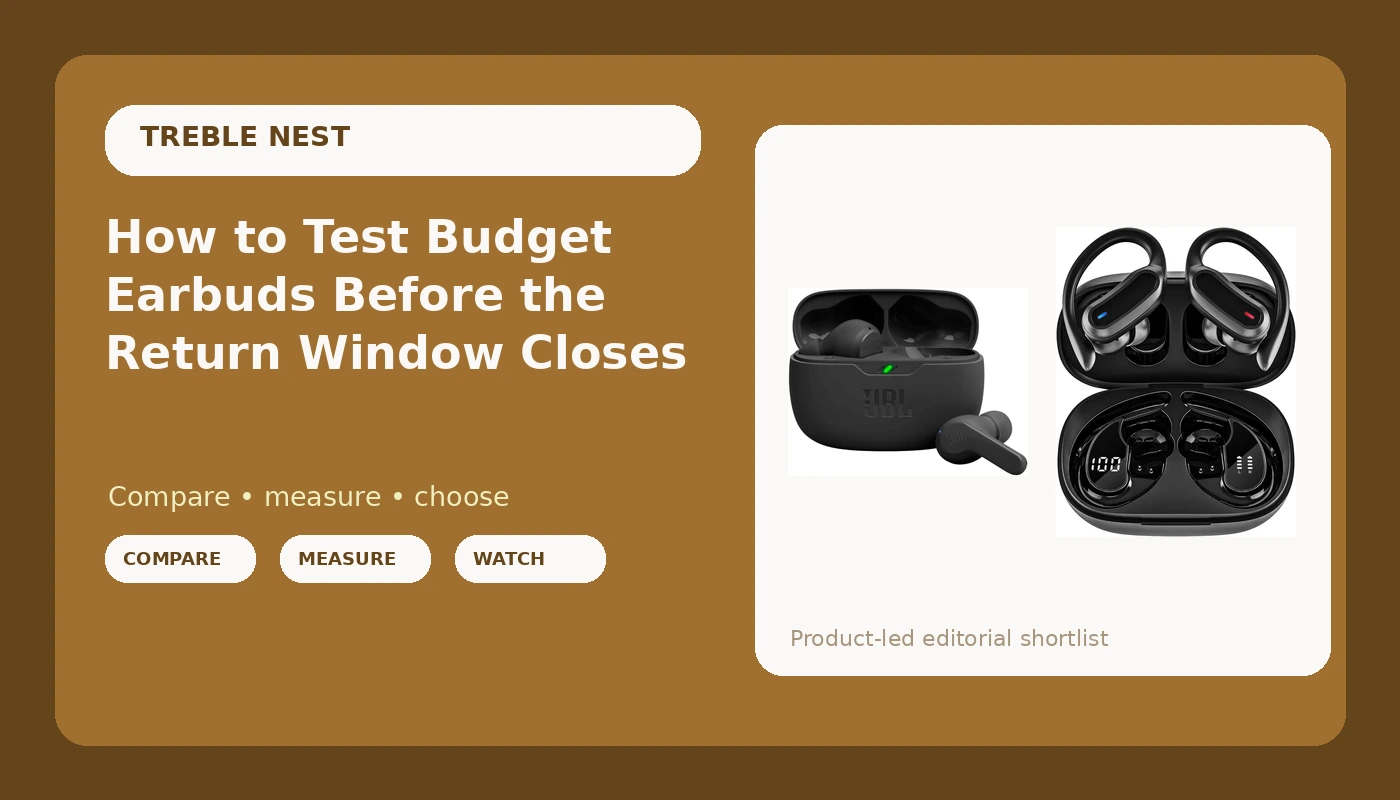
Wireless is the practical reality now. I held onto a 3.5mm jack for years, ran the adapters, watched every one of them die in a pocket or a bag, and finally admitted the phone had moved on. So here is the budget earbuds test I wish someone had handed me back then: two weeks, eight checks, and a clear answer about whether the pair on your desk is worth keeping or going back in the box.
The reason you need a test at all is that reviews contradict each other. One person says the bass is huge, the next says there is none. One says the fit is perfect, the next says they fall out on a walk. Both are telling the truth about their own ears, their own phone, and their own listening volume. That is why I stopped trusting the spec sheet and started running every pair through the same protocol. The protocol is below, and you can run it on whatever pair you already own.
Why you should trust me
I mix monitors in small venues around Nashville and clean up podcast audio for a living. At the desk I use a serious pair of Sony over-ears, the reference pair, the ones that cost real money and never leave the house. Everything else, walks, chores, the gym, the commute, happens on budget earbuds. I have been through more pairs than I can list, and I have bought the same model three separate times because I kept losing it and kept going back for another.
Two things shape how I judge a pair. First, my ear canals are small and sore easily, so when I say a pair is comfortable, it means it survived two weeks of daily wear without leaving my ears hot and aching. Second, I test battery at my normal volume, not the volume on the box. Loud listening drains a cell fast and makes any pair look worse than it is. Very quiet listening makes any pair look great. Neither one is your life.
How I picked and how I tested
There are two pairs on my bench right now. One is a sport pair with earhooks, the other is a stick-style pair from a known brand. Both sit in the budget tier, and I paid for both, because a pair I did not buy is a pair I cannot be honest about. No sponsored units, no loaners, no affiliate-first recommendations dressed up as reviews.
Both pairs went through the same eight checks: battery drain at normal volume, independent use of each bud, the minimum volume floor, a two-week fit test on walks and workouts, the case recharge math, pairing and dropout behavior around the house and on a busy street, real phone calls in real noise, and the small daily annoyances that decide whether you actually keep reaching for them.
The numbers I trust are the ones I can produce myself. Battery drain at your normal volume is the only battery number that matters. The quietest volume step is the only volume number that matters. Fit is not a number at all, it is two weeks on your own ears, and it is the one spec no reviewer can measure for you.
The two pairs on my bench right now
These are the two I am running through the protocol this month, one for workouts and one for everything else. Neither is a splurge, and both are the kind of pair this article is written for.
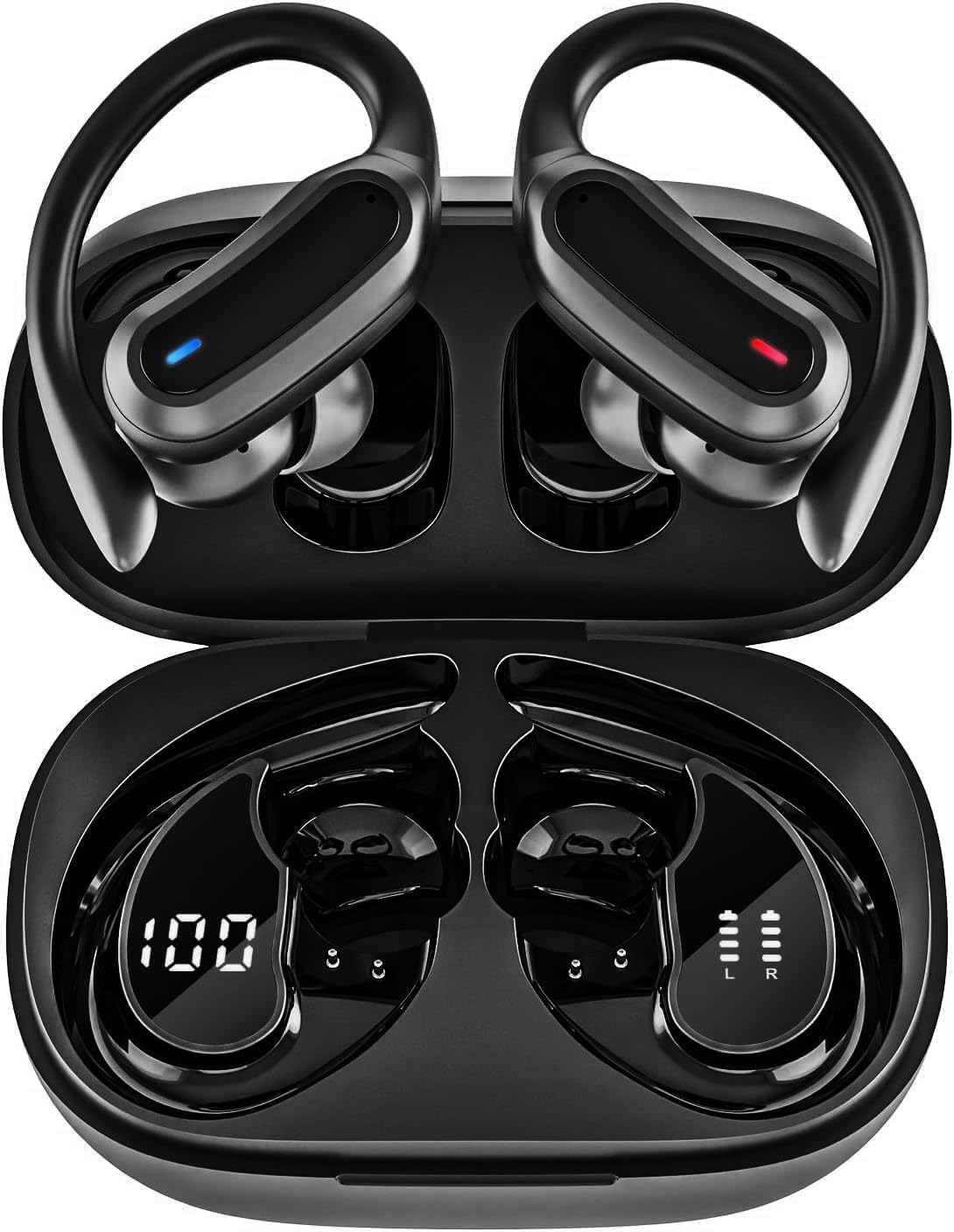
The workout pick: Wireless Earbuds Bluetooth Headphones, 54H Playtime Stereo Over Ear Buds with ENC Noise Cancelling, LED Power Display, IPX7 Waterproof Sport Earphones with Earhooks for Running/Workouts (Black)
 Visit on Amazon →
This is the pair I grab on run days and gym days, and the reason is the earhooks. A hook holds the bud outside the canal and takes the weight off it, and for ears like mine that is the difference between finishing a workout and thinking about my ears for three miles. The listing claims 54 hours of playtime, IPX7 waterproofing, ENC noise cancelling for calls, and an LED power display on the case.
Two of those claims you can verify yourself in about a minute. The LED display tells you what is left in the case, which is the feature I miss most on pairs that hide their battery behind a chime. IPX7 is the rating you want for sweat and rain, and it is the reason I am willing to wear this pair on a humid Nashville afternoon instead of babying it. The 54 hour number is a case-inclusive number, which means it counts the recharges from the case rather than one continuous session, so treat it as a total across charges. Run step one of the protocol and get your own number at your own volume.
Flaws but not dealbreakers: Earhooks change the fit equation. They solve canal soreness, but they also mean the bud sits differently in your ear, and the seal matters for bass. If the sound feels thin, try the other tip sizes before you blame the drivers.
Anyone who runs, lifts, or sweats through a commute and has given up on in-canal buds should start here.
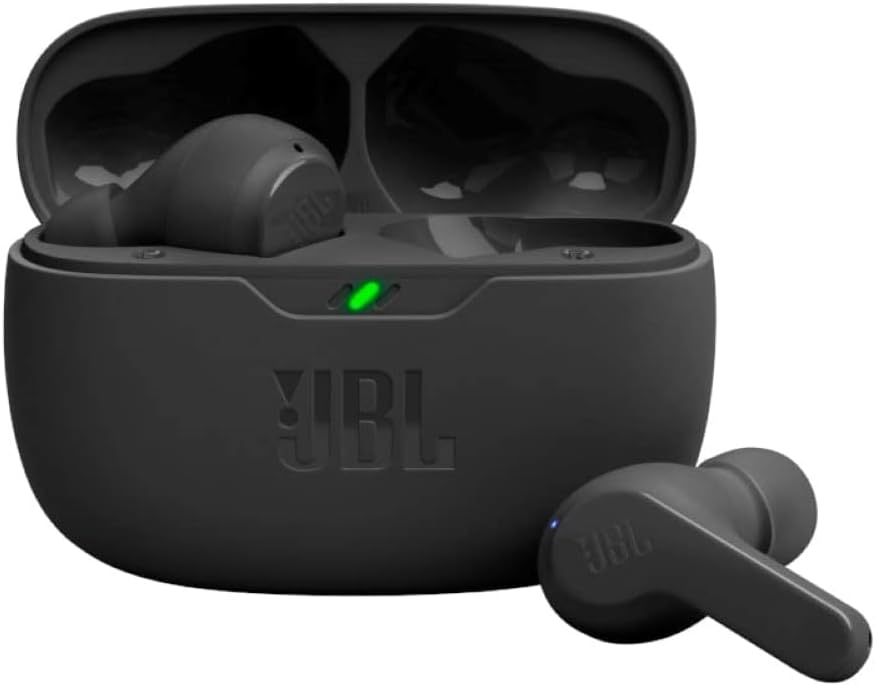
The everyday pick: JBL Vibe Beam - True Wireless Earbuds - Black
 Visit on Amazon →
This is the stick-style pair, no hooks, and it is the one I would hand to someone who wants a name brand in the budget tier. The practical argument for a brand is not sound quality, it is longevity: a company with a support page and a product line that stays on shelves for years is easier to live with than a listing that vanishes three months after you buy it, especially when you need a replacement tip or a warranty conversation.
The fit is in-canal, so the small-ear-canal caveat applies in full. Budget the whole two weeks for tips, and do not judge comfort in the first hour, because every in-canal pair feels fine for the first hour. The real test is day four, when the soreness either shows up or does not.
Flaws but not dealbreakers: Stick-style buds sit in the canal, which is exactly where my ears complain. If you already know in-canal designs hurt you, the earhook pair above is the smarter starting point, and this one is the pair for shorter sessions.
Anyone who wants a familiar name, a simple shape, and everyday listening without a hook behind the ear will be fine here.
The protocol: eight checks before you decide
Run these in order. You can do all eight on a pair you already own, and you should, because the point is to find the problem while you can still do something about it.
Step one: Battery drain at your normal volume. Charge the buds and the case to full. Put them in, set the volume to where you actually listen, and run them until they die. Write down the time. The number on the box is almost always a case-inclusive number, which means it counts the recharges from the case rather than one continuous session. That is not a lie exactly, it is marketing arithmetic. Your number is the one that decides.
Step two: Each bud on its own. Take the left bud out, put the right one in, and play something. Then take a call that way. Then swap. Plenty of pairs only work with both buds out of the case, or only let one side handle calls. I did not know I needed independent use until I had it, and now a pair that fails this check is a return for me.
Step three: The volume floor. Wait until the house is quiet, or take a night walk. Set the volume to the lowest step that produces sound. If the quietest setting is still loud enough to bother you, that is a dealbreaker, because night listening is exactly when this shows up and there is nothing you can do about it afterward.
Step four: The fit test on your own ears. Two weeks minimum. Walks, workouts, chores, the whole routine. Try every tip size in the box, and give each size a full day before you switch. Note where it hurts and when it falls out. Fit beats frequency response, always. A pair that hurts your canals or drops out mid-walk does not get saved by good tuning.
Step five: The case math. Count how many recharges you actually get before the case needs a cable. Then leave the case in a drawer for a week and see whether it still holds a charge. Case marketing loves the phrase "extends playtime," which sounds like extra battery and means recharging. There is no magic in it, and the only number worth trusting is the one you counted.
Step six: Pairing and dropouts. Pocket the phone and walk through a busy intersection. Leave the phone on the kitchen counter and walk to the far end of the house. Watch a video and look for lip-sync lag. If you have to re-pair more than once in two weeks, that is data, and it is the kind of data that gets worse over a year, not better.
Step seven: Real calls in real noise. Call someone from a street corner with traffic going by, and from a windy spot. Then ask the person on the other end what they heard, because ENC claims are cheap and your own ears cannot tell you what your microphone is sending. A pair that sounds great to you and terrible to your caller is a pair you will stop using for calls.
Step eight: The small daily annoyances. Does the power-on announcement greet you like an overenthusiastic receptionist? Do the touch controls respond on the first tap, or do you end up grabbing your phone anyway? A pair can pass every check above and still annoy you every single day. That counts.
One caveat on the whole protocol: run it inside your return window, whatever that window is. And do not skip the second week because the first week felt fine. Week one tells you about battery and pairing. Week two is where fit problems and slow annoyances surface.
What fails the protocol, and why I stopped buying it
The no-name generic pairs are the enemy. They are the ones that lag behind video, drop out when you turn your head, and die after a couple of hours of real listening. The volume floor is usually the worst part, because the quietest setting is still loud enough to blast your eardrums, which makes them useless at night.
Open-ear buds are the other trap, and I say that as someone who used them as a compromise for years. They sit outside the canal, which genuinely stops the ear pain, and you pay for that comfort with sound quality and isolation. I got tired of pretending otherwise, so they are no longer my first recommendation.
And the "extends playtime" language on charging cases has to go. It recharges. That is all it does. When you read a playtime number, ask whether it is continuous listening or total time across case recharges, because those are two very different products.
What this all costs
Both pairs here sit in the budget tier, so the honest math is not the sticker price. It is cost per month of use. A pair you keep for two years costs you a fraction of a dollar a day, and a pair you replace every four months because the battery collapsed costs you more than the expensive pair you talked yourself out of.
The real variable is whether you keep them. A pair that hurts your ears goes in a drawer and gets replaced, which is money spent twice. That is why the protocol above matters more than any spec sheet: it tells you in two weeks what you would otherwise find out in month four.
Charge them, run the eight checks, take the notes, and let the pair decide for itself. That is the whole job.