Every pair of budget earbuds sounds impressive for the first ten minutes. That is the problem. The ten-minute impression is what most reviews are built on, and it tells you almost nothing about whether you will still be happy with the pair in March.
I have bought the same pair of budget earbuds three times. Not out of brand loyalty: I lost one pair after a year, lost the second a year and seven months later, and both times I reordered the same model without a second thought. That only happens when a pair has already survived a real test instead of a showroom listen. So this is how to test budget earbuds before the return window closes: battery drain at your normal volume, each bud running solo, the volume floor at night, call clarity on a loud street, and a week of walks and workouts on ear canals that hurt if you look at them wrong.
None of it requires a lab or a meter. It requires seven days, a phone, and a note file.
Why you should trust me
I do live sound and recording-editing work around Nashville, running monitor mixes in small venues and cleaning up podcast audio. My reference pair is a set of Sony over-ears that cost real money and never leaves the desk. Everything else, the walks, the chores, the gym, the commute, gets done on earbuds that cost less than dinner.
I held onto wired headphones with a 3.5mm jack for years, because wired still sounds better and I will say that until I am hoarse. Then the adapters kept dying and the phone stopped cooperating, so I made peace with wireless and went down the review rabbit hole like everyone else. Every review contradicted the last one. I finally ordered a pair of Soundcore P20i on gut instinct, and I have bought them three times since. I also tested the Fhumsh A10 Pro against low expectations and it beat them.
The part that matters for this guide: my ear canals are small and sore easily. Every pair hurts eventually, no matter the tip size or the material. So when I say a pair is comfortable, it means it survived my ears, not a reviewer's.
How I picked and how I tested
This article is not a ranking. It is a procedure. The two pairs below are here because they represent the two buying cases I get asked about most: the gym-and-commute pair that has to survive sweat and long days, and the small-shell pair for people whose ear canals reject everything else.
The test itself is the same gauntlet I run every pair through before I am willing to say anything about it. Battery drain measured at normal volume, not at half and not at max. Each bud used alone for music and for calls. The minimum volume setting checked at night, because a pair that cannot get quiet is useless after 10 p.m. Fit checked on walks and in workouts, not on a couch. The charging case left in a pocket to see whether it holds a charge between sessions. And the power-on announcement listened to once, carefully, because a dramatic voice greeting you like an overenthusiastic receptionist is a dealbreaker I will not negotiate on.
What I do not count: the number printed on the box, the word "premium" anywhere in the listing, and any sentence that describes a charging case as extending playtime. A case recharges. That is all it does.
The two pairs I would put through this test first
These are the two shapes of earbud worth running through the seven days below. Neither is a verdict on its own. The test is what produces the verdict.
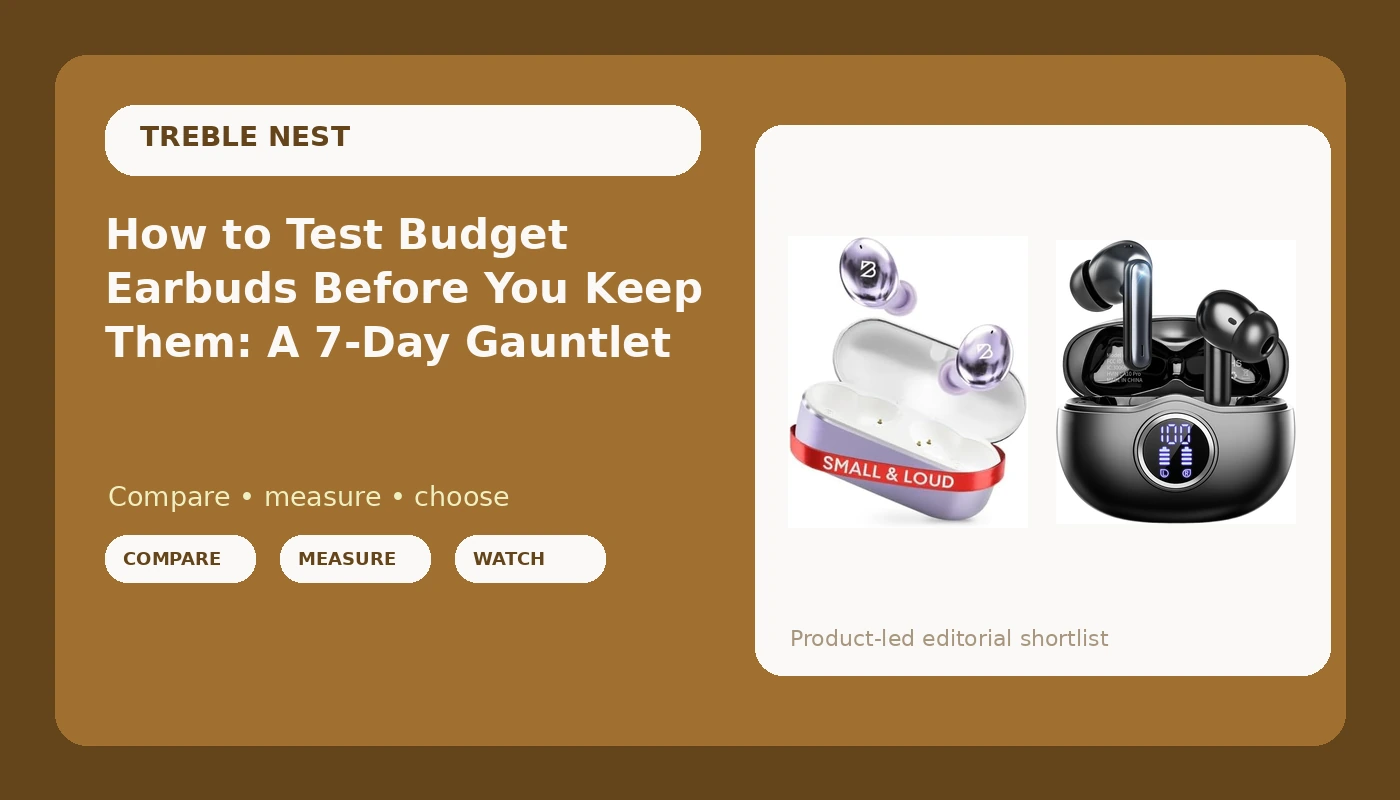
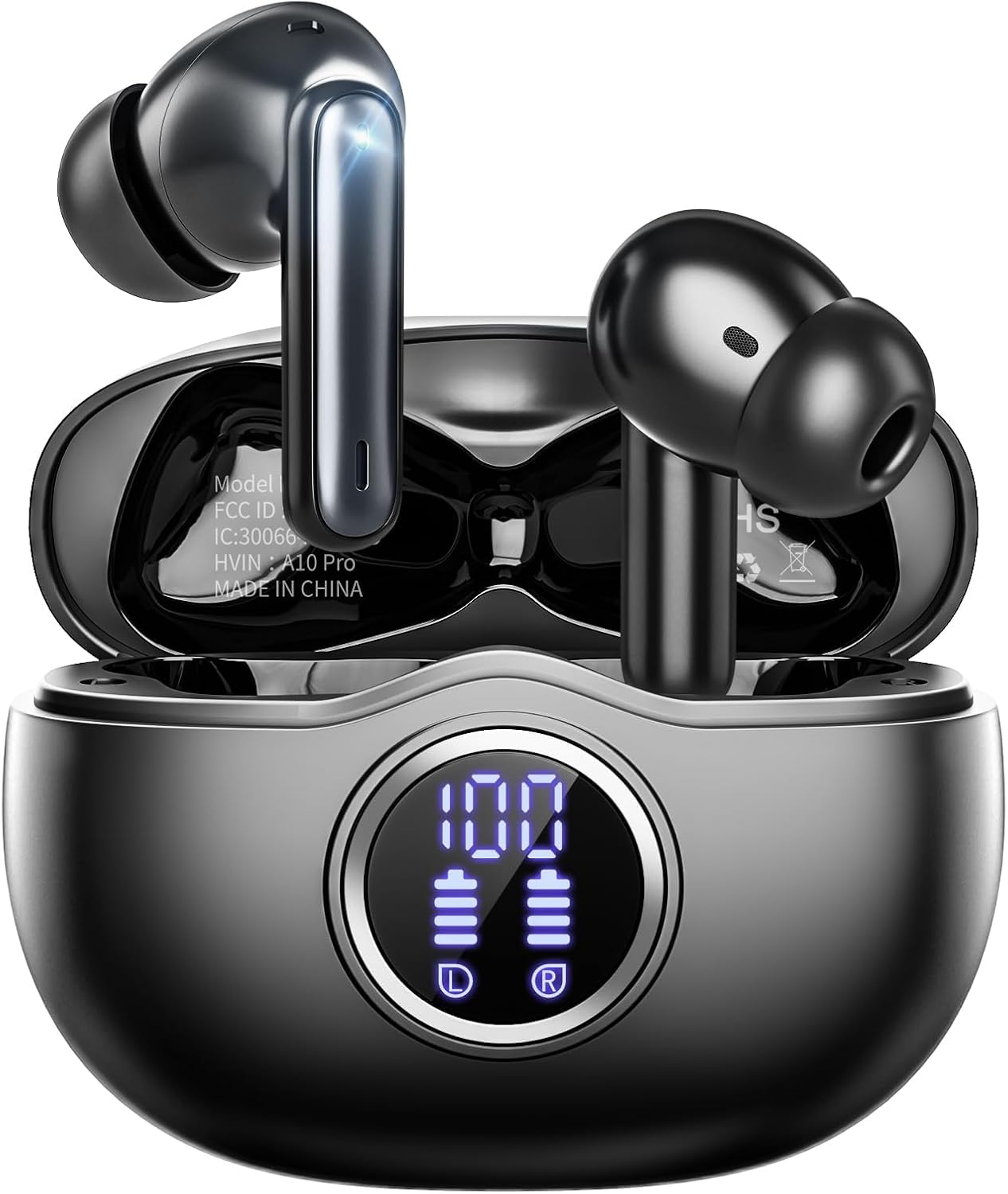
The gym-and-commute pick: Wireless Earbuds, Bluetooth 5.3 Headphones HiFi Stereo 50H Playback LED Digital Display Ear Buds with ENC Noise Canceling Headset, IPX7 Waterproof Earphones for Gym/Running/Work(Black)
 Visit on Amazon →
This is the pair for the sweaty half of the list: Bluetooth 5.3, an IPX7 water rating, an ENC noise-canceling microphone array for calls, and a charging case with an LED display that shows remaining charge instead of making you guess. The listing claims 50 hours of playback. Check current Amazon price before you decide anything else.
Two things to verify on day one. First, whether that 50-hour figure is a single charge or the running total after the case has refilled the buds several times. It is almost always the second one, and the number that matters to you is the single-charge figure, which the drain test in step two will find for you. Second, whether each bud runs alone, which matters more than people expect once you start taking calls with one ear free.
Flaws but not dealbreakers: An LED display on the case is a convenience, not a feature that changes how the buds sound. IPX7 covers water, so rinse the sweat off after a workout, but do not read it as a promise about long-term durability. And shell size is the one thing a listing photo will not tell you, so if your ear canals are on the small side, read the next entry before you commit.
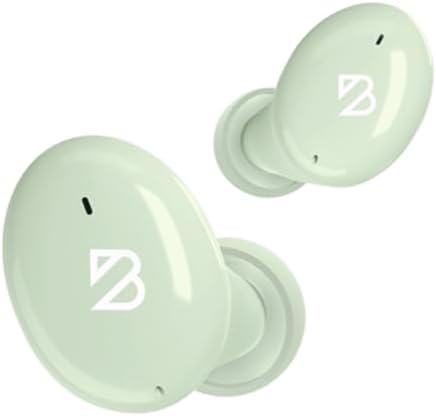
The small-ear pick: Back Bay Audio Mini Wireless Earbuds for Small Ears, Award-Winning Sound
 Visit on Amazon →
A smaller shell aimed at exactly the problem that sends most people back to the review pages: buds that will not sit still in a small canal. If every pair you have tried aches by hour two, this is the shape of thing to test, because no amount of tip swapping fixes a housing that is simply too big for your ear. Check current Amazon price.
What to verify: whether the smaller housing stays put through a walk without you pressing it back in every block, and whether the volume floor drops low enough for night listening. The award language in the name is marketing copy, and marketing copy is not a test result. The drain test in step two is what settles it.
Flaws but not dealbreakers: Small housings sometimes trade battery capacity for size, so do not assume the runtime will match a full-size pair. A mini bud that fits perfectly but has a touch control you cannot hit reliably will send you back to your phone anyway, so test the controls while walking, not while sitting still.
The seven-day test, step by step
Day one: full charge and a start time. Charge both buds and the case to full, note the exact time, and use them normally. Normal means your normal volume, not half to be safe and not maxed out to be impressed. Whatever you actually do is the number you care about.
Day two: the drain test. Keep using them until the buds die and write down the elapsed time. That is your real single-charge number. Now charge the case and count how many times it refills the buds before the case itself gives up. That is your real total. This is the only battery number worth repeating to anyone, and it is the one the box never gives you.
Day three: the volume floor. Sit somewhere quiet, drop the volume to the lowest setting, and listen. If the quietest setting still feels like it is shouting at you, you have found a dealbreaker for night listening, podcasts in bed, and anything after the house goes quiet. Volume ceilings get all the attention. Floors are what make a pair livable.
Day four: solo bud day. Use the left bud alone for a call, then the right bud alone. Both should pair and both should carry audio without the other one sitting in the case. If only one side works independently, that is a limitation you will notice every single day, usually while driving or cooking.
Day five: the noisy-street call test. Call someone from a sidewalk, not from your kitchen. ENC microphones are advertised on nearly every budget pair and they are not all equal. Ask the person on the other end to be honest about how much of the street they can hear, then ask them again while a bus goes past.
Day six: the fit test. Wear them on a walk, then in a workout, then for an hour at a desk. Three activities, three different kinds of discomfort. Canal pain shows up late, not immediately, which is why a ten-minute try-on is worthless. If you have small canals, this is the day that decides it.
Day seven: the case and the announcement. Leave the case in a pocket or bag all day and see whether it still has charge when you pull it out. Then power the buds on with the volume low and listen to whatever greeting they play. A soft chime is fine. A voice announcing itself at full volume is not, and no amount of good sound makes up for hearing it every time you open the case.
What to do when a pair fails
Send it back. That sounds obvious, and it is the step people skip, because by day five they have already decided the pair is good enough and the return window feels like a hassle. A pair that fails the volume floor or the solo bud test is not going to grow out of it.
Test inside the return window on purpose. Order, test immediately, decide while the option is still open. If a pair passes everything, you have a keeper. If it fails one test, you know exactly why, and that is more information than a hundred reviews that contradict each other.
The competition and why it lost
For context on where these two sit, my own baseline is a pair of Soundcore P20i that I have bought three times. Decent bass, each bud works alone, soft power-on sounds, a volume floor that actually goes quiet, and a case that holds a charge for ages. That is what "fine" means in this tier: no gimmicks, no nonsense, no regrets.
The Fhumsh A10 Pro is the other pair I have spent real time with. Stable Bluetooth 5.3 with no lag or dropouts, ENC clarity on calls, and it survived the gym. Excellent value, though I still reach for the P20i first.
The Sony over-ears stay at the desk. That is the reference pair for recording and editing, and no wireless set matches wired sound quality. If you want the best sound available, buy wired and accept the adapter. If you want earbuds you can lose on a walk without mourning them, that is what this guide is for.
What this all costs
Both pairs here sit in the budget tier, and the honest answer on price is the same for both: check current Amazon price, because it moves. What does not move is the cost of skipping the test. Buy blind, keep a pair that hurts your ears or dies at hour three, and you have spent the money plus the weeks of annoyance that follow.
The test itself costs you seven days and a notes app. That is the whole investment. Do it once per pair and you will stop reading reviews that contradict each other, because you will have your own numbers instead.
That is the job. Earbuds are supposed to be the cheap, replaceable part of your day. Test them like it.