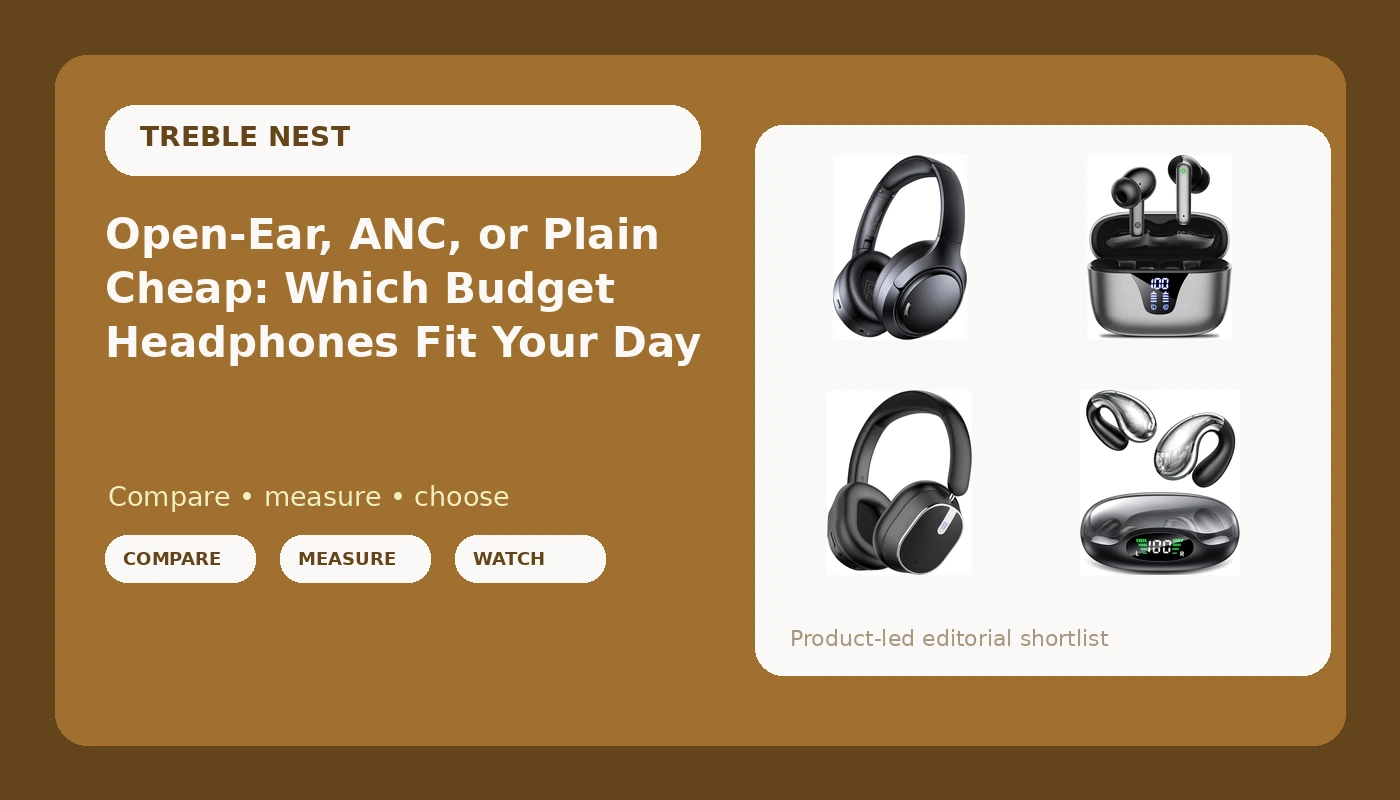
You want one cheap pair of headphones that just works, and instead you get four listings that all shout at you. That is the trap with budget noise cancelling headphones: every product name is stuffed with numbers, every number comes from the manufacturer, and none of them answers the question you actually have, which is whether the thing will survive your commute, your gym bag, and your ears.
I run monitor mixes in small Nashville venues and clean up podcast audio for a living, so my serious listening happens on a reference pair that never leaves the desk. Everything else, walks, chores, the gym, flights, I do on cheap wireless gear. I have been down the review rabbit hole, lost pairs, re-bought the same model three times, and I have small ear canals that hurt easily. That is the lens here. Below are the four options in this batch, and the honest way to tell them apart without trusting a single line of marketing copy.
Related: How Battery Life Claims Work on Budget Earbuds →
Quick answer
There is no single best pick in this group, and any page that names one is guessing. Match the pair to the job instead. For travel, office, and long sessions, the over-ear Hybrid Active Noise Cancelling Bluetooth 6.0 Headphones carries the longest feature list of the four: hybrid ANC, a transparency mode, six ENC microphones, memory foam earcups, and a 120H playtime claim. For the lowest-cost everyday pair, the Wireless Earbuds with the LED display case is the entry point. If you run, lift, or ride and hate anything inside your ear canal, the Boytond Ultra Open Ear Earbuds clip outside the canal instead of sealing it. And if you want noise cancelling in an over-ear shape at the lower cost of the two over-ears here, the Hybrid Active Noise Cancelling Bluetooth Headphones is the budget ANC option. Treat every number above as a claim to test, not a result.
Four useful options
| Model | Best fit | What stands out |
|---|---|---|
| Hybrid Active Noise Cancelling Bluetooth 6.0 Headphones 120H Long Playtime, 6 ENC Mic, Over Ear Headphones Wireless, Hi-Res Audio, Memory Foam Earcup, Transparency Mode ANC Headphone for Travel Office | Travel, office, long listening sessions | Hybrid ANC, transparency mode, 6 ENC mics, 120H playtime claim |
| Wireless Earbuds, 50H Playtime Bluetooth Headphones, LED Display Case | Cheapest everyday pair | LED display case, 50H playtime claim, lowest cost of the four |
| Boytond Ultra Open Ear Earbuds - Clip on Earbuds, Open Ear Headphones with Comfortable Bone Conduction Design, Waterproof Build for Running, Gym Workouts and Outdoor Sports,Crystal Black | Running, gym, outdoor workouts | Clip-on open-ear design, bone conduction style, waterproof build |
| Hybrid Active Noise Cancelling Bluetooth Headphones Wireless Headphones | Budget ANC in an over-ear shape | Hybrid active noise cancelling, over-ear wireless fit |
The travel and office pick: Hybrid Active Noise Cancelling Bluetooth 6.0 Headphones
Over-ears are the right shape for this job because the earcup itself does part of the work: the seal blocks high-frequency noise passively, and the electronics handle the low rumble of engines and air handlers. That is also why the fit matters more than the spec sheet. A memory foam earcup that clamps too hard gives you a headache by hour two, and a loose one leaks the bass you paid for. The 120H figure deserves the same skepticism as any playtime number: it is measured under conditions the listing does not spell out, and ANC on, volume up, and cold weather all pull it down. Charge it, run it at your normal volume for a week, and note the actual hours before you trust it.
The cheapest everyday pair: Wireless Earbuds, 50H Playtime Bluetooth Headphones, LED Display Case
Here is the place to be blunt about the magic case. A 50H figure on earbuds this size almost always means earbud battery plus two or three recharges from the case, not fifty hours in your ears between charges. The case is a charger, not a battery extender, and the LED display is genuinely useful because it tells you where you stand instead of making you guess. The other thing to check on any cheap pair is whether each earbud works on its own, because solo use is the feature you miss most once you have had it, and it is not guaranteed at this price.
The open-ear workout pick: Boytond Ultra Open Ear Earbuds
Open-ear is a compromise, and I would rather say that than pretend otherwise. Nothing seals your canal, so you keep traffic noise and gym announcements, which is the entire point if you run outdoors. The cost is bass: without a seal, low end is thin, and quiet passages get lost in a noisy room. What you gain is comfort for people whose canals ache, plus a fit that does not depend on finding the right tip size. If you have spent years swapping tips and still hurt, this category exists for you, and it is worth accepting the sound trade.
The budget ANC over-ear: Hybrid Active Noise Cancelling Bluetooth Headphones
This is the option for someone who wants the over-ear shape and the noise cancelling circuitry and does not want to pay for the extra claims. The trade is simple: fewer listed features, so fewer things to verify, but also fewer conveniences if you end up wanting a transparency mode or a longer playtime figure. Check the clamp force first, since that is what determines whether you can wear them for a full workday, and check the minimum volume, because a pair whose quietest setting is still loud is useless for late-night listening.
Prices and availability may change. Product images, names, and retailer links are matched to verified listings. No current price, rating, stock status, or measured result is stated here without current evidence.
What the numbers on the box actually mean
Hybrid active noise cancelling means the headphones use microphones on the outside and inside of the cup to cancel noise in two stages. It works best on steady low-frequency sound, the drone of a plane or a fan, and much less well on voices, which is why a cabin gets quieter while a conversation at the next table does not disappear. Transparency mode does the opposite: it pipes outside sound in through the mics so you can order coffee without pulling the headphones off. If a pair lacks it, you are taking them off.
ENC microphones are a different system entirely. They are for the person on the other end of your call, not for you, and the count in the name tells you how many mics the beamforming array uses. Six is a marketing-friendly number; what matters is whether your callers say you sound clear on a street corner.
Bluetooth version numbers are backward compatible, so a newer version works with older phones, and the version alone does not guarantee low latency. Codec support and the phone's own radio decide that. Playtime claims are usually measured at a moderate volume with features off, and case figures include recharges. Open-ear designs skip the seal entirely, which trades bass for comfort and awareness. None of that is a reason to avoid a pair, it is just what the number means before you buy.
How to run your own test in the first week
- Charge everything to full, then run the battery down at your normal listening volume with the features you actually use turned on, and write down the hours.
- Pair one earbud alone, then the other, to confirm independent use works the way you need it to.
- Set volume to the lowest step and listen in a quiet room. If it is still loud enough to hurt, that is a dealbreaker.
- Wear them for a two-week stretch of walks, workouts, and calls. Comfort problems show up on day three, not day one.
- Listen for the power-on announcement and check whether the case claims to extend playtime or simply recharge. Both tell you a lot about the product's manners.
Practical guidance before you order
- Decide the shape first, because over-ear, in-ear, and open-ear solve different problems and no amount of tuning fixes the wrong category.
- Buy from a listing with a return window you can actually use, since fit is the one thing no reviewer can predict for your ears.
- If you have small or sore canals, prioritize open-ear or a pair with several tip sizes over any sound-quality claim.
- Ignore the playtime headline and look for whether the figure is for the buds alone or buds plus case recharges.
- Keep your expectations calibrated: at these prices you are buying reliability, comfort, and a working connection, not reference-grade sound.
Which option should you choose?
Choose the Hybrid Active Noise Cancelling Bluetooth 6.0 Headphones 120H Long Playtime, 6 ENC Mic, Over Ear Headphones Wireless, Hi-Res Audio, Memory Foam Earcup, Transparency Mode ANC Headphone for Travel Office when you want one pair for flights, an open office, and long sessions, and you want the most features available in this group. Choose the Wireless Earbuds, 50H Playtime Bluetooth Headphones, LED Display Case when you want the cheapest everyday pair and a case that tells you its charge at a glance. Choose the Boytond Ultra Open Ear Earbuds - Clip on Earbuds, Open Ear Headphones with Comfortable Bone Conduction Design, Waterproof Build for Running, Gym Workouts and Outdoor Sports,Crystal Black when your ear canals hurt, or when you run outdoors and want to hear traffic. Choose the Hybrid Active Noise Cancelling Bluetooth Headphones Wireless Headphones when you want noise cancelling in an over-ear shape at the lower of the two over-ear costs.
One caveat I will not skip: I have not spent a week living with each of these four, so nothing here is a verdict on their sound, their real battery life, or their fit. Those claims come from the listings, and the checks above are how you turn them into facts you can trust for your own ears.
The bottom line
The right answer depends on which problem you are solving. Noise cancelling and long sessions point to an over-ear pair, and the two here differ mainly in how many features you want to pay for. Portability and price point to the small earbuds with the display case. Ear pain and outdoor workouts point to the open-ear clip-ons, as long as you accept the thinner bass that comes with an unsealed fit. Whichever you pick, judge it on the things the box never tells you: how long it lasts at your volume, how quiet it goes, whether each side works alone, and whether your ears still like it after two weeks.