Shopping for wireless earbuds and on-ear headphones looks like a simple question of shape, and it is not. The real question is what your day looks like: whether you want the world turned down, whether you want one charge to survive a week of commutes, and whether the thing on your head or in your ears stays comfortable past the twenty minute mark. I mix live sound for a living, so my serious listening happens on a pair of over-ears that never leave the desk. Everything else, the walks, the gym, the grocery store, the phone calls from a loud street, runs on budget gear. That split is why I keep sorting this category by behavior instead of by spec sheet.
Related: Ear Tips and Fit: Why Budget Earbuds Hurt and What to Do About It →
Quick answer
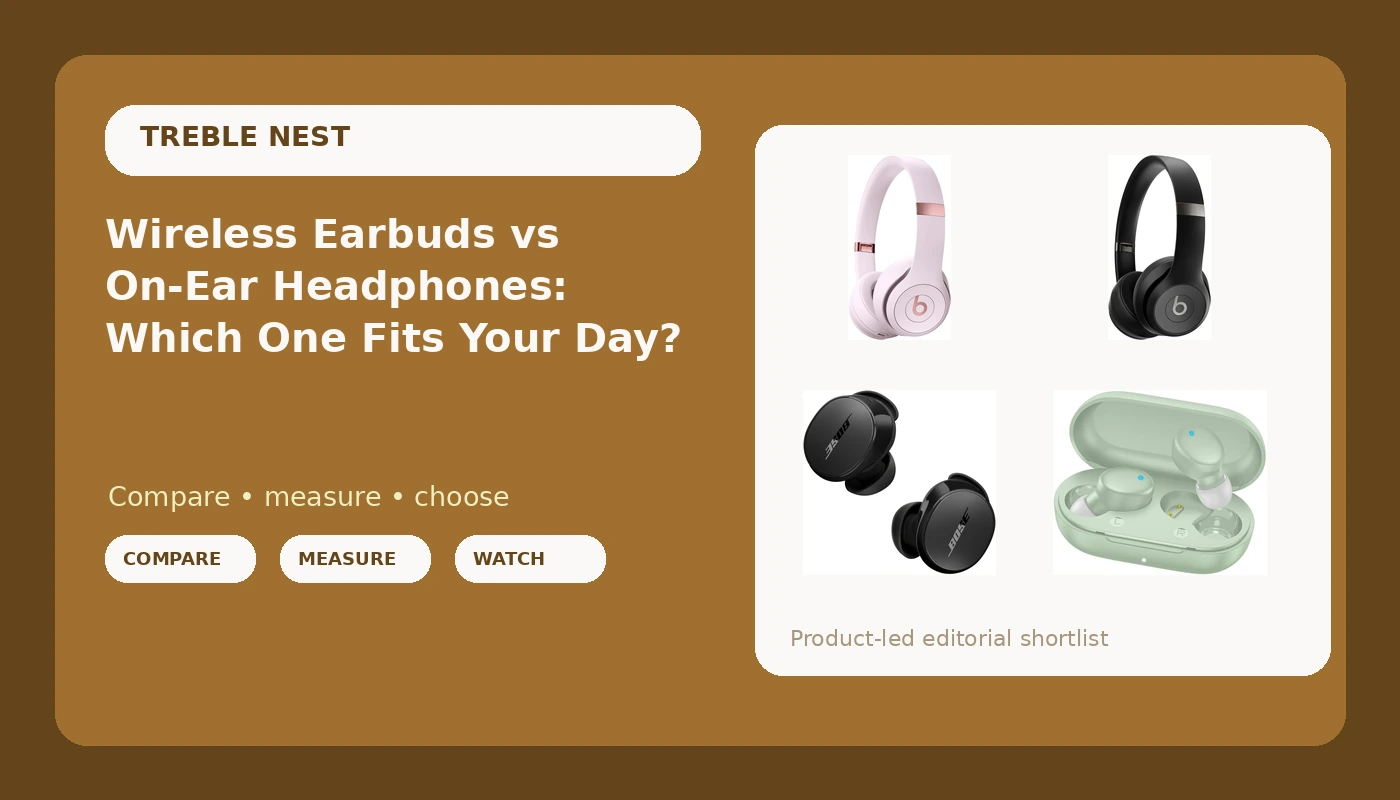
Pick by the job, not by the category. The Bose QuietComfort Earbuds are the pair in this group built around active noise cancellation, with an IPX4 rating and a claimed 8.5 hours of playtime. The Beats Solo 4 is an on-ear design with a claimed 50-hour battery life, which is the number to look at if charging is the thing that annoys you. The MOZOTER Mini Wireless Earbuds sit at the entry end with Bluetooth 5.3. Two of the four options here are the same Beats model in different colorways, so the real decision is between noise cancelling in-ear, long battery on-ear, and the cheapest functional pair.
4 useful options
| Model | Best fit | What stands out |
|---|---|---|
| Bose QuietComfort Earbuds | Commutes and noisy rooms | Active noise cancellation, IPX4 rating, claimed 8.5 hours of playtime |
| Beats Solo 4, Cloud Pink | All-day wear without charging | Claimed 50-hour battery life, on-ear design, Apple and Android compatible |
| Beats Solo 4, Matte Black | Same as above, different finish | Same claimed 50-hour battery and on-ear build in a matte black colorway |
| MOZOTER Mini Wireless Earbuds | Lowest spend that still works | Bluetooth 5.3 and a mini in-ear shape at the entry price tier |
The noise cancelling pick: Bose QuietComfort Earbuds
This is the pair that changes what you hear rather than how long you hear it. Noise cancellation is the feature I care least about at my desk and most about on a bus, in a cafe, or on a plane, because it lets you listen at a lower volume than you otherwise would. That matters to me specifically: my complaint about cheap earbuds has never been that they are too quiet, it is that the quietest setting is still loud enough to feel aggressive. The trade-off with any in-ear is the seal. The seal is what makes the noise cancellation work, and the seal is also what makes small ear canals ache after an hour, so the fit question arrives before the sound question.
The long battery on-ear: Beats Solo 4, Cloud Pink
Battery life is the first spec I check on anything, and it is the reason an on-ear pair deserves a place in this comparison at all. In-ear buds live in a case that has to be charged, and I have written before about how much I dislike case marketing that describes recharging as if it extends playtime into another dimension. Fifty hours claimed is a different kind of number, because it means the charging cable becomes a monthly errand instead of a nightly ritual. The cost is bulk and clamp. On-ear headphones press against the outside of your ear, and some people feel that pressure within an hour. If you have ever been annoyed by a headband, this shape is the risk you are taking.
The same on-ear in black: Beats Solo 4, Matte Black
There is no audio reason to pick between these two listings. Same model, same claimed battery, same on-ear build, different finish. The reason both are here is that colorway stock moves around, and a reader who wants the matte black version should not have to guess whether it exists. My only advice on this decision is boring: buy the color you will not get tired of looking at, because the finish is the one part of the spec sheet you look at every single day.
The budget pick: MOZOTER Mini Wireless Earbuds
The budget tier is where I actually live, and it is where the most bad advice circulates. A cheap pair is not a compromise you apologize for. It is a pair you can lose on a jog and not have a bad week about it. Bluetooth 5.3 is the modern baseline for connection stability and power draw, and a compact in-ear shape is the easiest thing to carry. What a budget pair will not give you is noise cancellation, and it will not give you the fifty-hour runtime of an on-ear. Know that going in and the purchase is straightforward. Expect it to behave like a premium pair and you will be back in the review rabbit hole by Thursday.
Prices and availability may change. Product images, names, and retailer links must be matched by verified ASIN. Do not state a current price, rating, stock status, or measured result without current evidence.
What the battery number on the box actually means
Every runtime figure you see is a claim made under conditions the manufacturer chooses. Volume level, whether noise cancellation is on, which Bluetooth codec is in use, and the age of the battery all move the number. That does not make the claims dishonest. It makes them a ceiling rather than a promise. The practical move is to treat the claimed figure as a starting point and ask what fraction of it you actually need. If your commute is forty minutes each way, a claimed 8.5 hours is roughly a week of trips. If you are on calls all afternoon, that same number is one long day, and the on-ear claim of 50 hours starts looking like the calmer choice.
There is a second layer, and it is the one that bothers me most. Charging cases do not extend playtime. They recharge the buds, which is useful and also completely ordinary. When you see language about a case "extending" your listening, translate it into the plain math: the buds have a runtime, the case holds a certain number of recharges, and the total is the two multiplied. Nothing magical happened. Reading that language correctly saves you from expecting a two-hour pair to become an all-day pair.
Fit, ear tips, and the volume floor
Fit is the spec nobody prints and the one that decides whether you keep using the thing. My ear canals are small and they get sore, so I have a high bar for the word comfortable: it has to survive a two-week stretch of walks and workouts, not a five-minute demo. In-ear models depend on a seal for both bass and noise cancellation, and the wrong tip size breaks both at once. On-ear models avoid the canal problem entirely but introduce clamp pressure instead. Neither shape is universally safe, which is why the honest answer to "which is more comfortable" is "it depends on your head."
The volume floor is the other thing the box will not tell you. Some gear simply cannot go quiet. The lowest setting is still loud enough to feel like an assault at night, and that single flaw can ruin an otherwise fine pair. Test it the day the box arrives. If the quietest step is not quiet enough for a dim room, return it while you still can.
Here is the order I run through before buying anything in this category:
- Decide the shape first: in-ear for portability and noise control, on-ear for runtime and no canal pressure.
- Check the claimed battery life against your actual longest day, not your best-case day.
- Confirm whether noise cancellation is part of the product at all, because it is not a setting you can add later.
- Look for an IP rating if you sweat or get caught in weather.
- Plan on testing the volume floor and the fit within the return window, before you get attached.
Practical guidance before you order
- Write down how many hours a week you actually listen, then compare that to the claimed runtime with some margin subtracted.
- Assume any in-ear pair will need tip experimentation, and give it a week before you decide it hurts.
- If you take calls, weight the microphone and the noise cancellation, not the music tuning.
- Sweat and rain are real: an IPX4 rating is worth having if you work out outdoors.
- Buy the colorway you will still like in six months, since it is the one spec that never gets better or worse.
Which option should you choose?
Choose the Bose QuietComfort Earbuds when you want the environment turned down and you will accept the fit work that comes with an in-ear seal. Choose the Beats Solo 4 in whichever colorway you prefer when charging is the chore you resent most and you want a claimed runtime measured in weeks rather than hours. Choose the MOZOTER Mini Wireless Earbuds when the goal is a compact, current-Bluetooth pair at the entry price tier and you have no expectation of noise cancellation.
One caveat worth stating plainly: I have not put every one of these through my own drain test, and I do not quote measured numbers I have not produced. The runtime figures above are manufacturer claims, and the compatibility and rating details come from the product listings. Your volume habits and your ear shape will move the results more than any review can.
The bottom line
This is not a category with a single winner, it is a category with three jobs. Noise cancelling in-ear for the loud parts, long-battery on-ear for the days you refuse to think about charging, and a cheap Bluetooth 5.3 pair for everything else. Match the product to the job, test the fit and the volume floor inside the return window, and stop reading the fourth review that contradicts the first three. Fine is a perfectly good outcome here, and most people land on it by picking the shape that fits their day instead of the one with the biggest number on the box.