Most people shopping for budget headphones and earbuds are not chasing a hobby. They want something that survives a commute, stays put on a run, and does not introduce itself to the entire train car with a dramatic voice prompt. The trouble is that the category is a maze. Wired, on-ear, over-ear, and true wireless all solve different problems, and the spec sheet rarely answers the questions that decide whether you keep reaching for the thing six months from now.
Here is the honest version of the search. Wired still sounds better than wireless for the money, but the jack situation on phones settled that argument years ago, and adapters die in a drawer. So the real question is not which technology wins. It is which of the four approaches below fits the way you actually listen, and what you are willing to give up to get it.
Related: How Much Battery Life Do Budget Earbuds Actually Need? →
Quick answer
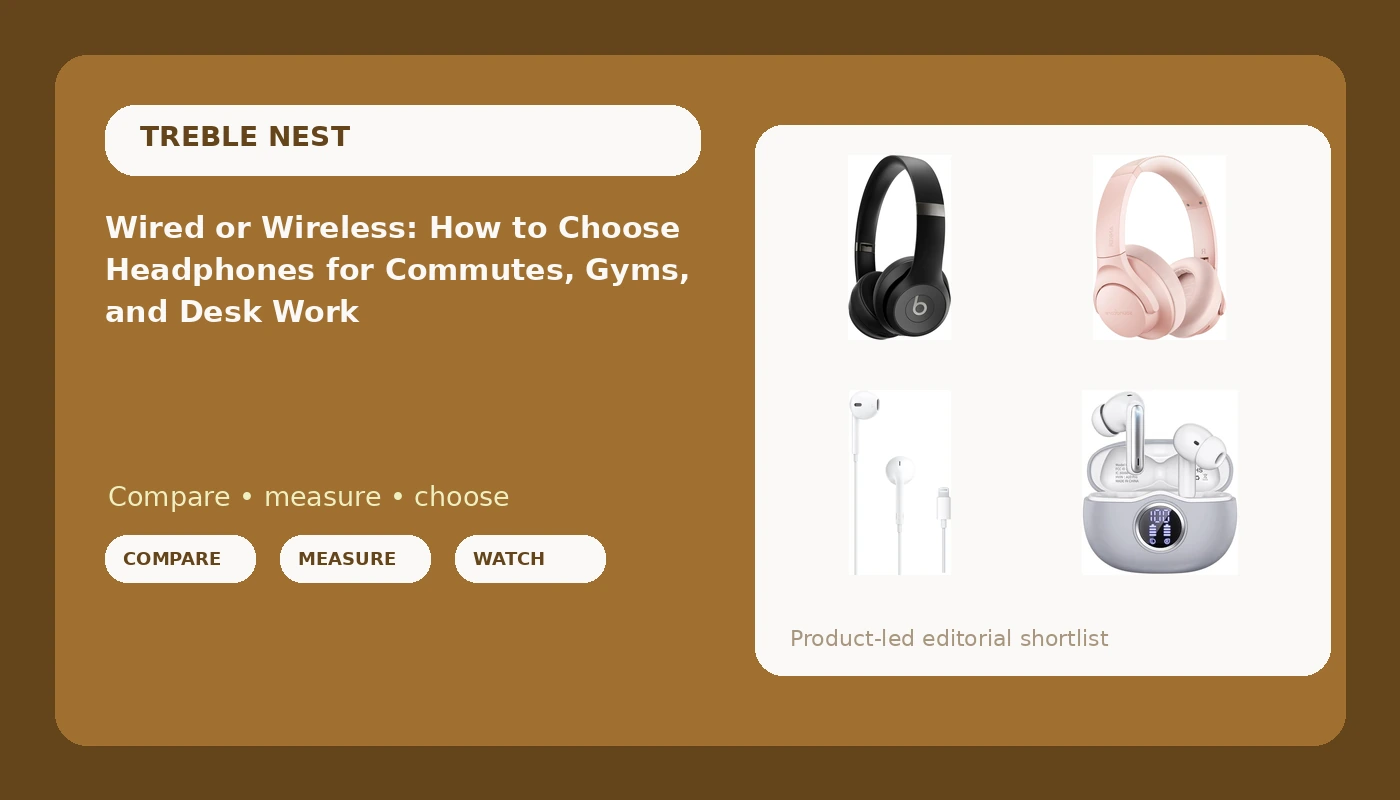
There is no single winner here, because these four solve different problems. If you never want to think about charging and your phone still has a Lightning port, the wired EarPods are the simplest answer. If you want wireless with the longest stated battery life in this group and a lightweight on-ear fit, the Beats Solo 4 is the one to look at. If you want active noise cancelling over foam ear cups for travel or an office, the Soundcore Anker Life Q20 is built for that job. And if you need something that survives sweat and rain at the gym, the A10 Pro is the waterproof true wireless option. Match the shape to the situation first, then compare everything else.
Four useful options
| Model | Best fit | What stands out |
|---|---|---|
| Apple EarPods Headphones with Lightning Connector | Wired listening with no battery to manage | Lightning connector, no charging required |
| Beats Solo 4 - Wireless On-Ear Bluetooth Headphones, Up to 50-Hour Battery Life, Ultra-Lightweight Comfort, Powerful and Balanced Sound, Apple & Android Compatible - Matte Black | Lightweight wireless on-ear use across both phone platforms | Up to 50-hour battery life, on-ear design, Apple and Android compatible |
| Soundcore Anker Life Q20 Hybrid Active Noise Cancelling Headphones, Wireless Over Ear Bluetooth Headphones, 60H Playtime, Hi-Res Audio, Deep Bass, Foam Ear Cups, Travel, Office, USB-C Charging | Travel, office, and long listening sessions | Hybrid active noise cancelling, 60H playtime, foam ear cups, USB-C charging |
| A10 Pro Wireless Earbuds, Bluetooth 5.3 Headphones HiFi Stereo 50H Playback LED Digital Display Ear Buds with ENC Noise Canceling Headset, IPX7 Waterproof Earphones for Gym/Running/Work,Gray | Gym, running, and workouts in weather | Bluetooth 5.3, IPX7 waterproof rating, ENC noise cancelling microphone |
The wired baseline: Apple EarPods with Lightning Connector
The trade-off is the port itself. Lightning is on older iPhones and iPads, and newer devices moved to USB-C, so this is not a universal pick. What you get in exchange is the one thing wireless cannot offer: an unlimited listening session with nothing to charge. For desk work, podcasts, and calls where you are already sitting near the device, that is a genuinely useful kind of freedom.
The lightweight on-ear option: Beats Solo 4
On-ear headphones sit against the ear rather than around it, which is why the lightweight claim matters here. Some people find that pressure comfortable for hours; others find the clamping force annoying after a long session. That is a fit question, not a spec question, and it is the reason you should treat any on-ear model as something to try before committing to a full workday in them.
The noise cancelling over-ear option: Soundcore Anker Life Q20
Over-ear is the shape that most reliably blocks sound, and active noise cancelling is what handles the steady low rumble of engines and ventilation that foam alone cannot. The cost is size. These are not pocket headphones. If you want something you can carry in a jacket and forget about, the on-ear and earbud options are the better fit. If you want to disappear into a mix on a plane, this is the shape to buy.
The waterproof true wireless option: A10 Pro Wireless Earbuds
True wireless means small batteries in each bud, which is exactly why the IPX7 rating matters: moisture is what kills earbuds that live in a gym bag. The trade-off is the size of the cell. Playback figures are measured under specific conditions, so expect the number on the box to describe a best case rather than your average afternoon.
Prices and availability may change. Product images, names, and retailer links are matched to verified listings. No current price, rating, stock status, or measured result is stated here without current evidence.
What the spec sheet will not tell you
Every number above comes from the manufacturer, and manufacturer numbers are measured under conditions that rarely match your day. A playtime figure is usually taken at a moderate volume with noise cancelling off or on depending on how the brand likes to present it. Volume is the variable that moves the number most, and it is the one nobody publishes.
The same goes for "noise cancelling." Active noise cancelling works best on steady, low-frequency sound, engine drone, air conditioning, the hum of a bus. It does much less against a nearby conversation or a crying baby, because those are sudden and higher pitched. A hybrid system, which uses microphones inside and outside the cup, is generally the more thorough approach, but it still cannot make a crowded room silent.
Waterproof ratings are also widely misread. IPX7 describes immersion resistance under test conditions, not a license to swim with your earbuds. Sweat and rain are well within what a rating like that implies. A washing machine is not.
And one category of annoyance never appears on a spec sheet at all: the voice prompt. Some headphones greet you with a loud spoken announcement when they power on, which is unpleasant on a quiet train at 7 a.m. Others use a soft chime. You cannot tell from a listing which one you are getting, so it belongs on your personal checklist.
How to run your own two-week test
Buying is the easy part. Deciding whether to keep a pair is where most people go wrong, because a first impression tells you almost nothing. Give any new pair two weeks of ordinary use and check these five things in order.
- Drain the battery at your normal listening volume, not at a whisper, and note how many days it actually lasts between charges.
- Use each earbud on its own, one at a time, to confirm independent use works the way you expect.
- Test the minimum volume setting late at night. If the quietest step is still loud enough to be uncomfortable, that is a dealbreaker for evening listening.
- Wear them for a full walk and a workout and pay attention to your ear canals, not to the sound. Soreness shows up on day two, not day one.
- Take one real phone call in a noisy place and ask the person on the other end how you sounded.
If a pair survives all five, it is fine. That is the bar, and it is a higher bar than most people apply before they decide to keep something.
Practical guidance before you buy
- Decide the shape before the model. Wired, on-ear, over-ear, or true wireless each rules out a set of situations the others handle well.
- Check the connector on your phone first. A Lightning pair is useless on a USB-C device, and a wireless pair is useless if you forget to charge it.
- Treat stated battery life as a ceiling. Your normal volume and your noise cancelling setting will land below it.
- Prioritize fit over frequency response at this price level. A pair that hurts or falls out gets returned no matter how it sounds.
- Think about where the gear lives. Gym bag, desk, and pocket are three different requirements, and one pair rarely covers all three.
- Ignore the "extends playtime" language on charging cases. A case recharges the buds. It does not add battery capacity to them.
Which option should you choose?
Choose the Apple EarPods Headphones with Lightning Connector when your phone uses Lightning, you are usually near your device, and you want zero charging routine. Choose the Beats Solo 4 when you want wireless on-ear listening with a long stated battery figure and you switch between Apple and Android hardware. Choose the Soundcore Anker Life Q20 when travel or an open office is the main problem and you want over-ear cups with active noise cancelling. Choose the A10 Pro Wireless Earbuds when workouts and weather are the priority and you need something small that can get wet.
Two caveats before you commit. First, battery figures and waterproof ratings here are manufacturer claims, not independent measurements, so plan around them rather than relying on them exactly. Second, fit is personal. Nothing in a listing tells you how a pair will feel on your ears after three hours, and that is the single most common reason a perfectly reasonable set of headphones ends up in a drawer.
The bottom line
The wired-versus-wireless argument is mostly settled by your phone's port, not by sound quality debates. What is left is matching shape to situation: wired for zero maintenance, on-ear for light wireless listening, over-ear with noise cancelling for travel and desk work, and waterproof true wireless for the gym. Pick the one that fits the place you will use it most, run the two-week test, and judge it on whether it stays comfortable and stays charged. Gear that quietly works every day beats gear that looks better on paper.