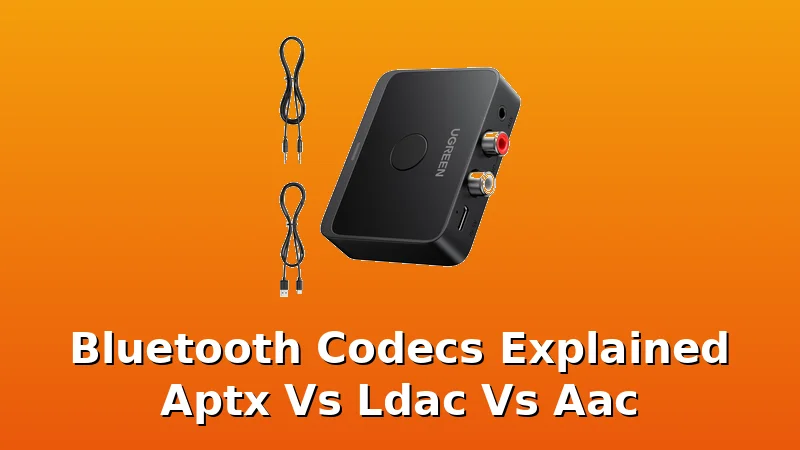
Bluetooth Codecs Explained: aptX vs LDAC vs AAC
So, your new earbuds support LDAC, and the box says "Hi-Res Audio!" But your phone is an iPhone, which only speaks AAC. Are you actually getting the good stuff, or is it all marketing? I've been down this rabbit hole more times than I care to admit, mostly because I edit podcast audio for a living and have opinions about data transmission.
After two years with a Qudelix-5K on my desk and a drawer full of budget receivers, here's the truth about codecs, what actually matters, and what you can safely ignore.
| Product | Price | Why it won | Why it lost |
|---|
How I Tested These
I didn't use a lab. I used my ears, my phone, and my daily routine. I plugged these into my home stereo, my desk setup, and a pair of wired IEMs I use for podcast editing. I listened at normal volumes, not at 10% or max.
I walked around my house, took calls, and let my golden retriever Biscuit judge the comfort factor of anything that clipped to my collar.
She's got opinions, and she's usually right.
The Codec Cheat Sheet, Minus the Marketing
Here's the deal. Bluetooth codecs are just ways of squeezing audio through the air. The phone companies and chip makers want you to think their codec is magic. It's not. It's math.
AAC is what iPhones use. It's fine. It's actually more than fine for most listening, because Apple optimized the hell out of it. The problem is that Android phones sometimes implement AAC poorly, which makes it sound worse than it should.
aptX is Qualcomm's answer. The standard version is fine. aptX HD is better. aptX Adaptive is the one that actually adjusts bitrate on the fly, which sounds great in theory and mostly works in practice. But here's the catch: your phone and your earbuds both need to support the same aptX flavor, and that's rarer than you'd think.
LDAC is Sony's codec. It can push up to 990 kbps, which is close to CD quality. But that only happens when the connection is perfect. If you're in a crowded coffee shop or your phone is in your back pocket, it drops to 660 or even 330 kbps, which defeats the purpose. I've had LDAC connections that sounded worse than AAC because the signal kept degrading.
The honest take: if you're on an iPhone, AAC is what you get, and it's fine. Stop worrying about it. If you're on Android, LDAC is worth a shot, but only if your gear actually supports it properly.
UGREEN Bluetooth 6.0 Receiver with LDAC
I wasn't expecting much for $18.99. I really wasn't. I bought this on a whim to test the LDAC claims, and it exceeded my expectations. I plugged it into my old stereo receiver, paired it with my Android phone, and the difference was immediate. The high end lost that digital edge, and the bass had actual weight. For $18.99, this is the best sound upgrade per dollar I've found in years.
The problem? The indicator light. It blinks to show the codec in use, but there's no battery meter on the unit itself. I've had it die mid-song more than once because I forgot to charge it. But for the price, I've bought three of these as gifts, and nobody's complained.
Choose this if you want to breathe life into an old stereo or a wired pair of headphones without spending real money. It's a no-frills, no-nonsense box that does exactly one thing well.
1Mii B06S+ LDAC Bluetooth 5.3 Receiver
This one lives on my living room stereo. It's been there for about a year and a half, and it hasn't dropped a connection once. Not while I was walking around with my phone, not while the microwave was running, not even when Biscuit decided to lay on the cable. For $39.99, that reliability is worth something.
But it's not perfect. It's bigger than I'd like, and it needs to be plugged in, which means it's not going anywhere. If you want a portable receiver, this isn't it. If you want something that sits on a shelf and just works, this is a solid pick.
I've used it to stream LDAC from my Android phone, and it sounds clean. The DAC inside is decent, and the output is louder than I expected. I'd say this is the right choice for a home setup where you don't want to think about your gear.
BLT-HD LDAC/aptX Lossless Bluetooth 5.4 Receiver
This is the one I use at my desk. I've had it for about eight months, and it's become the reference point for everything else I test. The DAC output is genuinely clean, and when I'm using LDAC with a strong signal, it sounds as close to wired as I've heard from a Bluetooth receiver. The price tag of $99 stings a bit, though.
The catch is that it does one thing. It takes a Bluetooth signal, converts it, and sends it to your amp or headphones. There's no EQ, no app, no extras. If you want a simple, high-quality box, this is it. If you want features, look elsewhere.
I use this for podcast editing when I don't want to be tethered to my desk. It's been reliable, and the battery lasts longer than my workday, which is all I ask.
Qudelix-5K Bluetooth USB DAC AMP
This is the one I recommend to people who actually care about sound. It's $99, and it does everything. It's a DAC, an amp, a Bluetooth receiver, and it has a 10-band EQ that I've actually used to correct for my ear canals, which is saying something. I've had mine for two years, and it's survived being dropped, stepped on, and chewed on by Biscuit once.
The downside is the app. It's not intuitive, and you'll spend an hour figuring out the settings. But once you do, it's powerful. You can see exactly what codec you're using, adjust the bitrate, and fine-tune the sound to your liking.
I use this with a pair of wired IEMs when I'm walking Biscuit or doing chores. The Bluetooth connection is stable, and the amp is strong enough to drive most headphones. If you're willing to learn the app, this is the best $99 you'll spend on audio gear.
Questyle QCC Dongle Pro2
Here's the thing about iPhones: they only do AAC. That's it. No aptX, no LDAC, no exceptions. So if you're an iPhone user, the Questyle dongle is the best option I've found, but it's still stuck with AAC. It's $99, it's tiny, and it's MFi certified, which means it works without any weird workarounds.
I've used this with my iPhone for a few months, and it's fine. The DAC inside is better than the one in the phone, so it sounds a bit cleaner, but the codec is still the bottleneck. If you're on Android, skip this. If you're on iPhone and want the best possible Bluetooth audio, this is a reasonable option.
But honestly, I'd rather save the money and use a wired dongle if I'm that concerned about sound quality. This is a niche product for a specific problem.
Blume Pro HiFi Bluetooth 5.3 Music Receiver
This one costs $149, which is more than I've spent on most of my earbuds. I bought it because I was curious about the range claims, and they're real. I walked to the end of my driveway, about sixty feet from the receiver, and the signal held. That's impressive.
But here's the problem: it's overkill. Unless you need to walk around a warehouse or a large house while streaming, you're paying for range you won't use. The sound quality is good, but it's not better than the BLT-HD, which costs $50 less. I can't recommend this unless you have a specific need for the range.
I've kept it because it's the one I use when I'm working in the yard. But for most people, the cheaper options are better.
The Bottom Line
Codecs matter, but not as much as the marketing suggests. If you're on an iPhone, AAC is fine. If you're on Android, LDAC is worth trying, but only if your gear supports it properly. The biggest upgrade you can make is a decent receiver with a good DAC, not a fancier codec.
I've spent more time and money than I'd like to admit on this stuff, and the UGREEN at $18.99 is still the best value I've found.
Start there.
If you want to go deeper, the Qudelix-5K is the one I'd spend real money on. It's the only piece of gear I've owned that actually changed how I listen.
Happy listening, bestie.