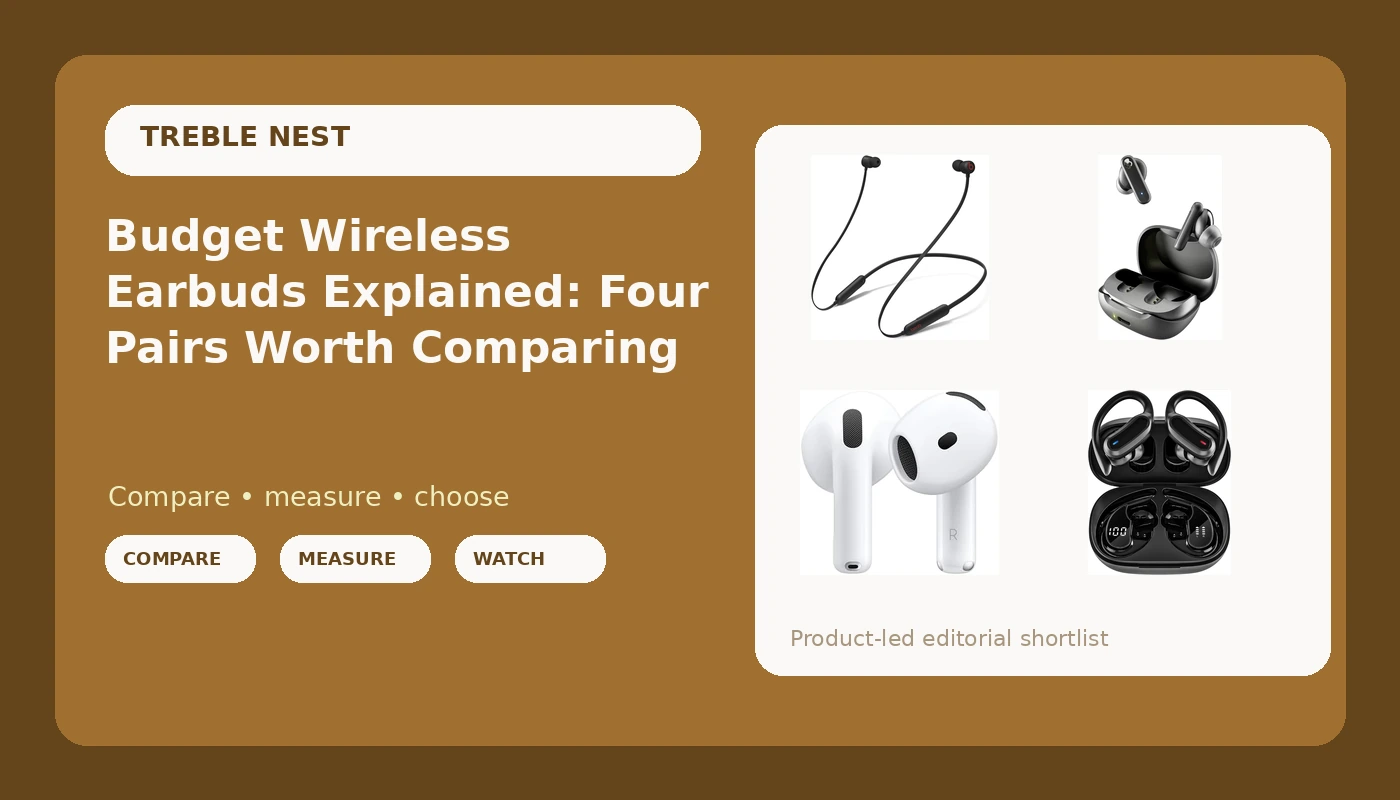
Budget wireless earbuds are a category where the box and the real experience barely overlap. You can line four pairs up, read every bullet point on every package, and still not know which one will make it through a two mile walk without hurting your ear canals or dropping the connection at a busy crosswalk. The four models below cover most of what people actually buy: a mainstream Apple pair, a magnetic set from Beats with an Apple chip inside, a low cost Skullcandy option, and a sport focused design with ear hooks and a stated 54 hour playtime. None of them is a reference monitor, and none of them is trying to be. What they are is a set of workable daily choices, and this guide breaks down what separates them so you can match a pair to the way you actually listen.
Related: How to Check Earbud Battery Life Before You Buy →
Quick answer
These four pairs are not competing for the same buyer, so the useful answer is a set of matches rather than a single winner. The Apple AirPods 4 are the low friction choice if your phone, tablet, and laptop are all Apple. The Beats Flex are worth a look if you want magnetic earbuds with a manufacturer stated 12 hours of listening time and a built in microphone for calls. The Skullcandy Smokin’ Buds are the simple, noise isolating option at the low end of this group. The ear hook sport model is the one to consider when running and workouts are the main event, with an IPX7 waterproof rating, ENC noise cancelling, an LED power display, and a stated 54 hour playtime figure. Every number below is a manufacturer claim, not a measured result, and the only numbers that count are the ones you confirm during the return window.
Four useful options
| Model | Best fit | What stands out |
|---|---|---|
| Apple AirPods 4 Wireless Earbuds | Apple device owners who want minimal setup | Apple's own wireless earbuds, built to pair with Apple hardware |
| Beats Flex Wireless Earbuds - Apple W1 Headphone Chip, Magnetic Earphones, Class 1 Bluetooth, 12 Hours of Listening Time, Built-in Microphone - Black | Commutes and phone calls | Apple W1 headphone chip, magnetic earbuds, stated 12 hours of listening |
| Skullcandy Smokin’ Buds Wireless Noise Isolating Earbuds - True Black | Everyday listening on a tight budget | Noise isolating design in a straightforward wireless earbud |
| Wireless Earbuds Bluetooth Headphones, 54H Playtime Stereo Over Ear Buds with ENC Noise Cancelling, LED Power Display, IPX7 Waterproof Sport Earphones with Earhooks for Running/Workouts (Black) | Running, gym work, and sweaty weather | Ear hooks, IPX7 waterproof rating, ENC noise cancelling, LED power display |
The iPhone-first pick: Apple AirPods 4 Wireless Earbuds
The trade off here is that you are paying for the ecosystem, not for ruggedness. There is no ear hook, no IPX7 rating printed on this model, and nothing in the product description aimed at gym work. If your listening is commuting, calls, podcasts, and laptop video, that is fine. If your listening happens in the rain or on a treadmill, the sport model further down this page was built for exactly that. The other thing to watch is fit: AirPods sit in the ear rather than sealing the canal, which is comfortable for some people and loose for others, and no spec sheet can tell you which group you are in. Buy from a seller with a return window and wear them on a real walk before you commit.
The magnetic neckband pick: Beats Flex Wireless Earbuds
Two things are worth separating out. Class 1 Bluetooth is a range and power classification, not a sound quality rating, so do not read it as a promise about how these sound. And the stated 12 hours is a manufacturer figure for listening time, which is the kind of number you should treat as a ceiling rather than an average. The real advantage of this design is that there is no separate charging case to keep track of, which matters if you are the person who loses small objects. The real disadvantage is that a neckband style is not for everyone, and people who want nothing touching their neck should look at the true wireless options instead.
The low cost pick: Skullcandy Smokin’ Buds Wireless Noise Isolating Earbuds
Noise isolation is entirely a fit story. A sealed tip that sits properly in your canal will block a decent amount of bus noise and office chatter. A tip that sits slightly loose will block almost nothing, and the pair will feel like it is not working. That is why the tip selection process matters more on a pair like this than on anything else on the page. It also means the isolation varies from person to person, because ear canals are not the same size or shape. If you have small canals that get sore, plan on trying every included tip size and expect the smallest one to be the one you land on.
The workout pick: Wireless Earbuds Bluetooth Headphones with Earhooks
Two clarifications before you buy. First, IPX7 is a water resistance rating, not a durability guarantee, so treat it as protection against sweat and rain rather than an invitation to swim. Second, a stated 54 hours is almost certainly a combined figure that counts recharges from the case, not 54 hours from a single charge. That is normal for this category, but it is worth understanding before you compare it against the Beats figure, which is described differently. The ear hook shape also means a bulkier fit than the other three, which some people love on a run and dislike while lying on a couch.
Prices and availability may change. Product images, names, and retailer links must be matched by verified ASIN. Do not state a current price, rating, stock status, or measured result without current evidence.
What the spec sheet never tells you
Every product page in this category leads with numbers, and almost none of the numbers answer the questions that decide whether you keep a pair. Battery capacity is listed, but not battery life at the volume you actually listen at. Bluetooth version is listed, but not whether the connection holds when you turn your head at a crosswalk. Water resistance is listed, but not whether the ear hook starts to ache after forty minutes.
There are five questions that predict satisfaction better than any spec:
- How long does the battery last at your normal listening volume? Box numbers are usually measured at moderate volume with features turned off. If you listen loudly or take a lot of calls, expect less.
- Can each earbud be used on its own? Some models let you take one out and keep listening, which is genuinely useful for calls and for stretching battery across a long day.
- How quiet is the quietest setting? This is the most under reported specification in the budget tier. A pair whose minimum volume is still loud is unusable for night listening or for anyone with sensitive ears.
- Does the shape survive your ears for a full week? Fit is not a spec, it is a two week experiment, and small or easily sore canals are the most common reason people give up on otherwise decent earbuds.
- Does anything obnoxious happen when it turns on? A loud voice announcement at full volume in a quiet room is the kind of detail that ruins daily use, and no product page mentions it.
None of those five items can be answered by reading. They can all be answered in the first week of ownership, which is why the return window is the most important feature of any pair you buy.
How to read playtime and charging case claims
Playtime figures are the most misunderstood numbers in the earbud market. A single charge figure describes how long the buds run before they need to go back in the case. A combined figure describes total listening time when you count recharges from the case. A 54 hour claim and a 12 hour claim can describe completely different things, so comparing them directly tells you almost nothing.
It also helps to stop thinking of a charging case as extra battery life. A case does not generate power. It stores a reserve and hands it back to the earbuds when they are docked. Marketing language that describes a case as extending playtime is describing recharging with more flattering words, and it leads people to expect more from a single charge than the hardware can deliver.
Class 1 Bluetooth, which appears in the Beats listing, is a radio classification. It relates to range and transmit power, not to how a track sounds. Codec support is the spec that affects audio quality and latency, and latency is the number that matters if you watch video, since a delayed audio stream is obvious and annoying in a way that a slightly different frequency response is not.
Fit, sweat, and daily handling
- Try every included ear tip size in both ears. Left and right canals are often different sizes, and the correct combination is frequently not a matching pair.
- Pick shape by activity. Ear hooks are for running, lifting, and anything where you sweat and move. Sealed tips are for transit and offices where you want to block noise.
- Treat IPX7 as sweat and rain protection. Rinse and dry the buds after a hard workout rather than assuming the rating covers everything.
- Test the minimum volume before the return window closes. Night listening and quiet rooms expose problems that a loud commute hides.
- Keep the packaging and the receipt until you have used the pair for a full week of real walks, real workouts, and at least one real phone call.
Which option should you choose?
Choose the Apple AirPods 4 Wireless Earbuds when your devices are Apple and you want the least setup friction, with no interest in ear hooks or a neckband. Choose the Beats Flex Wireless Earbuds when you want magnetic earbuds that hang together, a built in microphone for calls, and a design with no separate charging case to keep track of. Choose the Skullcandy Smokin’ Buds when you want a straightforward, noise isolating wireless pair and you are comfortable selecting tips carefully to get the seal right. Choose the Wireless Earbuds with Earhooks when workouts are the primary use, and the IPX7 rating, ENC call processing, and LED power display matter more to you than a slim fit.
One caveat applies to all four. Every figure on this page comes from manufacturer product information, and nothing here is a measured result from a controlled test. Battery life, fit, and call clarity all depend on your ears, your volume, and your environment, so the only reliable evaluation is your own during the return period.
The bottom line
There is no single best budget wireless earbud here, and anyone who tells you otherwise is guessing about your ears. There is a best match for how you listen. Apple users who want minimal setup should start with the AirPods 4. Anyone who wants magnetic earbuds, a stated 12 hours, and no case to lose should look at the Beats Flex. Shoppers who want a simple, noise isolating pair at the low end should consider the Skullcandy Smokin’ Buds. Runners and gym regulars should start with the ear hook sport model and its IPX7 rating and stated 54 hour playtime. Whichever you pick, buy where returns are easy, run the five questions in your first week, and let your own ears make the final call.