I held onto a 3.5mm jack for years. I get it. Wired still sounds better, and I will argue that with anyone who wants to have the conversation. But the adapters die, the phone ports went away, and eventually you make peace with the practical reality. If you are shopping the budget wireless earbuds aisle right now, this is the guide I wish somebody had handed me before I spent three years and four pairs figuring it out.
Most buying advice starts with frequency response. That is the wrong first question. The right first question is whether the pair will still be in your ears and still holding a charge three months from now. Battery life, fit, and the volume floor decide whether you actually use the thing. Sound quality decides whether you enjoy it. Both matter, but only one of them makes the other possible.
So here is the how-to: what to read on the listing, what to check in the first two weeks, and the two pairs currently sitting on my shortlist for two very different kinds of buyer.
Why you should trust me
I do live sound and recording editing around Nashville. Monitor mixes in small venues, podcast cleanup at the desk. My reference pair is a set of Sony over-ears that cost real money and never leave the house. For everything else, walks, chores, the gym, the commute, I live in the budget tier, and I have been through it.
I have bought the Soundcore P20i three times. Lost one pair after a year, lost the second after a year and seven months, and I would buy a fourth tomorrow if these disappeared. That is the highest praise I hand out. I also have small, easily sore ear canals. Every pair hurts at first. So when I say a set of earbuds is comfortable, I mean it survived my ears for two weeks, not that it felt fine for ten minutes in a store.
I pay for my own gear. No sponsorship, no free samples, no picks chosen because the commission is better. I write this to save you the rabbit hole I fell down, where every review contradicts the last one and you end up more confused than when you started.
How I picked and how I tested
The shortlist below is not a ranking of every pair on the internet. It is two designs that solve two different problems, plus the test protocol I run on anything before it earns a permanent spot in my bag.
Here is what I check, in order:
- Battery drain at normal listening volume, not the number on the box.
- Independent earbud use. Does one bud work alone while the other sits in the case?
- The volume floor. How quiet is the quietest setting?
- Fit across a two-week test, walks and workouts included.
- Bluetooth stability. Dropouts at the gym, lag on video.
- Power-on announcements. Soft chime or shouting receptionist?
- Case math. Does "extends playtime" mean anything beyond recharging?
The spec sheet answers none of these questions. That is the whole point of the list.
The two pairs on my shortlist
One is built to stay put when you are moving. One is built to shut the world out. Those are different jobs, and buying for the wrong one is how people end up disappointed in gear that was never meant for them.
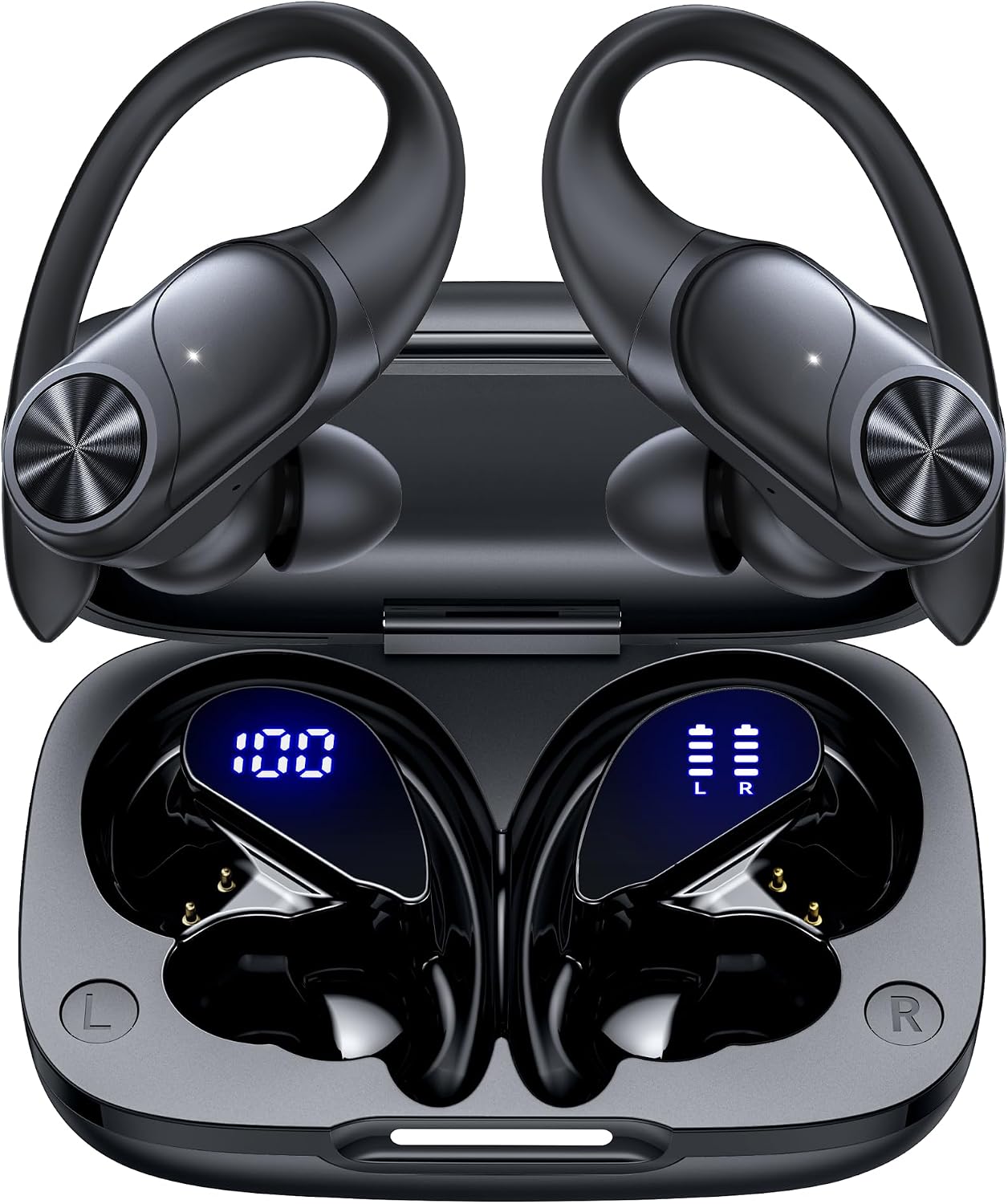
The sport pick: PocBuds Bluetooth Headphones Wireless Earbuds 80hrs Playtime Wireless Charging Case Digital Display Sports Ear Buds with Earhook Deep Bass IPX7 Waterproof Over-Ear Earphones for TV Phone Laptop Black
 Visit on Amazon →
This is the pair I point at when someone tells me their buds fall out mid-run. The earhook is the entire idea: a hook that wraps over the top of the ear instead of trusting a silicone tip alone to hold the bud in place. For lifting, trail walks, and anything where you are bouncing, that mechanical hold does work a tip cannot do by itself.
The case has a digital display, and that is the one gimmick I will defend. You can see the charge level instead of guessing at a blinking light and hoping. The name claims 80 hours of playtime and an IPX7 waterproof rating. Both deserve translation before you buy, and I get into that in the workflow below.
Flaws but not dealbreakers: The 80-hour figure is buds plus case recharges, so read it as total capacity, not one sitting. An earhook is a fit decision rather than a universal upgrade, and if your ear canals run small, the hook is the part to check first, because a hook that presses is worse than a tip that slips. Buy from somewhere with a return window and wear them for an hour before you commit.
Anyone who sweats, moves, and has lost a bud to a storm drain will get the most out of this design.
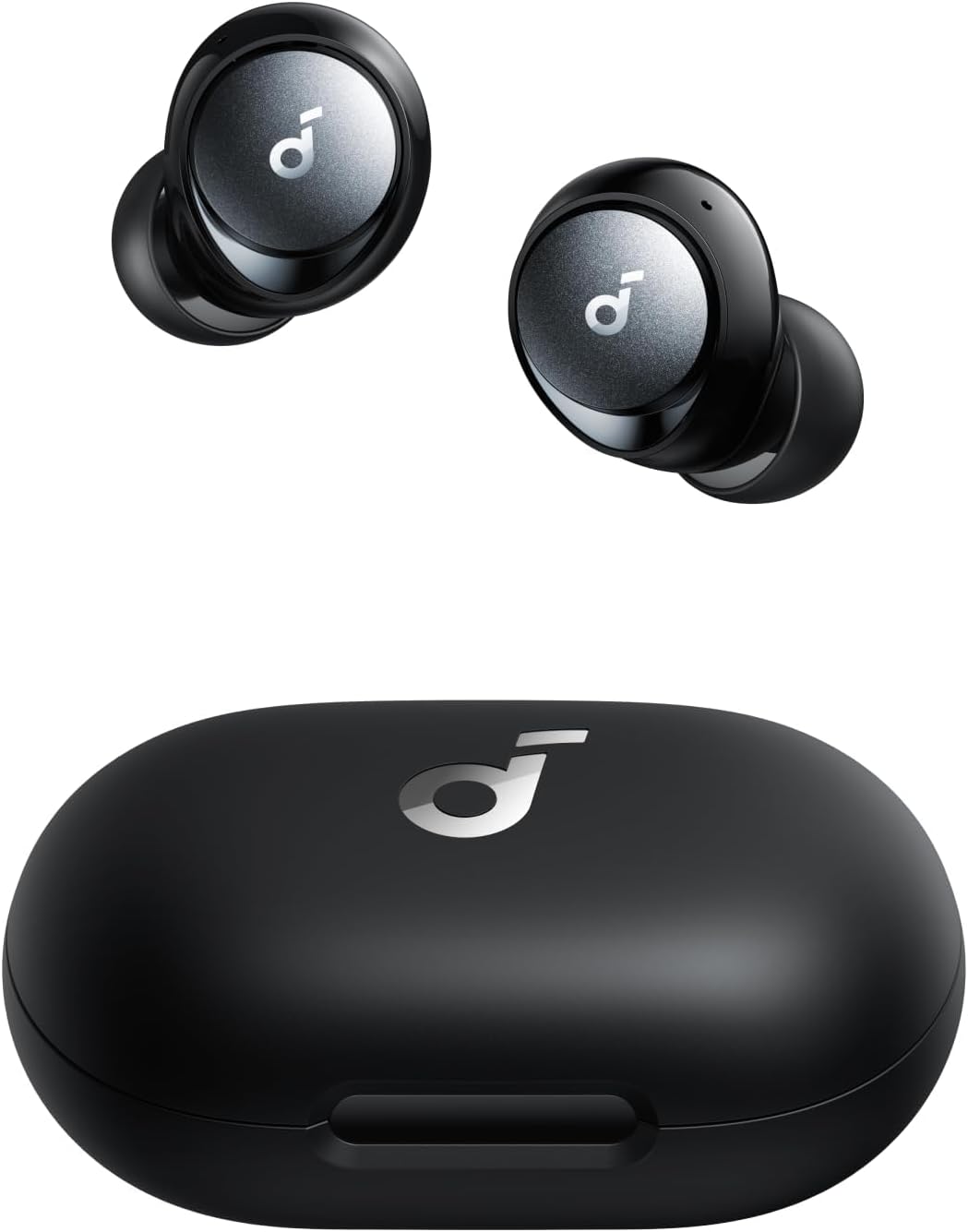
The everyday pick: Soundcore by Anker Space A40 Adaptive Active Noise Cancelling Earbuds
 Visit on Amazon →
This is the commuter pair. Adaptive active noise cancellation in a sealed in-ear design, which means the tip blocks what it can physically block and the electronics clean up what is left. Adaptive matters more than people give it credit for, because the amount of cancellation that helps on a plane is not the amount that helps in a quiet office.
Here is the honest part about ANC in this price bracket: the seal does most of the work. A perfect seal with modest electronics beats a mediocre seal with clever electronics, every time. That makes tip selection the single highest-value thing you can do with this pair, and it makes my small-ear-canal problem the exact thing I would test first.
Flaws but not dealbreakers: Noise cancellation adds a slight pressure sensation that some people feel in their sinuses, and no amount of tuning removes it entirely. If you have never worn ANC in-ears, give yourself a week before you decide you hate it. The volume floor still applies here, and I would check it before anything else.
Anyone on a bus, a train, or in an open-plan office who wants the room to get quieter without turning the music up will want this style.
The actual workflow: how to vet a new pair in two weeks
Now the part you came for. This works on any pair, at any price, and it takes two weeks of normal life rather than an afternoon of sitting still.
Step one: Read the name, not the badge. "80hrs playtime" almost always means the buds plus repeated case recharges. The case does not extend battery life into another dimension. It recharges the buds, which is a useful thing, and it is also a thing every case does. Do the math on the single-charge number, because that is what gets you through a day.
Step two: Set the volume floor before anything else. Play something quiet and drop the volume to its lowest setting. If the minimum is still loud enough to blast your eardrums at 11pm, that is a dealbreaker, not a quirk. Send them back. You will not get used to it, you will just stop wearing them at night.
Step three: Run the drain test at your normal volume. Charge to full, play at the level you actually listen at, and note when the first low-battery warning lands. The box number is measured at a volume nobody uses. Your number is the only one that matters.
Step four: Test each bud alone. Take one out, drop it in the case, and see whether the other keeps playing. Independent use is the feature I did not know I needed until I had it, and once you have it, losing it feels like a downgrade.
Step five: Take a call from a sidewalk. Call clarity claims only show up on a noisy street with wind and traffic. Call someone who will be honest with you and ask whether you sound like a person or like a drive-through speaker.
Step six: Wear them for two weeks. Walks, workouts, dishes, groceries. Day one comfort means nothing, because everything feels fine for twenty minutes. Day ten is the data.
Step seven: Walk away from the phone. Leave the source on a table and walk to the far end of the house. Bluetooth range on paper assumes a clear line of sight, and walls do not care about the version number.
Step eight: Check the controls with cold hands. Touch panels that ignore half your taps mean you will grab your phone anyway, which defeats the point. Test them while walking, not while sitting at a desk.
If a pair passes all eight, keep it. If it fails step two, that is the only one that ends the relationship immediately.
The competition and why it lost
The generic no-name pair. Lag, dropouts, battery that quits after a couple of hours, and a minimum volume loud enough to hurt. The cheapest listing is not a bargain, it is a subscription to frustration. I have made this mistake so you do not have to.
Open-ear buds. These sit outside the canal, and for years they were my compromise because nothing in my ears stayed comfortable. They solved the pain and charged me in sound quality. I got tired of pretending that trade was even.
Wired with an adapter. Still the best sound per dollar, and I keep a wired pair at the desk for editing work. But the adapters die on you, and the phone moved on, so wired is a desk answer now, not a pocket answer.
Over-ears at the gym. Heat, sweat, and a headband that slides down your forehead during a set. Fine at a desk, wrong on a treadmill.
What this all costs
Both pairs here sit in the budget tier, which is the entire point. Check current Amazon price on each before you decide, because that number moves and I do not print prices that go stale.
The math that actually matters is cost per day, not cost per pair. Divide what you pay by the number of days you will use them. A pair you wear daily for two years comes out to pennies a day. A pair you stop wearing after a month is expensive at any price, even if it was cheap at checkout.
That is why the two-week test matters more than the review score. You are not buying a spec sheet. You are buying the thing you will reach for on the way out the door, and the only way to know whether you will reach for it is to live with it for a while.
Do the eight checks once, on the pair you actually bought, and you will stop reading reviews for good. That is the goal. Buy something that is fine, wear it until it dies, and buy the same one again.