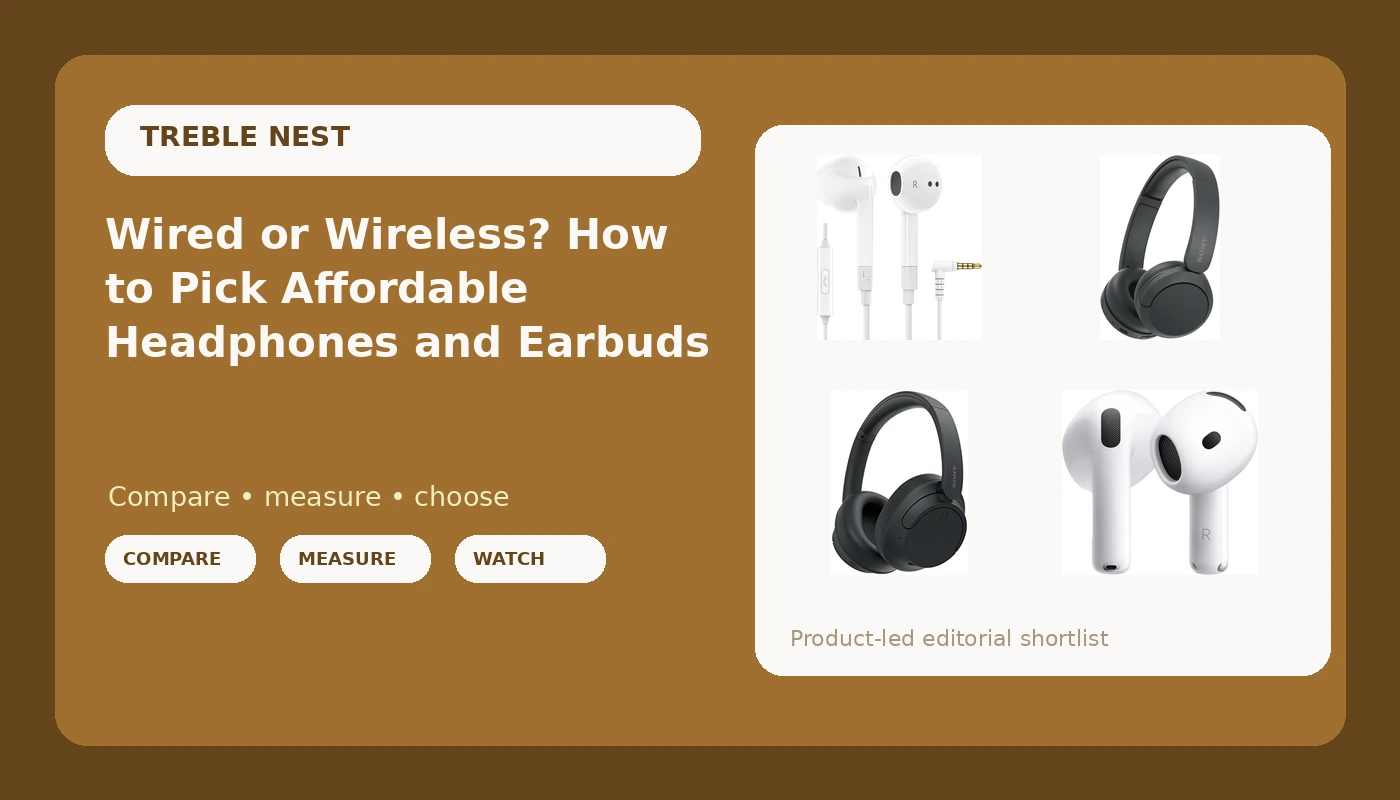
Most people shopping for affordable headphones and earbuds do not have a sound quality problem. They have a decision problem. The reviews contradict each other, the spec sheets all read the same, and the one thing you actually need to know, whether the pair will survive your commute and your ear canals, is never printed on the box. I spent years on the wired side of this argument. I held onto a 3.5mm jack because wired headphones sound better, and they do, and then I burned through one adapter after another until the phone stopped accepting them at all. That is the trade most buyers are facing now. The four options below cover the realistic paths: a corded pair, a budget Bluetooth on-ear, a noise cancelling over-ear, and Apple's wireless earbuds. None of them is right for everyone, and the point of this piece is to work out which problem you actually have.
Related: Wired vs Wireless: What Actually Matters for Daily Listening →
Quick answer
Start with your phone, not the spec sheet. If the device you listen on still has a 3.5mm jack and you do not mind a cable, a wired pair gives you the least to manage: nothing to charge, nothing to pair, and nothing that can be lost one half at a time. If there is no jack, you are choosing between wireless earbuds and wireless headphones, and the deciding factors become battery life at your normal volume, whether each earbud works on its own, how quiet the lowest volume setting goes, and whether the fit survives a long walk. Noise cancelling is a separate question from sound quality, and the Sony WH-CH720N is the only option here that includes it. The Apple AirPods 5 make the most sense if you already carry an iPhone, an iPad, or a Mac. The LUDOS FEROX Wired Earbuds are the pair to look at when a jack is available, when the listener is a student or a kid, or when you want a backup that never needs charging.
Four useful options
| Model | Best fit | What stands out |
|---|---|---|
| LUDOS FEROX Wired Earbuds | Phones, laptops, and school devices that still have a 3.5mm jack | Corded in-ear design with an inline microphone, noise isolation, and a five year warranty |
| Sony WH-CH520 | All-day Bluetooth listening without paying for noise cancelling | Wireless on-ear fit with a built-in microphone |
| Sony WH-CH720N | Commutes, flights, and open offices | Wireless over-ear design with active noise cancelling |
| Apple AirPods 5 | iPhone, iPad, and Mac owners who want no cable at all | Apple's own true wireless earbuds |
The wired holdout: LUDOS FEROX Wired Earbuds
The case for wired is not nostalgia. A cable cannot run out of power mid-call, it does not introduce Bluetooth latency when you are watching video, and there is no voice announcement shouting at you when you switch it on. The cost is the cable itself. It snags on door handles, it needs a jack or an adapter, and on most recent phones the adapter is an extra part that fails sooner or later. If your laptop, your tablet, or your kid's school device still has a 3.5mm port, that entire problem disappears. This is also the pair to consider if you lose earbuds regularly, because replacing a corded set stings far less than replacing a wireless one.
The budget Bluetooth on-ear: Sony WH-CH520
On-ear is the compromise position, and it is worth understanding before you buy. You get the convenience of wireless and a microphone for calls, and you give up the passive isolation an over-ear cup provides. In a noisy office or on a plane, an on-ear model asks more of the volume dial. What matters with any Bluetooth headphone is battery life at the level you actually listen at, not the number on the box, because box numbers are measured under conditions that are rarely yours.
The noise cancelling over-ear: Sony WH-CH720N
Noise cancelling earns its keep on steady, low-frequency sound: engine drone, air conditioning, the hum of a bus. It does much less against a coworker's conversation or a crying baby. It also drains battery faster than listening with it switched off, so plan around the version of the headphone you will actually use most. The other thing to know about over-ear designs is clamp force. A tighter fit blocks more sound and, past a certain point, starts to hurt, which is the one specification no listing can give you.
The wireless earbuds: Apple AirPods 5
Two things decide whether a true wireless pair works out for you, and neither of them appears in the marketing. The first is whether each earbud can be used on its own. Independent use sounds like a small feature until you have it: one bud in while the other charges, one bud in while you take a call with a hand free. The second is how easily the pair gets lost. There is no cable to catch them and no headband holding them together, and earbuds that leave a pocket quietly are the ones you end up buying twice. If you lose things, that belongs in the decision.
Prices and availability may change. Product images, names, and retailer links are matched to verified listings. No current price, rating, stock status, or measured result is stated here without current evidence.
The jack question comes first
Before you compare anything, check the port on the device you listen on most. This single question eliminates half the list. A 3.5mm jack means a corded pair is available to you with no adapters, no charging, and no pairing. A phone without one pushes you toward wireless or toward a dongle, and dongles are a failure point. I have owned several, and none of them outlived the headphones they were attached to. They bend at the plug, they get lost, they stop being recognized, and they cost money every time you replace one.
If most of your listening happens on a laptop, the jack is probably still there and the corded option becomes simple again. Wired also keeps the advantage on latency and on power: a cable cannot lag behind a video and cannot die three hours into a flight. The reason wireless won anyway is not sound quality. It is that the port disappeared and the adapters did not survive.
What wireless asks of you in return
Going wireless means taking on a set of maintenance tasks a cable never asked of you. Battery life is the first, and the number that matters is the one you observe yourself at normal volume, not the one on the box. The second is the volume floor. Some pairs stay loud at their quietest setting, which makes them useless for late-night listening; a pair that can go properly quiet is worth more than one that can go loud. The third is pairing behavior: does it reconnect on its own, does it hold a connection when you walk away from your phone, does each earbud work alone. The fourth is the announcement voice, because a model that greets you at full volume will become a nightly annoyance. The fifth is the charging case, which recharges the earbuds and does not extend battery life into another dimension, whatever the listing implies.
Run these five checks before you buy anything wireless:
- Battery life at your normal listening volume, watched over several days rather than trusted from the box.
- Independent earbud use, if you want to take calls with one ear free.
- The minimum volume setting, tested in a quiet room at night.
- Fit over a long walk or a workout, not five minutes in front of a mirror.
- Reconnection behavior and latency when you move between phone, laptop, and video.
Practical guidance for the first two weeks
- Give a new pair a full week of real use before you decide: walks, chores, calls, and at least one long session.
- Test the volume floor in a quiet room. If the quietest setting is still loud, that is a return, not a compromise.
- Check whether each earbud works alone if you take calls, and whether the microphone stays clear on a busy street.
- If your ears hurt with the tips in the box, try the other sizes before giving up on the model. Small ear canals are common and the tip is often the culprit, not the earbud.
- Treat "extends playtime" as a description of a charging case, not of battery life, and plan your day around the earbuds themselves.
Which option should you choose?
Choose the LUDOS FEROX Wired Earbuds when your device still has a 3.5mm jack, when the listener is a student or a kid, or when you want a pair that never needs charging. Choose the Sony WH-CH520 when you want wireless freedom and a microphone without paying for noise cancelling. Choose the Sony WH-CH720N when the room around you is the problem and you want it turned down on a commute or a flight. Choose the Apple AirPods 5 when you are already in Apple's ecosystem and want the smallest, most pocketable option of the four.
What none of this can tell you is how any of them will feel on your head or in your ears after two hours, and that is the part of the decision no listing can make for you. Treat the specifications as a filter and your own fit test as the verdict.
The bottom line
If you have a jack, a corded pair is the lowest-risk purchase in audio: nothing to charge, nothing to pair, and a replacement cost that does not hurt. If you do not have one, the choice narrows to what you need the headphones to do. The Sony WH-CH520 covers calls and everyday listening on a budget. The Sony WH-CH720N covers noisy rooms. The Apple AirPods 5 covers Apple owners who want nothing in their pocket but a small case. The LUDOS FEROX covers everyone who still has a port and does not want to think about any of this again. Pick the one that solves your actual problem, then stop reading reviews, because the rabbit hole does not end and the headphones do not improve while you are down there.