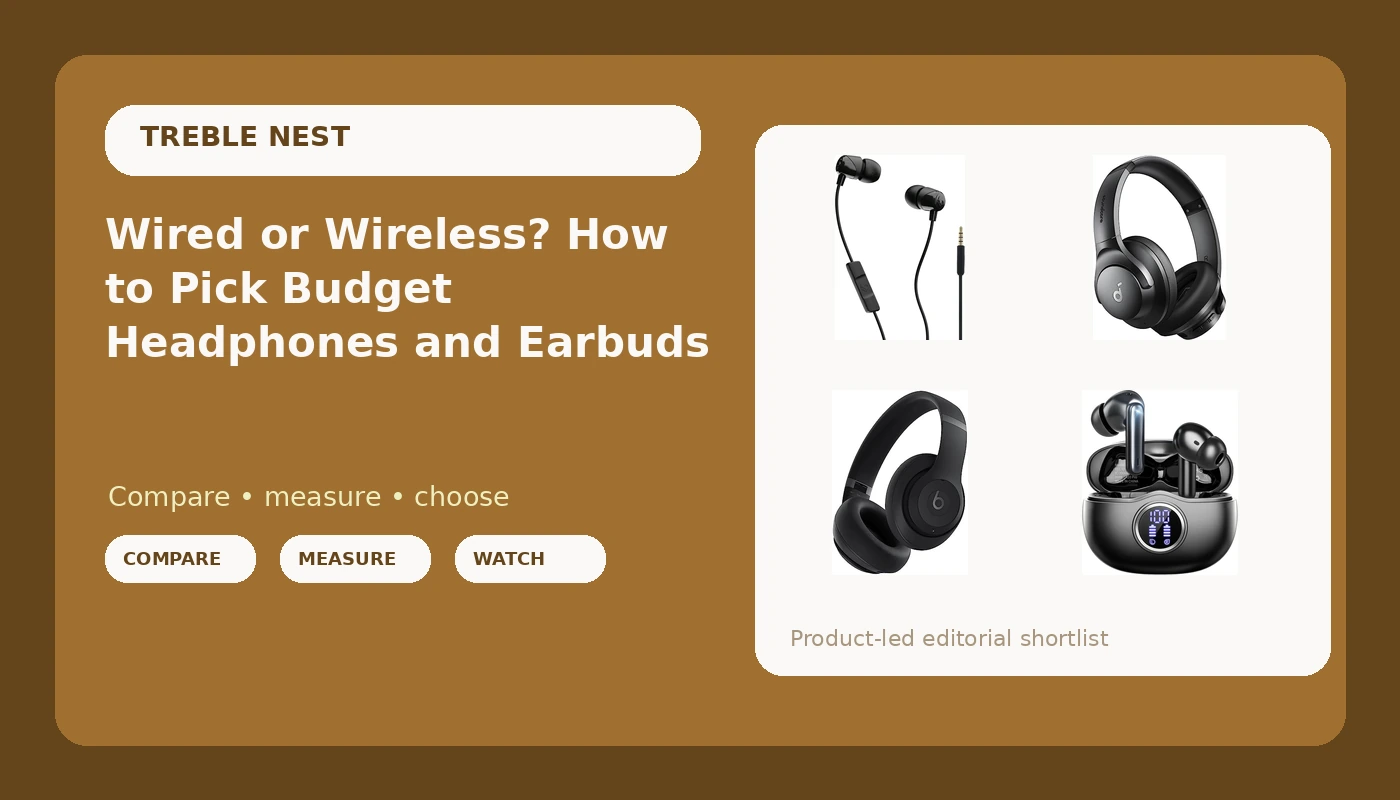
Most listening does not happen on a reference pair. It happens on a walk, on a bus, in a gym, at a kitchen table. That is why budget headphones and earbuds matter more than the expensive ones we all like to talk about: they are the pairs that actually get used, dropped, lost, and replaced. The trouble is that the budget tier is where the marketing gets loudest and the specs get vaguest. Playback numbers on the box rarely describe what you get at a normal volume, "extends playtime" usually just means "recharges," and a pair that looks fine on paper can still hurt your ear canals after twenty minutes. This guide walks through four very different options, from a wired pair with a 3.5mm plug to noise cancelling over-ears built for a plane, and explains how to choose between them without losing another week down the review rabbit hole.
Related: How to Test Earbud Battery Life at Home Without Special Gear →
Quick answer
There is no single winner here, because these four products are built for four different jobs. The Skullcandy Jib is a wired pair for anything with a headphone jack. The Bluetooth 5.3 wireless earbuds are the pair you take into sweat and rain. The Soundcore by Anker Q20i is over-ear hybrid noise cancelling at the entry level. The Beats Studio Pro is the travel-oriented package with a long battery rating and USB-C audio.
The short version: buy wired if you listen at a desk or a laptop and never want to think about charging, buy the IPX7 earbuds if you work out in them, buy the Q20i if you want over-ear noise cancelling without flagship money, and buy the Beats Studio Pro if travel, battery rating, and USB-C audio are your priorities. Match the pair to the job and you will be fine.
Four useful options
| Model | Best fit | What stands out |
|---|---|---|
| Skullcandy Jib Wired Earbuds with 3.5mm AUX Plug - Black | Desks, laptops, older phones, seat-back screens | Wired 3.5mm AUX connection, no battery or pairing at all |
| Wireless Earbuds, Bluetooth 5.3 Headphones HiFi Stereo 50H Playback LED Digital Display Ear Buds with ENC Noise Canceling Headset, IPX7 Waterproof Earphones for Gym/Running/Work(Black) | Gym, running, wet weather | IPX7 waterproof rating, ENC call microphone, LED battery display on the case |
| Soundcore by Anker Q20i Hybrid Active Noise Cancelling Headphones, Black | Commutes and shared rooms | Over-ear hybrid active noise cancelling from a mainstream audio brand |
| Beats Studio Pro Premium Wireless Over-Ear Headphones- Up to 40-Hour Battery Life, Active Noise Cancelling, Great for Travel & Commuting, USB-C Lossless Audio, Apple & Android Compatible -Black | Travel and long listening sessions | Up to 40-hour battery rating, active noise cancelling, USB-C lossless audio |
The wired baseline: Skullcandy Jib Wired Earbuds with 3.5mm AUX Plug - Black
I held onto wired headphones for years because wired still sounds better than wireless, and I stand by that. What killed the habit was not the sound, it was the hardware: the phone dropped the jack, the adapters died one after another, and the drawer of dead dongles got embarrassing. If you still have a laptop, a desktop audio interface, an older phone, a handheld console, or a seat-back screen in your life, a cheap wired pair is the least complicated audio purchase you can make. No charging case, no firmware, no "POWER ON" announcement at full volume. The trade-off is obvious: a cable. It snags on door handles, it conducts noise when it rubs against a jacket, and it will not survive forever. But for the price of a couple of coffees, a wired pair is the one thing in this guide that can never run out of battery.
The sweaty one: Wireless Earbuds, Bluetooth 5.3 Headphones HiFi Stereo 50H Playback LED Digital Display Ear Buds with ENC Noise Canceling Headset, IPX7 Waterproof Earphones for Gym/Running/Work(Black)
Two specs on this listing do the real work: IPX7 and Bluetooth 5.3. The IPX7 rating is about water, not dust, and it is the difference between a pair you can wear through a rainy run and a pair you baby. Bluetooth 5.3 is the newer version of the standard, which in practice tends to mean steadier connections and better power behavior than older chips, though the phone on the other end still has a vote. ENC means the microphone uses noise cancelling to pull your voice out of the background, which is what matters when you take a call on a busy street. The 50H figure deserves a caveat that applies to every pair in this shape: a number that large on small buds is a total across the charging case, not one continuous sitting. The case recharges the buds. It does not extend playtime into another dimension. Also worth checking before you commit: whether each bud works on its own, how quiet the lowest volume setting goes, and what the power-on sound actually sounds like.
The over-ear value pick: Soundcore by Anker Q20i Hybrid Active Noise Cancelling Headphones, Black
Hybrid is the word to understand here. A hybrid noise cancelling system uses microphones on the outside of the cup to sample the noise around you and microphones on the inside to check what still got through, then corrects both. That is generally more effective than a feed-forward-only design, and it is the kind of feature that used to live only on expensive headphones. The other thing this pair solves is the ear canal problem. If in-ear buds hurt you no matter the tip size or material, an over-ear design takes the canal out of the equation entirely, which is worth more than any frequency response chart. The trade-offs are the usual ones for over-ears: they are bulky, they get warm, they mess up your hair, and they are not what you want to wear on a run. For a commute, a noisy office, or a long flight, though, this is the shape that does the most work per dollar.
The travel upgrade: Beats Studio Pro Premium Wireless Over-Ear Headphones- Up to 40-Hour Battery Life, Active Noise Cancelling, Great for Travel & Commuting, USB-C Lossless Audio, Apple & Android Compatible -Black
The interesting detail on this listing is USB-C lossless audio. On most wireless headphones, the USB-C port only charges. Here it is also described as an audio path, which means you can plug into a laptop or a phone with a USB-C port and listen without the Bluetooth link in the chain. That is a genuinely useful option for anyone who believes, as I do, that a cable still beats a codec, and it makes this pair the closest thing in this group to a hybrid of wired and wireless. The 40-hour battery rating is also the largest number in this article, though it is worth reading the fine print on any rating: noise cancelling on or off, and volume level, both change the math. Compatibility with both Apple and Android devices matters if you switch phones or share a pair with someone on the other platform. What you give up is money and simplicity. This is the pair in this group that asks the most of your budget, and if all you need is something for the gym, it is more headphone than the job requires.
Prices and availability may change. Product images, names, and retailer links must be matched by verified ASIN. Do not state a current price, rating, stock status, or measured result without current evidence.
Why the number on the box and the number you get are different
Every battery figure you see on a pair of wireless earbuds or headphones is a best case, and the test conditions behind it are rarely the conditions you listen in. Three things move the number. The first is volume. Manufacturers test at a moderate level, and if you listen loud, you will not reach the advertised figure. The second is noise cancelling. Active noise cancelling runs its own microphones and processing, and switching it on typically shortens runtime. The third is the case, and this is where budget earbuds get confusing. A figure like 50H on a small pair is almost never one continuous session. It is the buds plus the recharges stored in the case, which is why I call it the magic case. The case is not a battery extender. It is a battery, and it runs out too.
None of that makes the numbers useless. It just means you should read them as relative, not literal. A pair rated higher than another will usually last longer under the same conditions. What you cannot do is assume the rated figure is what you will get on a cold morning at high volume with noise cancelling on. The only number that matters to you is the one you measure yourself, at your normal listening volume, with the settings you actually use. That takes about a week, not a lab.
How to choose in five steps
- Decide wired or wireless before you look at anything else. If your main listening happens at a desk, a laptop, or a device with a headphone jack, a wired pair removes charging, pairing, latency, and firmware from your life entirely. If your listening happens in motion, wireless is the practical reality, and you should make peace with it.
- Read the battery rating and ask what it includes. Find out whether the number is per charge or total with the case, whether noise cancelling was on, and at what volume. A rating with no conditions attached is marketing, not information.
- Check whether each earbud works independently. Using one bud at a time is a feature you do not realize you need until you have it, and not every pair allows it. If you take calls all day, this one matters.
- Think about fit before features. If you have small or easily sore ear canals, in-ear buds may hurt no matter the tip size, and an over-ear design is the better answer. Fit beats frequency response, because a pair that hurts gets left in a drawer.
- Check the minimum volume and the power-on sound. Some pairs cannot go quiet enough for night listening, and some greet you with a full-volume voice announcement. Both are dealbreakers you cannot fix later.
How to get more out of whichever pair you buy
- Run your own drain test at normal volume for a week instead of trusting the box. Note how many hours you actually get, and whether noise cancelling changes it.
- Try every ear tip size, and give each one a full walk before judging it. The seal matters more than the material, and a bad seal costs you bass.
- Keep the charging case topped up rather than waiting for a full drain. Small batteries age faster when they live at zero.
- If your pair supports USB-C audio, use it at the desk. It sidesteps Bluetooth latency and codec limits entirely for video editing and gaming.
- Check the return window before you commit. Comfort is the one spec nobody can publish for you, and two weeks of real use is the only honest test.
Which option should you choose?
Choose the Skullcandy Jib Wired Earbuds with 3.5mm AUX Plug - Black when you want a wired pair for a laptop, a desktop interface, an older phone, or a seat-back screen, and you never want to think about charging. Choose the Wireless Earbuds, Bluetooth 5.3 Headphones HiFi Stereo 50H Playback LED Digital Display Ear Buds with ENC Noise Canceling Headset, IPX7 Waterproof Earphones for Gym/Running/Work(Black) when your listening happens in motion and around water, and the IPX7 rating plus the ENC microphone matter more to you than refinement. Choose the Soundcore by Anker Q20i Hybrid Active Noise Cancelling Headphones, Black when you want over-ear hybrid noise cancelling for a commute or a shared room and you would rather not pay flagship prices. Choose the Beats Studio Pro Premium Wireless Over-Ear Headphones- Up to 40-Hour Battery Life, Active Noise Cancelling, Great for Travel & Commuting, USB-C Lossless Audio, Apple & Android Compatible -Black when travel, the longest battery rating in this group, and USB-C audio are the priorities, and you want one pair that covers both Apple and Android devices.
One caveat worth stating plainly: I have not lived with these four long enough to call any of them comfortable, and comfort is the one thing a spec sheet cannot answer for you. My own rule is a week of walks, workouts, and real phone calls before I will say a pair is fine, because my ears hurt easily and a reviewer's "comfortable" means nothing until it survives mine. Treat everything above as a starting point, buy from somewhere with a return window, and let your own ears cast the deciding vote.
The bottom line
The budget tier rewards patience and punishes wishful thinking. No single pair here wins on every axis, and that is the point: a wired pair solves the jack problem, an IPX7 pair solves sweat, an over-ear pair solves noise and sore ear canals, and a travel pair solves long trips and cross-platform compatibility. Pick the problem you actually have, check the battery rating for the conditions behind it, and ignore the magic-case language, because a charging case recharges your buds and nothing more. Do that and whatever you buy will be fine, which from me is the highest praise budget gear gets.