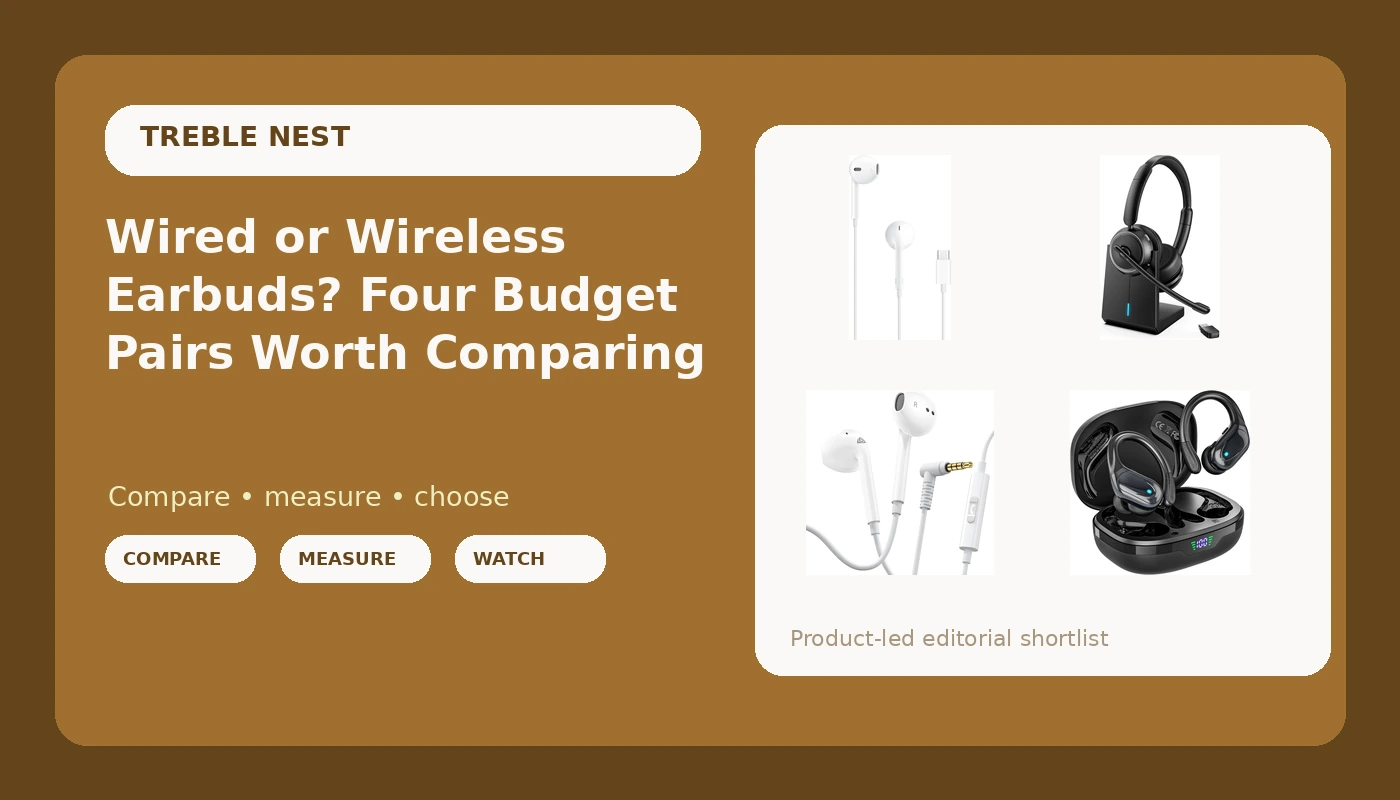
Shopping for budget earbuds is where most people's research goes sideways. One review swears wired sounds better, another says the headphone jack is dead, a third insists you cannot commute without active noise cancellation, and a fourth promises a charging case that extends your playtime into another dimension. Nobody agrees, and you end up further down the rabbit hole than when you started, which is roughly how I spent a few years of my own listening life before I stopped reading and started checking four things instead: battery, fit, the volume floor, and whether each bud works on its own.
This is an explainer, not a shootout. The four products below sit in different lanes. Two are wireless, two are wired, one is built for talking at a desk, and one is built for sweat. Here is how to figure out which lane you actually live in, and what each type of headphone is genuinely good at.
Related: How to Check Earbud Battery Claims Before You Buy →
Quick answer
There is no single best pick in this group, and anyone who tells you otherwise is selling something. The honest version: if your phone still has a headphone jack, or you mostly listen at a desk or on a laptop, a wired pair is the simplest thing you can own, because it never needs charging and never drops a connection. If your phone is USB-C only, wired USB-C ear buds give you that same no-battery simplicity without an adapter in the chain. If you move around, take calls on the go, or get rained on, wireless earns its keep. Match the pair to your day first, then compare features.
Four useful options
| Model | Best fit | What stands out |
|---|---|---|
| HAOYUYAN Wireless Earbuds, Sports Bluetooth Headphones, 80Hrs Playtime Ear Buds with LED Power Display, Noise Canceling Headset, IPX7 Waterproof Earphones for Workout/Running(Black) | Workouts and weather | Maker-rated 80 hours of playtime, IPX7 water resistance, LED power display |
| Apple EarPods Headphones with USB-C Plug, Wired Ear Buds with Built-in Remote to Control Music, Phone Calls, and Volume | USB-C phones with no adapter | Wired USB-C connection, built-in remote for music, calls, and volume |
| Upgrade ANC & ENC Wireless Headset with Mic for Work(Flip-to-Mute & Dongle) | Work calls and meetings | Flip-to-mute boom mic, bundled dongle, ANC and ENC |
| LUDOS Zenith Wired Earbuds in-Ear Headphones, 5 Year Warranty, Earphones with Microphone, Corded for 3.5mm Jack Ear Buds for iPhone, Samsung, Computer, Laptop, Kids, School Students, Women, Small Ear | Small ears and tight budgets | 3.5mm wired connection, inline mic, 5 year warranty |
The workout pair: HAOYUYAN Wireless Earbuds
That 80-hour figure deserves a translation before you get excited. Playtime numbers on wireless ear buds almost always count the buds plus every recharge the case can hand them, not one continuous listening session. That is the magic case in plain language: the case recharges the buds, and the total is what gets printed on the box. It is still genuinely useful, because a case that holds several recharges means you charge the whole thing once a week instead of every night. Just do not expect one unbroken 80-hour stretch. IPX7 means sweat and rain are fine and a dropped bud in a puddle is survivable; it does not mean swim with them. And noise canceling on a sports pair is usually mild, enough to take the edge off a treadmill, not enough to erase a bus.
The no-battery wired pick: Apple EarPods with USB-C Plug
This is the pair I would hand to anyone who is tired of charging. Plug it in, it works, every time, on the first try, with zero latency because there is no wireless link to introduce any. The trade-offs are real and worth naming. The cable snags on doorknobs and jacket zippers. The open fit does not seal your ear canal, so you hear traffic, keyboards, and conversations around you, which is either a safety feature or an annoyance depending on where you are. And USB-C only means it will not help you on a laptop with a 3.5mm jack unless you buy the other kind of adapter. If you have ever had a dongle die on you mid-commute, this is the way around that whole problem.
The work-call headset: Upgrade ANC & ENC Wireless Headset with Mic
ANC and ENC get used interchangeably in marketing, and they are not the same thing. ANC is for your ears: it reduces what you hear. ENC is for your microphone: it reduces what the person on the other end hears, so your call does not sound like it is being placed from inside a coffee grinder. A headset that advertises both is telling you it was built for conversations. The flip-to-mute boom is the feature I would pay for on its own, because it is a physical mute you can feel and see, rather than a touch target you have to hunt for while someone is mid-sentence. The dongle matters too: Bluetooth on some laptops and desktops is unreliable enough that a dedicated receiver is the difference between a clean call and a stuttering one. The cost is that a boom mic and a dongle are awkward on a run and pointless at the gym.
The small-ear wired backup: LUDOS Zenith Wired Earbuds
In-ear fit is the whole story with a pair like this. I have small, easily sore ear canals, and I have thrown away more ear buds than I have worn out, because a tip that is comfortable for twenty minutes is not the same as a tip that survives a two-hour walk. The listing calls out small ears directly, which is worth more than it sounds, since most budget pairs are built around a medium tip and treat small tips as an afterthought. The 5 year warranty is also unusual in this tier and suggests the maker expects the cable to be the failure point. The catch is obvious: 3.5mm means you need a jack or an adapter, and adapters are exactly the thing that dies in your bag after a couple of months.
Prices and availability may change. Product images, names, and retailer links are matched to verified listings. No current price, rating, stock status, or measured result is stated here without current evidence.
What the numbers on the box actually mean
Playtime is the first spec to check and the easiest to misread. A number like 80 hours is the buds plus the case recharges, and your real-world figure depends on volume. Turn the volume up and battery drains faster on every pair ever made. The only honest test is your own: charge everything to full, listen at your normal volume for an hour, and see what percentage is left.
Water resistance ratings are next. IPX7 means the product survives being submerged briefly, which in practice covers sweat, rain, and a dropped bud in a puddle. It does not cover swimming or showering, and it does not protect a charging case, which is usually the part that dies first when it gets wet.
Then there is the question that started all of this. Wired still sounds better than wireless at any given price, and I will keep saying that while owning wireless pairs, because the phone makers took the jack and the adapters were never reliable. What you gain going wireless is freedom from the cable and from the port. What you lose is latency, battery anxiety, and a little clarity. For podcasts, calls, and walking around, that trade is fine. For critical listening, it is not.
Finally, USB-C versus 3.5mm is not a preference, it is a compatibility question. Check the port on the device you actually use most, not the one you wish you had.
How to test a new pair in the first week
- Run a drain test at your normal volume, not maximum, and write down the result. Box numbers are marketing; your number is the truth.
- Use each bud on its own for a full day. Independent use sounds like a small feature until you need it and discover one side will not pair alone.
- Find the volume floor. Play something quiet at the lowest setting. If the minimum is still loud enough to blast your eardrums, you will hate it at night, and no other feature makes up for that.
- Wear them for a week of walks and workouts before you decide they fit. Comfort problems show up in hour two, not minute five.
- Make an actual phone call from a noisy street. Microphone quality is the spec nobody tests and everybody complains about later.
Matching a pair to your day
- Gym, running, and rain: wireless with a real water-resistance rating and a fit that stays put when you sweat.
- Desk and laptop work: a headset with a boom mic and a dongle beats any pair of ear buds for call clarity.
- Commuting on a phone with no headphone jack: wired USB-C is the lowest-maintenance option you can own.
- Kids, students, and spare bags: a cheap wired pair with an inline mic is the one you will not mourn when it disappears.
- Any pair at all: check the volume floor before you fall in love with the sound.
Which option should you choose?
Choose the HAOYUYAN Wireless Earbuds when you need something that moves with you and survives sweat and rain. Choose the Apple EarPods with USB-C Plug when your phone is USB-C only and you want zero charging, zero pairing, and zero latency. Choose the Upgrade ANC & ENC Wireless Headset with Mic when most of your listening is meetings and phone calls from a desk. Choose the LUDOS Zenith Wired Earbuds when you want an inexpensive spare for small ears that lives in a bag and works on any device with a 3.5mm jack.
The caveat that applies to all four: fit and battery behavior are personal, and no spec sheet can tell you whether a tip will hurt your ear after an hour or how long a charge will last at the volume you actually use. That answer only comes from your own first week.
The bottom line
Budget audio is not about finding the perfect pair, it is about finding the pair whose weaknesses you can live with. Wired buys you reliability and simplicity at the cost of a cable. Wireless buys you freedom at the cost of charging and latency. A call headset buys you clarity at the cost of looking like you are at work, because you are. Pick the lane that matches your actual day, verify the battery and the fit yourself, and treat the box numbers as claims rather than facts. That is how you end up with something that is, in the best possible sense, fine.