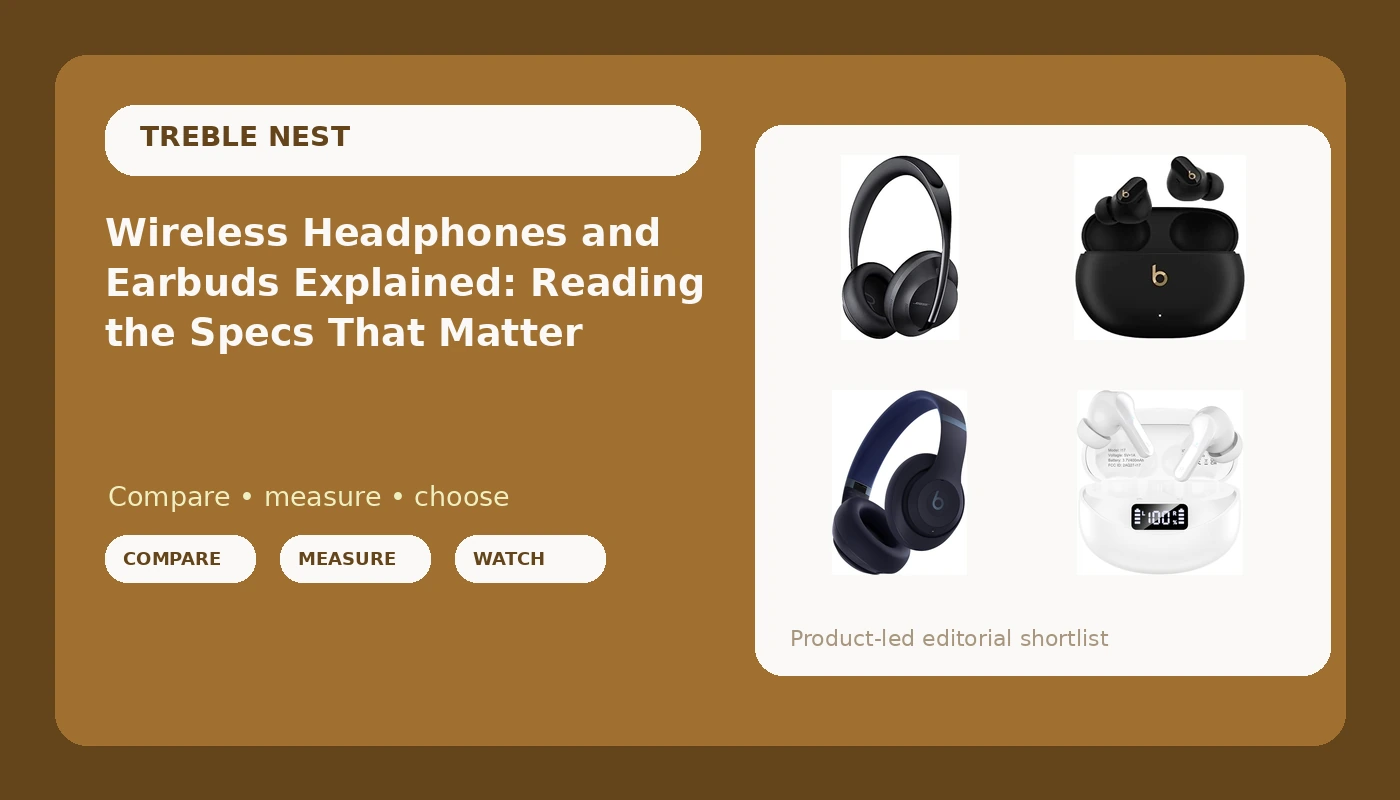
Wireless headphones and earbuds are the rare purchase where the box copy and the daily experience have almost nothing to do with each other. The packaging promises immersive sound and all-day power. What actually decides whether you keep a pair is duller and more specific: how long the battery lasts at the volume you really listen at, whether one bud works on its own when the other is charging, how quiet the quietest setting gets, and whether the thing survives two hours in your ears without leaving them sore. None of that is printed on the front of the box, and the reviews you find online contradict each other so thoroughly that you end up further from a decision than when you started. This is an explainer, not a ranking. It walks through four verified options at four different price tiers and explains what the language around them, including the word renewed, actually means before you spend anything.
Related: How Long Do Budget Earbuds Actually Last? A Battery Reality Check →
Quick answer
The right pick depends on where you listen and how much you want to carry. A budget true wireless pair built on Bluetooth 5.4 covers walks, chores, and commuting for the least money. Sweat resistant earbuds with active noise cancelling and dual-platform support suit workouts and mixed Apple and Android households. A renewed pair of over-ear noise cancelling headphones gets you flagship noise cancelling without paying new-flagship money, provided you read what the seller includes. And a premium over-ear model with a stated 40-hour battery and USB-C audio suits long flights and desk work. Fit and battery life decide more than the marketing does.
Four useful options
| Model | Best fit | What stands out |
|---|---|---|
| Wireless Earbuds, Bluetooth 5.4 Headphones HIFI Stereo/Crystal clear, White | Cheapest everyday listening | Bluetooth 5.4 with a compact true wireless design |
| Beats Studio Buds + | True Wireless Noise Cancelling Earbuds, Enhanced Apple & Android Compatibility, Built-in Microphone, Sweat Resistant Bluetooth Headphones, Spatial Audio - Black/Gold | Workouts and mixed phone households | Active noise cancelling, sweat resistance, spatial audio, built-in microphone |
| Bose 700 Noise-Cancelling Bluetooth Headphones (Triple Black) (Renewed) | Over-ear noise cancelling on a budget | Renewed flagship over-ear with active noise cancelling |
| Beats Studio Pro Premium Wireless Over-Ear Headphones- Up to 40-Hour Battery Life, Active Noise Cancelling, Great for Travel & Commuting, USB-C Lossless Audio, Apple & Android Compatible - Navy | Travel and long listening sessions | Stated 40-hour battery, active noise cancelling, USB-C audio |
The budget daily pair: Wireless Earbuds, Bluetooth 5.4 Headphones HIFI Stereo/Crystal clear, White
This is the tier where you accept trade-offs up front instead of being surprised by them later. The newer Bluetooth version matters because the connection standard governs how reliably the buds hold a link across a room, and version 5.4 is the most recent of the mainstream generations, though the codec your phone supports still decides what the audio stream can carry. What you are not getting at this price is meaningful active noise cancelling or premium build materials, and the manufacturer copy offers no independent battery figure, so treat runtime as something to verify in your own use rather than a number to trust. If your goal is a cheap, replaceable pair for podcasts, walks, and the gym bag, this is the sensible place to start.
The earbuds for workouts: Beats Studio Buds + | True Wireless Noise Cancelling Earbuds, Enhanced Apple & Android Compatibility, Built-in Microphone, Sweat Resistant Bluetooth Headphones, Spatial Audio - Black/Gold
The interesting part of this listing is the dual-platform language. Plenty of earbuds work best when you own one brand of phone and grudgingly accept the other, so a pair explicitly built for enhanced compatibility with both Apple and Android is worth noticing if your household is split or you switch devices. Sweat resistance is the second thing that matters here: it is the difference between a pair you can wear through a workout and a pair you have to baby, and it is not something you can retrofit later. Spatial audio is a feature you either use or ignore, and the built-in microphone means these can handle calls without a separate accessory. Noise cancelling at this size is never as deep as an over-ear pair's, which is a physics problem rather than a marketing one.
The renewed over-ear: Bose 700 Noise-Cancelling Bluetooth Headphones (Triple Black) (Renewed)
Over-ear headphones still have an advantage that no earbud can copy, and it is not about drivers. The cups physically cover your ears, so the passive seal does part of the work before the electronics even switch on, and the battery has room to be bigger. The catch with a renewed listing is that the condition language is doing a lot of lifting, and what the seller includes in the box varies from one listing to the next. Read the renewed description carefully, confirm what accessories come with it, and understand that a renewed pair is a used pair that has been checked and repackaged. If you want flagship noise cancelling for less than new-flagship money and you are comfortable with that trade, this is the route.
The long-battery travel pair: Beats Studio Pro Premium Wireless Over-Ear Headphones- Up to 40-Hour Battery Life, Active Noise Cancelling, Great for Travel & Commuting, USB-C Lossless Audio, Apple & Android Compatible - Navy
Two details in that name are worth slowing down for. First, "up to 40 hours" is a manufacturer figure, and "up to" is doing exactly the work it sounds like it is doing: noise cancelling and volume both drain a battery faster, so the honest expectation is somewhere below the headline number depending on how you listen. Second, USB-C audio is the more interesting feature, because it means the headphones can take a digital wired connection instead of relying on Bluetooth. That is the closest thing to a best-of-both arrangement in this group, and it is the feature to care about if you ever want to edit audio or watch something without worrying about latency.
Prices and availability change, and listings get updated without warning. Check the current Amazon page for the live details, and read the condition and included-accessory notes on any renewed item before you buy.
What renewed actually means when you buy headphones
Renewed is one of the most misunderstood words in consumer audio. It does not mean the product is new, and it does not automatically mean it is damaged goods either. It generally describes an item that was returned, inspected, and repackaged, sometimes with parts replaced and sometimes with only a functional check. The condition can range from indistinguishable from new to visibly used, and the listing is where that distinction lives.
That makes renewed gear a reading exercise. Look for what the seller states about the inspection process, what accessories are included, and whether the original packaging is part of the deal. The real value of a renewed flagship over-ear is that noise cancelling technology ages more slowly than phone hardware does. A top-tier pair from a few generations back still blocks airplane cabin noise well, because the physics of a sealed cup and a microphone array have not changed much. You are trading warranty convenience and cosmetic perfection for money, and for some buyers that is a straightforward win.
The risk you accept is that you are relying on the seller's description rather than a fresh factory seal. If the description is vague, that vagueness is information. A clear renewed listing tells you what was checked. A listing that just says renewed and moves on is asking you to hope.
Reading battery, ANC, and compatibility claims without getting fooled
Three phrases show up in nearly every headphone listing, and each one deserves a translation. Battery life is usually quoted at a reduced volume with noise cancelling off, so the number you experience at a comfortable volume in a noisy place will be lower. Noise cancelling performance is about steady, low-frequency sound, which means engine rumble and air conditioning disappear while voices at the next table do not. And compatibility claims describe which Bluetooth codecs and platform features work, not which phone the headphones secretly prefer.
The other thing worth understanding is that earbuds and over-ears solve different problems. A sealed over-ear cup gives you passive isolation on top of the electronics, and the housing has room for a larger battery. An earbud gives you something that fits in a pocket and can be worn in the rain or at the gym. Neither is universally better, and a person who owns both is usually not confused about that, just practical about which one matches the errand.
Before you buy anything, run the order of operations that actually settles the decision:
- Decide whether you need in-ear or over-ear, because that single choice eliminates half the market immediately.
- Work out how many hours you listen between charges on a normal day, then compare that against the stated battery figure rather than the marketing headline.
- Check whether you need active noise cancelling for commuting or travel, or whether a passive seal is enough.
- List the devices you will pair with, since a pair optimized for one platform may give you fewer features on another.
- Settle the fit question, because ear tips and clamping force decide comfort, and comfort decides whether the headphones ever come out of the case.
How to choose in one afternoon instead of three weeks
- Set a hard spending ceiling first, then look only at options under it. Doing it in the other order is how the rabbit hole opens.
- Treat any battery number as a ceiling and not a promise, and expect noise cancelling to pull it down.
- Read the return policy before you read the reviews, because a generous return window is worth more than a hundred conflicting opinions.
- Check whether each earbud works independently if you like keeping one ear open, since that feature is not universal.
- Buy for the 90 percent case, which is walks, chores, commutes, and calls rather than a listening session you do twice a year.
Which option should you choose?
Choose the Wireless Earbuds, Bluetooth 5.4 Headphones HIFI Stereo/Crystal clear, White when you want a cheap, pocketable pair for everyday listening and you would rather replace them than protect them. Choose the Beats Studio Buds + when you work out, sweat, take calls, and split your time between Apple and Android devices. Choose the Bose 700 Noise-Cancelling Bluetooth Headphones (Triple Black) (Renewed) when you want over-ear noise cancelling and are comfortable with a renewed listing in exchange for a lower entry point. Choose the Beats Studio Pro Premium Wireless Over-Ear Headphones when the stated 40-hour battery, active noise cancelling, and USB-C audio matter more to you than portability.
One caveat applies to all four. Nothing here is a measurement, and no runtime, noise cancelling depth, or fit outcome is guaranteed by a listing. Those depend on your ears, your volume, your phone, and how much noise is around you, which is why the return window matters as much as the spec sheet.
The bottom line
Four products, four jobs. The inexpensive white wireless earbuds handle the daily errands and the gym bag. The Beats Studio Buds + add sweat resistance, active noise cancelling, and dual-platform support for people who do not stay in one ecosystem. The renewed Bose 700 gives you over-ear noise cancelling without new-flagship pricing, if you read the condition notes. The Beats Studio Pro pushes the battery figure to a stated 40 hours and adds USB-C audio for the times when wireless is not the answer. Fit and battery life are what you will live with every day, so decide those two first and let the rest fall into place. They are fine, and fine is a good outcome.