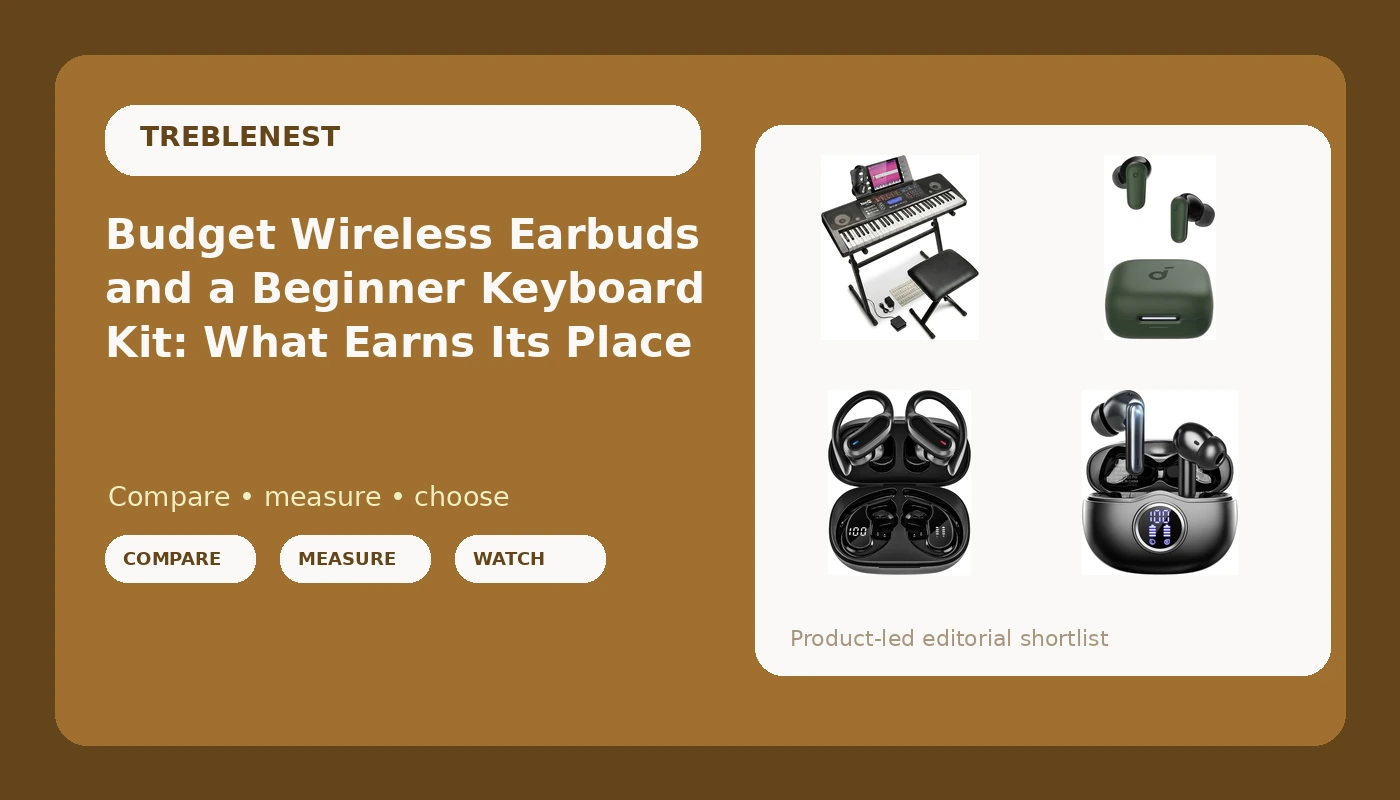
Most people shopping for budget wireless earbuds are not deciding between good and bad. They are deciding between four listings that all claim roughly the same things: long playtime, noise cancelling, waterproofing, an LED battery display. The spec sheets blur together, the reviews contradict one another, and an afternoon of research leaves you further from a decision than when you started. This guide takes four specific products, three pairs of budget wireless earbuds and one beginner keyboard kit, and explains what each one is actually for. It also covers the small number of specs that decide whether a cheap pair survives daily life: battery math, fit, the volume floor, and whether each bud works on its own. What follows is a way to read the listings, not a promise about sound you have not heard yet.
Related: How to Test Budget Earbud Battery Life at Home →
Quick answer
For daily listening on walks, at the gym, or on a commute, a pair of budget wireless earbuds with a long playtime rating and an IPX7 water-resistance rating covers most of what an average listener needs. The Soundcore P30i by Anker is the option here with an established audio brand behind it and active noise cancelling in the listing. The pair with earhooks is shaped for people whose buds work their way loose when they move. The third pair is the plain, no-frills Bluetooth 5.3 option with a digital battery display. If the goal is playing music rather than listening to it, none of the earbuds help, and the RockJam RJ761 kit is the only product in this group built for that. Decide what the gear is for first, then compare the spec sheets.
4 useful options
| Model | Best fit | What stands out |
|---|---|---|
| Soundcore P30i by Anker Noise Cancelling Earbuds | Everyday listening and calls | Active noise cancelling and a recognized audio brand |
| Wireless Earbuds with 54H Playtime and Earhooks | Running and workouts | Earhook shape, IPX7 rating, 54H playtime claim, LED power display |
| Wireless Earbuds Bluetooth 5.3 with 50H Playback | A spare pair for the gym bag | Bluetooth 5.3, 50H playback claim, ENC, IPX7, digital display |
| RockJam RJ761 61 Key Keyboard Piano Kit | Learning to play keys | 61 keys plus stand, stool, sustain pedal, and headphones in one kit |
The brand-name pick: Soundcore P30i by Anker Noise Cancelling Earbuds
Brand accountability is the quiet feature here. When a listing comes from a company whose entire business is audio, there is a track record to search, a support page to find, and a reputation to lose. That matters more in the budget tier than any single line on a spec sheet, because the failure modes are boring rather than dramatic: a bud that stops pairing, a case that quits charging, a microphone nobody on the other end can hear. The trade-off is that this pair does not chase the biggest numbers in the group. It does not claim the earhook shape or the 54H playtime figure the sport pair advertises. What it offers instead is active noise cancelling, which reduces what you hear, and a name you can investigate before you spend anything.
The sport-fit pick: Wireless Earbuds Bluetooth Headphones, 54H Playtime
Fit is the spec nobody advertises and everybody notices. A bud that seals inside the canal depends on that seal for both sound and grip, and if your canals are small or easily sore, the seal is exactly where the discomfort starts. An earhook moves the job of holding the bud to the outside of the ear, which is a real structural difference rather than a marketing one. The trade-off is that a hook sits against more of your ear, so a pair that fits perfectly can still become noticeable after an hour, and a pair that does not fit will rub. IPX7 covers sweat, rain, and a rinse, but the rating applies to the buds, not the case, and it does not make anything swim-proof. The 54H figure is a listing claim that almost certainly includes case recharges, so read it as fuel plus a gas can rather than a single tank.
The no-frills pick: Wireless Earbuds, Bluetooth 5.3 Headphones
Two acronyms in this listing look like the ones in the Soundcore listing and mean something different. ENC, environmental noise cancelling, is about the microphone: it is there so the person on the other end of your call hears less of the street. ANC is about your ears. A listing that says ENC is making a claim about call clarity, not about how quiet your commute will feel, and mixing the two up is one of the easiest ways to be disappointed. Bluetooth 5.3 is a connection claim, not a sound claim, and in this tier a stable link matters more than a version number sounds like it should. The trade-off with this pair is that nothing about it stands out, which is the point of a spare set. The one thing no listing can tell you is how quiet the quietest volume setting goes, so the return window is doing real work here.
The learning pick: RockJam RJ761 61 Key Keyboard Piano Kit
Buying a first instrument is a different decision from buying a first pair of earbuds. Earbuds are consumable and replaceable, and a bad pair costs you a few months of mild irritation. An instrument is a commitment of floor space and habit, and the bundle logic exists for a reason: the stand, stool, sustain pedal, and headphones are the things that keep a beginner from quitting in the first month, and buying them separately is how practice sessions get postponed. The included headphones are for silent practice, not for critical listening, so do not treat them as a substitute for a decent pair of earbuds, and do not treat earbuds as a substitute for them. The trade-off is space and routine. A 61-key setup needs a corner it can live in, and gear that gets folded into a closet stops getting played.
Prices and availability may change. Confirm the current price, stock status, and product details on the retailer page before buying. The features described here come from the product listings, not from a lab bench.
What the playtime numbers and water ratings actually mean
Playtime is the number most listings lead with, and it is the number most likely to mislead you. A 54H or 50H figure almost always describes total listening time across the earbuds plus several recharges from the case, not a single charge. That is not a scam, but it is not what most people picture when they read it either. The honest way to think about it: the case is a battery bank, and every time you drop the buds in, you spend one of its charges. Treat the headline number as the size of the fuel tank and the case as a gas can, and you will never be surprised by a pair that dies on day three.
Water ratings are more literal. IPX7 describes protection against immersion, which means sweat, rain, and a rinse under the tap are within the design intent. It does not mean swim-proof, and it does not cover the charging case, since the rating applies to the buds.
The two noise-cancelling acronyms are not the same thing. ENC, or environmental noise cancelling, is about the microphone: it is there so the person on the other end of your call hears less of the street. ANC, active noise cancelling, is about your ears: it reduces what you hear. A listing that says ENC is making a claim about call clarity, not about how quiet your commute will feel.
Bluetooth version numbers describe the connection, not the sound. Bluetooth 5.3 is newer than 5.0 and generally means better power efficiency and a more stable link, which in the budget tier is worth more than it sounds like it should be.
How to judge a pair before it arrives
You cannot hear a pair through a web page. You can answer five questions from the listing, and those five questions decide most of whether you will still like the things in three months.
- Battery first. Find the playtime number and work out how much of it is the case. If the listing gives one big figure and no breakdown, assume it is total time including recharges.
- Check whether each bud works on its own. Single-bud use doubles the ways you can keep listening when one side runs down, and it matters if you take calls at a desk.
- Look for the volume floor. A pair whose quietest setting is still loud is unusable at night, and no listing advertises this. It is the one spec you cannot check until the box arrives, which is why the return window is part of the purchase.
- Judge the shape, not the marketing. Earhooks hold the bud from outside the ear; in-canal tips seal and depend on that seal. If your canals are small or sore, shape decides the outcome, not tip material.
- Plan the first two weeks. Test a real phone call, a walk, and a workout while you can still send them back, and listen for a power-on announcement loud enough to make you wince.
Practical guidance for the first two weeks
- Charge the case fully before the first long session, then note how many days of normal use you get before the buds need a recharge. That number beats the box figure.
- Swap through every ear tip size, starting smaller than you think you need. A seal that hurts is not a seal that works.
- Use one bud at a time for podcasts and calls to stretch the battery and keep one side fresh.
- Make a real call from a noisy street in the first week. ENC claims are the easiest thing to overstate and the cheapest thing to verify.
- If you are buying the keyboard kit, measure the space before it arrives. A 61-key setup with a stand and stool needs a permanent corner, and instruments that live in closets do not get played.
Which option should you choose?
Choose the Soundcore P30i by Anker Noise Cancelling Earbuds when you want a name you can look up and active noise cancelling on the commute. Choose the Wireless Earbuds Bluetooth Headphones, 54H Playtime when fit is the problem and your current buds work their way loose on runs. Choose the Wireless Earbuds, Bluetooth 5.3 Headphones when you want a plain second set for the gym bag with a digital battery readout. Choose the RockJam RJ761 61 Key Keyboard Piano Kit when the goal is learning to play rather than listening, and you want the stand, stool, sustain pedal, and headphones in one purchase.
Every feature described here comes from the product listings rather than from a lab bench. Playtime figures, water ratings, and noise-cancelling claims are the manufacturer's, and the only way to confirm them is to use the gear yourself, which is why the return window belongs in the decision. Availability and pricing move constantly, so check the retailer page before you commit.
The bottom line
Three pairs of budget wireless earbuds and one beginner keyboard kit, and the right answer depends entirely on the job. For everyday listening with a brand behind it, the Soundcore P30i is the straightforward pick. For running and workouts, the earhook pair addresses a fit problem the other two do not. For a spare set that lives in the gym bag, the Bluetooth 5.3 pair is fine, and in this tier fine is a real compliment. For actually learning to play, the RockJam kit is the only product here that moves you forward. Read the listings with the five questions above, keep the return window in mind, and let your own ears make the last call.