Most people shopping for budget wireless earbuds are not chasing reference-grade sound. They want a pair that survives a walk, a workout, a night of tossing in bed, or a noisy commute without hurting their ear canals, dying at hour three, or greeting them with a shouted "POWER ON." The trouble is that every listing sounds identical: enormous battery numbers, a waterproof rating, a noise cancelling claim, and a spec sheet that never answers the questions that actually decide whether you keep the things. There are four options here, four different jobs, and one short checklist that matters more than any of the marketing copy.
Related: How to Read Earbud Battery Claims Without Getting Fooled →
Quick answer
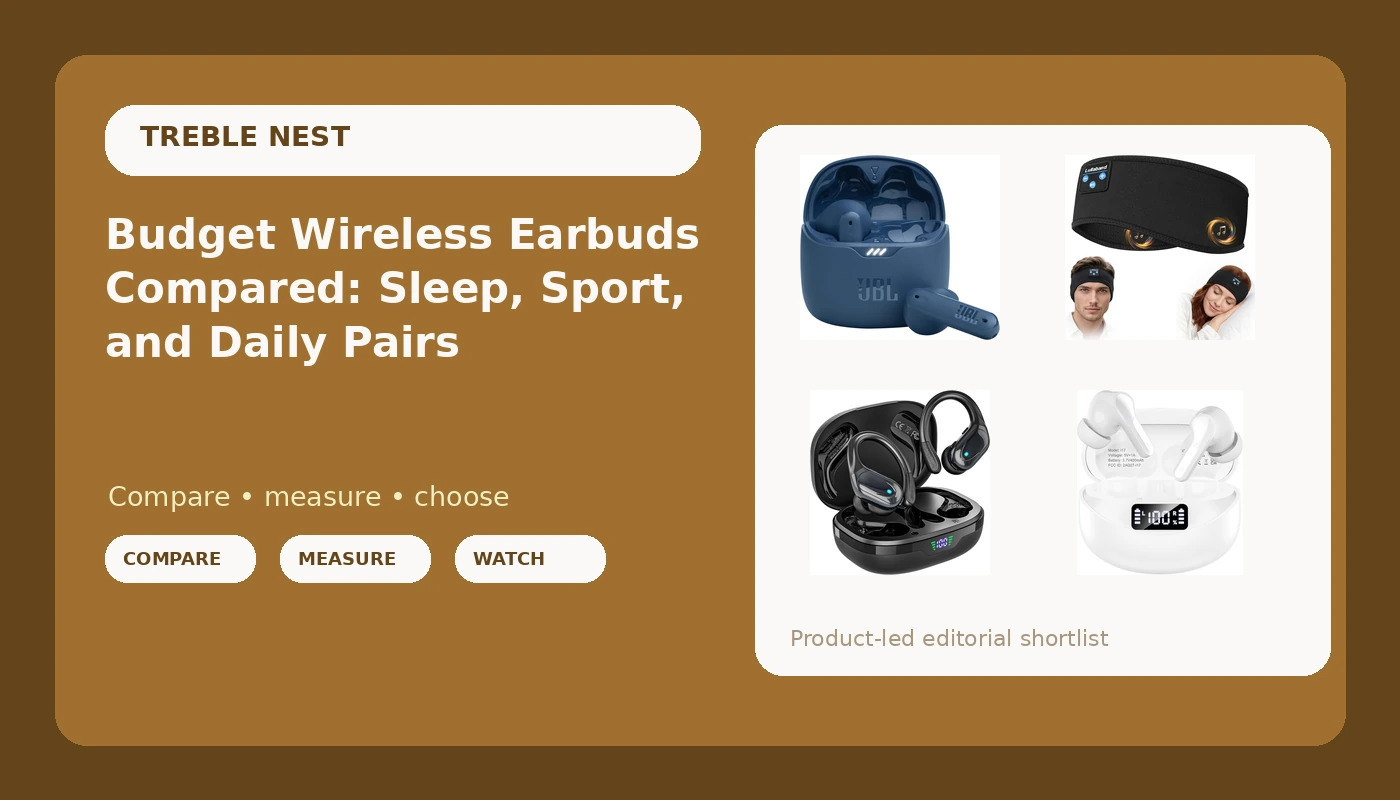
There is no single winner across these four, because they are shaped for different jobs. The JBL Tune Flex is the only pair here from a widely recognized audio brand and the only listing that names active noise cancelling, so it is the one to consider if brand familiarity and ANC matter to you. The HAOYUYAN pair is the one the listing builds around sport, with an IPX7 waterproof rating and a workout-and-running framing. The Lullaband is not an earbud at all but a Bluetooth headband, which is the shape that makes sense for sleeping and lying down. The white Bluetooth 5.4 earbuds are the plainest entry in the group, an everyday spare rather than a specialist. Pick by the job you need done, not by the size of the number on the box.
4 useful options
| Model | Best fit | What stands out |
|---|---|---|
| JBL Tune Flex | Commuting and daily listening | True wireless with active noise cancelling named in the listing |
| HAOYUYAN Wireless Earbuds | Workouts and running | IPX7 waterproof rating and a sport-focused build |
| Lullaband Sleep Headphones | Sleeping and lying down | Headband design with a stated 12-hour battery |
| Wireless Earbuds, Bluetooth 5.4 (White) | A cheap everyday spare | Bluetooth 5.4 in a plain white shell at the lowest entry point |
The brand-name pick: JBL Tune Flex
The JBL Tune Flex is the one pair here where the badge does some of the work for you. JBL has been building consumer audio for decades, and this listing describes true wireless earbuds with active noise cancelling in a blue finish with a small size option. That combination is what you are paying for: a name you have probably seen in an airport kiosk, plus a noise cancelling claim that none of the other listings in this group make. The trade-off is that this is the most expensive entry of the four, and price is the one spec a listing cannot argue its way around. If your budget is strict, the other three options exist precisely because this one costs more. If cutting down a commute is the entire point of the purchase, this is the only listing here that promises it.
The sport pick: HAOYUYAN Wireless Earbuds
This is the pair to look at if your earbuds live in a gym bag. The listing leans hard into sport: IPX7 waterproof, an LED power display, a black shell, and a stated 80 hours of playtime. Two of those deserve translation. IPX7 means the earbuds are rated to survive immersion in water for a short period under test conditions, which covers sweat, rain, and the occasional dropped-in-the-sink moment far better than a splash rating would. The 80-hour figure is almost certainly counting recharges from the charging case rather than 80 hours in a single sitting, because that is how nearly every listing in this tier arrives at a big number. The LED display is a genuinely useful budget feature, since it tells you roughly how much charge is left without making you guess or open an app. The trade-off is that a sport shell and a large claimed number say nothing about how the pair sounds or how the ear tips will sit in your particular canals, and those are the things you cannot easily return your way out of.
The sleep pick: Lullaband Sleep Headphones
Everything else here goes in your ear. The Lullaband goes on your head. It is a Bluetooth headband with a stated 12-hour battery, sold for sleeping, travel, exercise, yoga, and relaxation, and the shape is the entire argument. If your problem is that earbuds hurt when you lie on your side, no ear tip in the world fixes that, because the problem is the bud pressing into your ear against a pillow. A soft headband with flat speakers moves that pressure somewhere else entirely. The trade-off is honest and unavoidable: headband speakers sit outside the ear canal, so you are trading isolation and detail for comfort, and anyone nearby may hear a little of what you are playing. If you need to fall asleep to a podcast without waking up in pain, that is a reasonable trade. If you need to disappear into your own bubble on a plane, it is the wrong tool for the job.
The budget spare: Wireless Earbuds, Bluetooth 5.4 (White)
This is the plainest pair in the group: white, described as Bluetooth 5.4 with HIFI stereo and crystal clear sound, and positioned at the lowest entry point of the four. Notice what the listing name does not say. There is no battery figure in it, no waterproof rating, no noise cancelling claim. That is not automatically a bad sign, but it does mean the detail page is where you do your homework, because the headline gave you nothing to work with except the Bluetooth version and a sound claim that every listing in this tier makes. Bluetooth 5.4 is a real and current version of the standard, and newer versions generally bring better power efficiency and connection stability than older ones, though the version number alone tells you nothing about codec support or latency. If you want a cheap second pair for a bag or a desk drawer, this is the least painful way into the group. If you want one pair to do everything, keep reading.
Prices and availability may change. Product images, names, and retailer links are matched to verified listings. No current price, rating, stock status, or measured result is stated here without current evidence.
Why the battery number on the box is not the battery you get
Battery life is the first spec worth checking and the last one you should trust at face value. Playtime claims in this tier are usually quoted as a combined figure: the charge in the earbuds plus however many times the case can top them up. That is how you end up with a number like 80 hours attached to a pair of buds that physically cannot hold more than a few hours of charge at a time. The case does not extend battery life in any meaningful sense, it recharges the buds, which is a fine thing for a case to do and a misleading thing for a box to imply. The number that matters is the one you will actually live with: how long the buds run on a single charge, at the volume you actually listen at. Volume is the variable nobody quotes and the one that moves the result most. A pair rated for eight hours at a moderate level may manage considerably less if you run it loud. So when you read a playtime claim, look for whether it describes the buds alone or the buds plus case, and treat the case figure as convenience rather than endurance.
Fit is the spec nobody puts on the box
Here is the thing about cheap earbuds: the sound is usually fine, and the fit is what ruins them. Ear canals come in wildly different sizes and shapes, and a pair that seals perfectly for one person can ache within twenty minutes for another. Small canals are the worst case, because the smallest stock tip is sometimes still too large, and no amount of wiggling fixes a tip that is simply the wrong size. That is why the honest test is not a five-minute listen in a store, it is a week of walks and workouts, which is exactly the kind of trial a spec sheet cannot give you. It is also why the Lullaband's headband shape is worth considering even if you would never otherwise buy a headband: it removes the ear canal from the equation entirely. And it is why an IPX7 rating matters more than it sounds like it should. Sweat is the enemy of anything you wear while running, and a rating that covers immersion is a meaningful form of insurance.
A five-step checklist before you buy
- Name the job first. Sleeping, running, commuting, and having a spare pair in a bag are four different purchases, and no single pair here is built for all four.
- Find the real battery figure. Look for whether the listed playtime covers the buds alone or the buds plus case recharges, and stop treating the combined number as a measure of endurance.
- Check whether each earbud works on its own. Using one bud at a time is the feature you miss most once you have had it, whether for calls, for one-ear listening at a desk, or for stretching battery across a long day.
- Check the volume floor. The quietest setting matters as much as the loudest. A pair whose minimum volume is still loud enough to blast your eardrums is useless for late-night listening, and it is a surprisingly common problem in this price range.
- Decide how much you care about the badge. A recognizable brand and a noise cancelling claim cost more. That is not a scam, it is simply the trade you are making, and it is worth knowing you made it.
Practical guidance
- Treat any playtime number above roughly ten hours as a combined figure until the listing proves otherwise.
- Look for an IPX rating if the pair will meet sweat or rain, and prefer a full waterproof rating for running over a splash rating.
- Give any new pair a full week before you decide, because ear fatigue shows up on day three, not in the first ten minutes.
- Buy for the shape that solves your problem. If lying down is the issue, a headband beats any ear tip. If blocking noise is the issue, a headband is the wrong answer.
- Listen for the power-on announcement. A soft chime is fine, a shouted greeting at six in the morning is not, and it is not something you can change after the fact.
- Keep your expectations calibrated. "Fine" is a real and respectable outcome at this price, and it beats a pair that impresses on paper and annoys you daily.
Which option should you choose?
Choose the JBL Tune Flex when brand familiarity and an active noise cancelling claim are worth the extra spend to you, and you want the one pair here from a name you already know. Choose the HAOYUYAN Wireless Earbuds when the pair lives in a gym bag, needs to shrug off sweat and rain, and you want a case that shows its charge at a glance. Choose the Lullaband Sleep Headphones when the problem is lying down or falling asleep, and comfort matters more than isolation. Choose the Wireless Earbuds, Bluetooth 5.4 when you want the cheapest honest way into a spare everyday pair and you are willing to read the detail page for the specs the headline left out.
A caveat worth stating plainly: none of these distinctions come from measurement. They come from what each listing actually claims, which is a different thing from what a pair will do in your ears. Playtime figures are manufacturer claims until someone drains them at a normal volume, waterproof ratings describe test conditions rather than your specific workout, and noise cancelling means different things at different prices. These four products span a real price range, and the more expensive one is not automatically the better one for your situation. What the group does give you is a clear set of shapes and priorities to choose between, which is more than most listings offer.
The bottom line
Budget earbuds are a solved problem if you buy for the right job. The JBL Tune Flex covers the commute and the brand-name itch. The HAOYUYAN pair covers the gym. The Lullaband covers the pillow. The white Bluetooth 5.4 pair covers the spare-pair need at the lowest cost. Check the battery claim carefully, confirm whether each bud works alone, listen for how quiet the quietest setting goes, and give the fit a week before you judge it. Do those four things and you will land on a pair that is, in the highest sense of the word, fine. Check current Amazon price on any of them before you commit, because the numbers move and the specs do not.