Choosing earbuds for daily listening should be a ten minute decision. It rarely is. One review calls a pair bright, the next calls the same pair muddy, and three hours later you are further from a decision than when you started. I kept a wired pair and a rotating cast of 3.5mm adapters going for years, mostly out of stubbornness, until the phone in my pocket stopped accepting the adapter at all and wireless stopped being a choice.
Here is the honest version of the problem: there is no single right answer, because the right pair depends on your phone, your charging habits, and the shape of your ears. An inexpensive wired pair can work better than a wireless pair that costs many times more, if your phone still has a jack and you hate charging things. Nothing below is ranked on sound quality alone, because sound quality is the least useful thing to argue about when a pair falls out mid-walk.
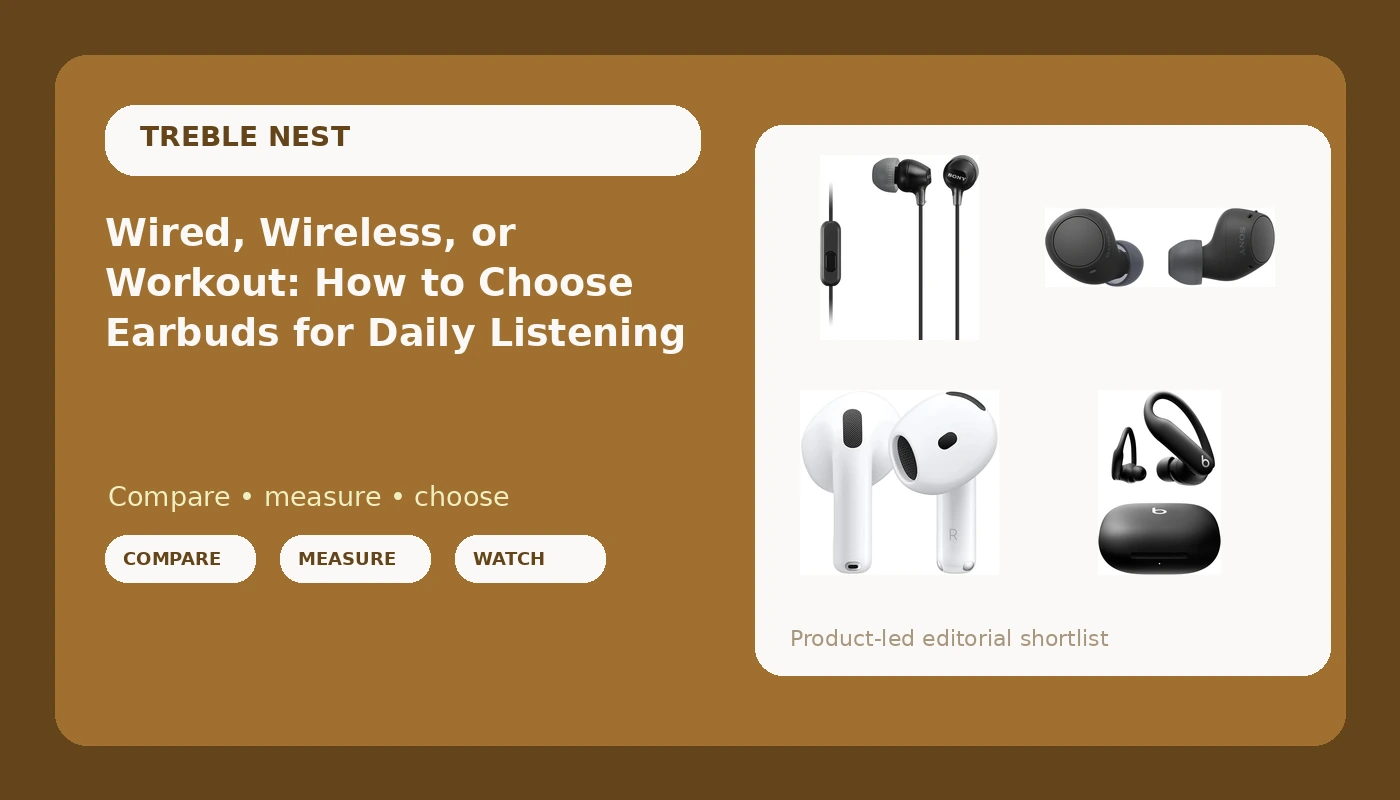
The four options here cover the whole spread, from a simple wired set to a workout pair with earhooks, and the sections after them are the checks worth running before you spend anything.
Related: How to Test Earbud Battery Life Without Fancy Gear →
Quick answer
Start with your phone, not with a spec sheet. If it still has a headphone jack, a wired pair like the Sony MDREX15AP is the simplest thing that works: no battery, no pairing, no charging case to lose track of. If the jack is gone, the Sony WF-C510 is a straightforward everyday wireless step, the Apple AirPods 4 makes the most sense when the rest of your devices are Apple, and the Beats Powerbeats Pro 2 is the one to look at when you need secure earhooks, noise cancelling, and sweat and water resistance for workouts. Whatever you pick, confirm battery life, fit, and the quietest volume setting on your own before you commit to it.
4 useful options
| Model | Best fit | What stands out |
|---|---|---|
| Sony MDREX15AP In-Ear Earbud Headphones with Mic | Phones that still have a headphone jack | Wired 3.5mm connection with an inline microphone |
| Sony WF-C510 Truly Wireless Bluetooth Earbuds | Everyday wireless listening | Truly wireless, with no cable between the two earbuds |
| Apple AirPods 4 Wireless Earbuds | iPhone, iPad, and Mac users | Apple's own fourth-generation AirPods |
| Beats Powerbeats Pro 2 Workout Earbuds with Earhooks | Running, gym, and sweaty sessions | Earhooks, noise cancelling, heart rate monitoring, and up to a 45-hour rating with the case |
The wired baseline: Sony MDREX15AP In-Ear Earbud Headphones with Mic, Black (MDREX15AP/B)
The case for wired is not nostalgia, it is fewer failure points. Nothing here needs a charge, nothing drops a Bluetooth connection, and nothing annoys you with an aggressive voice announcement when you turn it on. The catch is the jack. If your phone dropped it, you are back to an adapter, and the adapter is the part of that setup that fails. Mine died in bags, in pockets, and once in the middle of a call. So the rule is simple: buy wired only if the jack is on the device you actually carry around. The cable itself will also snag on door handles, and the microphone sits on the wire rather than in a stem, which takes a little getting used to. In exchange you get a pair that never asks for a charge.
The everyday wireless pick: Sony WF-C510 Truly Wireless Bluetooth Earbud Headphones, Black
This is where most people land, and for good reason. Going truly wireless removes the cable and the adapter in one move, which eliminates the two things that push people off wired pairs in the first place. What it adds back is a battery. Now something in your day needs charging, and the runtime you get will depend on how loud you listen, how many calls you take, and whether one bud is sitting in a case while the other works. Sony does not put a runtime figure in this product's name, so confirm the stated battery life on the listing and then watch your own drain over the first couple of weeks. If you lose things, decide now where the case lives. A case that disappears is a pair that disappears.
The iPhone-friendly pick: Apple AirPods 4 Wireless Earbuds
The trade-off here is ecosystem. If everything in your bag is Apple, the pairing and switching behavior is the reason this pair is on the list, and the setup is about as painless as wireless gets. If you carry Android, check the feature list carefully before buying, because the parts of the experience you have read about may not all apply to your phone. Note also what this listing does not promise. There is no earhook and no noise cancelling mentioned in the name, so if you want either of those, look at the fourth option instead of assuming this pair covers it. AirPods are also a fit question more than a sound question, and fit is the thing you cannot judge from a product page.
The workout pick: Beats Powerbeats Pro 2 - Wireless Noise Cancelling Workout Earbuds with Secure- Fit Earhooks, Up to 45-Hour Battery with Charging Case, Sweat & Water Resistant, Heart Rate Monitoring - Jet Black
Earhooks are a commitment. They solve the falling-out problem that plagues plain in-ear buds on a run, but they also wrap around your ear and press in a place most earbuds never touch, which some people love and some people cannot tolerate for twenty minutes. Buy from a seller with an easy return window and take a full walk before you decide. The 45-hour figure deserves a close read, since it is with the charging case, and case numbers describe recharges rather than one continuous listening session. That is a marketing habit worth ignoring on every product page. Finally, noise cancelling is the feature that separates this pair from the rest of the group, and it matters most on flights, trains, and loud streets.
Prices and availability may change. Product images, names, and retailer links are matched to verified listings. No current price, rating, stock status, or measured result is stated here without current evidence.
What actually changes when you cut the cable
Wired and wireless pairs fail in completely different ways, and knowing which failure you can live with is most of the decision. A wired pair has no battery, no pairing, and no firmware, so the only things that break are the cable and the jack. It also has no latency, which matters if you play along to a track or use a metronome. Its weakness is that it depends on a port your phone may not have.
Wireless pairs remove the port problem and add a battery problem. Now you are managing charge, keeping track of a case, and dealing with a Bluetooth connection that can stutter when your phone is in a back pocket. Latency depends on the codec your phone and buds agree on, and that agreement is not something you control from a product page. Some pairs also let you use one bud while the other charges, and once you have that, losing it is annoying.
Fit design matters as much as any of this. Plain in-ear buds sit in the canal, open-fit designs rest at the entrance, and earhooks add a physical anchor around the outside of the ear. Each type trades comfort against stability, and none of them is universally comfortable. If you have ever pulled a bud out after an hour because your ear ached, you already know which category you are shopping in.
The checks that matter more than the spec sheet
Work through these in order, and you will usually know your answer before you finish.
- Confirm whether the phone you carry still has a headphone jack, or whether you need an adapter that can fail on you.
- Decide how many hours you need between charges at the volume you actually listen at, not the volume on the box.
- Check whether each earbud works independently, because a dead bud should not end your listening for the day.
- Treat every battery figure that includes a charging case as a total of recharges, not one continuous stretch.
- Plan the return. Fit, volume floor, and connection stability are the three things you can only judge in your own ears.
Fit, volume, and other things the spec sheet never answers
- Check the quietest setting first. If the minimum volume is loud enough to blast your eardrums, the pair will be useless for late-night listening no matter how good it sounds.
- Give any new pair at least a week of walks before you judge comfort. Ear canals that are easily sore will not forgive a bad tip size on day one.
- Listen for the power-on sound. A soft chime is fine. A shouted announcement every time you open the case gets old fast.
- Carry the wired pair as a backup if you keep one around. It costs almost nothing to leave in a bag and it works when a battery does not.
- Ignore the phrase about extending playtime in the case marketing. Cases recharge, they do not add capacity to a single charge.
Which option should you choose?
Choose the Sony MDREX15AP In-Ear Earbud Headphones with Mic, Black (MDREX15AP/B) when your phone still has a headphone jack and you want the fewest things that can go wrong. Choose the Sony WF-C510 Truly Wireless Bluetooth Earbud Headphones, Black when you want truly wireless listening without paying for features you will not use. Choose the Apple AirPods 4 Wireless Earbuds when your phone, tablet, and laptop are already Apple devices. Choose the Beats Powerbeats Pro 2 when you need earhooks, noise cancelling, and sweat resistance for training rather than sitting still.
One caveat worth repeating: this is a framework, not a verdict on sound. Comfort, battery drain at your normal volume, the volume floor, and call quality on a noisy street are all things you have to measure for yourself, ideally inside a return window. Someone else's favorite pair can still be the wrong pair for your ears.
The bottom line
Pick the pair that matches your phone and your routine, then verify the three things no listing will tell you honestly: how long the battery lasts at the volume you use, how quiet the quietest setting really is, and whether the buds still feel fine after forty minutes. A wired pair wins on simplicity if the jack exists. A truly wireless pair wins on convenience if it does not. Earhooks and noise cancelling win if movement and loud rooms are part of your day. Everything else is marketing copy, and the case math is the least honest part of it.